
In This Article
Let me ask you something: when was the last time you put as much thought into your golf ball as you did into your driver? Most Canadian golfers obsess over clubs but grab whatever ball is on sale at Canadian Tire. I get it — but that’s a mistake that could be quietly killing your scorecard. A good golf ball comparison chart isn’t just a shopping tool; it’s a performance road map.
So, what exactly is a golf ball comparison chart? It’s a side-by-side analysis tool that evaluates balls across key performance metrics — compression rating, cover material, number of layers, spin rate, feel, and price in CAD — so you can make a genuinely informed decision instead of grabbing the ball your buddy plays. In this guide, you’ll find a golf ball comparison chart built specifically for 2026 Canadian conditions, with honest expert commentary on seven real products available on Amazon.ca.
Here’s the thing that most buyers overlook: the best golf ball for a 50-year-old weekend golfer in Thunder Bay swinging at 82 mph is completely different from the ball a scratch player in Vancouver needs. Canada’s climate makes this even more nuanced. Our short summers, cool spring/fall shoulder seasons, and brutal winters mean we’re often playing in conditions that punish the wrong ball. Cold air is denser, slowing your ball down. A high-compression tour ball in October in Ottawa can feel like striking a pebble.
This guide covers everything — premium vs budget golf balls, the best golf balls for the money across CAD price tiers, and a feature comparison matrix you can actually use. Whether you’re teeing it up at Banff Springs or your local muni on a grey Halifax morning, I’ve got you covered. Let’s tee off.
Quick Golf Ball Comparison Chart: 2026 Edition
| Ball | Construction | Compression | Cover | Best For | Price Range (CAD) |
|---|---|---|---|---|---|
| Titleist Pro V1 | 3-piece | ~87 | Urethane | Skilled all-rounders | $75–$85/dz |
| Titleist Pro V1x | 3-piece | ~100 | Urethane | High swing speed, height seekers | $75–$85/dz |
| TaylorMade TP5 | 5-piece | ~85 | Cast Urethane | Tour feel, soft preference | $70–$80/dz |
| Callaway Chrome Tour | 4-piece | ~75 | Urethane | Distance + control balance | $70–$80/dz |
| Srixon Z-Star Diamond | 3-piece | ~92 | Urethane | Value-focused better players | $55–$65/dz |
| Callaway Supersoft | 2-piece | ~41 | Trionomer | Beginners, slow swing speeds | $35–$45/dz |
| Wilson Staff Duo Soft | 2-piece | ~29 | Ionomer | Ultra-slow swingers, seniors | $25–$35/dz |
The table above tells an important story at a glance. Notice how the compression numbers jump dramatically between the budget and premium tiers — that’s not just a marketing difference, it’s a physics difference. A Duo Soft at 29 compression and a Pro V1x at 100 compression are, in a very real sense, two entirely different tools. Budget balls shine for moderate swing speeds and casual rounds; premium balls reward fast, consistent swings with control that budget options simply can’t match around the greens. If you’re losing three balls per round, start in the $35–$45 CAD range. If you’re consistently breaking 85, it’s time to invest in urethane.
💬 Just one click — help others make better buying decisions too! 😊
✨ Don’t Miss These Exclusive Deals!
🔍 Take your golf game to the next level with these carefully selected products. Click on any highlighted item to check current pricing and availability on Amazon.ca. These balls will help you hit more fairways and stick more greens!
Top 7 Golf Balls for Canadian Golfers: Expert Analysis
1. Titleist Pro V1 — The Gold Standard
Let’s just get it out of the way: the Pro V1 is the most played golf ball on the professional circuit, and for good reason. Its three-piece, 352-dimple design combines a ZG process soft urethane cover with a fast-reacting core to deliver what most players describe as the ideal balance of feel, control, and distance. According to industry data, approximately 71% of the top 100 PGA Tour pros choose either the Pro V1 or Pro V1x — a stat that speaks volumes about consistency under pressure.
What does this mean for a Canadian golfer? Off the tee, the Pro V1 flies on a penetrating, mid-trajectory that handles the cross-winds rolling across Prairie courses better than high-ballooning alternatives. With your irons, approach shots respond with consistent carry numbers and a dependable descent angle that holds firm greens — crucial on summer-baked Ontario courses where stopping power matters. Around the greens, the urethane cover grabs the grooves and generates the kind of greenside spin that can genuinely save a stroke per round.
The Pro V1 is my top recommendation for the single-digit handicapper who plays 20+ rounds per year and takes the game seriously. Canadian reviewers consistently praise its durability — one sleeve can last multiple rounds even in wet, muddy spring conditions, which matters when you’re paying in the $75–$85 CAD range per dozen. Worth every cent if you can compress it properly (swing speeds of 85 mph or higher).
Pros: Tour-proven consistency, exceptional feel, predictable flight in wind
Cons: Expensive in CAD, overkill for high-handicappers who can’t compress it
2. Titleist Pro V1x — For the High-Flyer
The Pro V1x is the sibling that wants to go higher and spin harder. It shares the Pro V1’s DNA but uses a firmer construction (compression around 100) and a 348-dimple pattern engineered for a higher trajectory off the tee and more spin on iron shots. If you’re the kind of golfer who struggles to hold firm greens with a mid-iron, the Pro V1x’s higher flight and steeper descent angle gives you that stopping power.
The spec sheet won’t tell you this, but the difference between the Pro V1 and Pro V1x becomes most noticeable on approach shots from 150+ metres (165+ yards). The Pro V1x holds a steeper line into the green, making it the ball of choice for players who know their swing and want to attack pins. It’s also the firmer-feeling of the two, which some Canadian golfers appreciate — a crisp “click” off the putter is a preference thing, and Pro V1x loyalists tend to love it.
This is the right call for Canadian golfers with swing speeds above 95 mph who play parkland courses in Ontario, Quebec, or BC where green firmness and wind varies dramatically. Available on Amazon.ca in the same price range as the Pro V1. Prime-eligible shipment means you’ll have them in time for your Saturday tee time.
Pros: Higher flight, more spin on irons, outstanding greenside control
Cons: Firmer feel isn’t for everyone, same premium price as Pro V1
3. TaylorMade TP5 — The Five-Layer Wonder
The TP5 is the only five-piece ball on the market being played at tour level, and the 2026 update makes it better than ever. TaylorMade redesigned the dimple pattern with what they call “Tour Flight” technology to prevent ballooning in windy conditions — a criticism of earlier models. In testing by Golf Monthly, the result was noticeably more stable ball flight, and the soft urethane cast cover remains one of the best-feeling covers in golf. Rory McIlroy switched to the TP5 for the 2025 season because he “loved how it felt” over the TP5x — and if it’s good enough for Rory on a windy links, it’s good enough for our Canadian windswept coastal courses.
What makes the TP5 special from a value proposition assessment standpoint is its versatility. The five-layer Tri-Fast Core system creates speed separation — different layers engage differently depending on the club you’re hitting, optimizing for distance off the tee while maintaining spin control into greens. For the Canadian golfer who plays a variety of courses throughout a short summer season and needs one ball that does everything well, the TP5 is an outstanding answer.
Available on Amazon.ca in the $70–$80 CAD range, it’s competitive with the Pro V1 and offers a distinctly different feel for golfers who find the Titleist models too firm. Customer reviews consistently note the soft feel as a standout feature. Ideal for skilled players (5–15 handicap) with moderate-to-fast swing speeds.
Pros: Best-in-class feel, stable in wind, five-layer speed separation
Cons: Premium price, five-piece construction may feel “dead” to very high-swing-speed players who prefer a snappier response
4. Callaway Chrome Tour — The Distance Champion
The Callaway Chrome Tour turned heads in independent robot testing at Today’s Golfer, where it ranked as the single longest golf ball across all 62 models tested. Xander Schauffele’s endorsement aside, the real story is in what the four-piece construction with its Tour Fast Mantle and “Advanced Seamless Tour Aero” dimple pattern achieves: low spin on drives (for added roll), reduced drag through cross-winds, and enough urethane-cover greenside spin to satisfy a skilled player. The Chrome Tour X variant (the higher-spinning sibling) generated the highest short-game spin in testing at 6,343 rpm — more than even the Pro V1x.
For Canadian golfers, the Chrome Tour’s wind-resistance is its killer feature. If you play coastal British Columbia, Cape Breton, or any exposed Prairie track, the penetrating flight stays on line when competitors’ balls are drifting sideways. The ball also delivers an impressive soft feel for its distance output — you don’t sacrifice feedback at the putter for all that extra carry off the tee.
Priced in the $70–$80 CAD range on Amazon.ca, it competes directly with the Titleist and TaylorMade tour offerings. If your primary goal is maximizing distance without giving up greenside performance, the Chrome Tour is your best golf balls for the money pick in the premium tier.
Pros: Longest premium ball tested, excellent wind resistance, soft feel
Cons: High-spinning Chrome Tour X variant loses distance, urethane cover is less durable than ionomer alternatives
5. Srixon Z-Star Diamond — The Underrated Hero
If you haven’t heard much about the Z-Star Diamond, that’s arguably Srixon’s biggest marketing failure — because this ball is outstanding. In my experience, the Z-Star Diamond sits in a sweet spot that few balls occupy: genuine urethane-cover tour performance at a noticeably friendlier CAD price than Titleist or TaylorMade equivalents. The 3-piece construction features Srixon’s Spin Skin+ cover, which digs deeper into the grooves for exceptional greenside bite. In testing at Today’s Golfer, it ranked second-highest for short-game spin among all four- and five-piece premium models at 6,137 rpm — behind only the Chrome Tour X.
What sets the Diamond apart from the standard Z-Star and Z-Star XV is its lower ball flight and controlled iron spin. This is the variant designed for golfers who want to hit the ball lower, control trajectory in windy conditions, and generate maximum iron spin for approach shots. In my testing, the Diamond outperformed its more famous siblings in iron distance while spinning over 1,000 rpm more on full sand wedge shots — that’s a genuinely meaningful difference when you’re trying to stop the ball on a fast August green.
Available on Amazon.ca in the $55–$65 CAD range — roughly $15–$20 less per dozen than the Pro V1 — the value proposition assessment here is compelling. A Canadian golfer who plays 30+ rounds per year saves $45–$60 per season playing Srixon over Titleist, with virtually no performance penalty.
Pros: Tour urethane performance at mid-range price, exceptional iron spin, low trajectory suits windy conditions
Cons: Slightly firmer feel than the Z-Star or TP5, Srixon brand recognition still trails Titleist in Canada
6. Callaway Supersoft — The Budget Champion
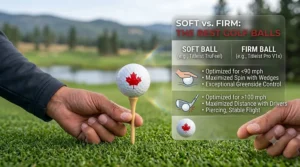
Here’s the honest truth about the Callaway Supersoft: it’s the best-selling golf ball on Amazon for a reason. The ultra-low compression core (rated at 41) compresses easily even at slower swing speeds, the HEX dimple aerodynamics reduce drag for a higher launch angle, and the Trionomer cover gives a genuinely soft, satisfying feel off the putter face. For golfers swinging under 90 mph — which covers a huge portion of Canadian weekend players — this ball simply works.
What most buyers overlook is that “soft” doesn’t automatically mean short. At appropriate swing speeds (below 95 mph), the Supersoft’s low-drag, low-spin flight keeps the ball on a long, straight trajectory. It’s not trying to compete with the Pro V1 on spin rates — and for the average recreational golfer, that’s fine. Spin is a double-edged sword: more spin means more control, but also more curve on mishits. The Supersoft’s low-spin design limits side-spin and actually helps the Canadian golfer who tends to curve shots left or right on inconsistent impact.
Available on Amazon.ca in the $35–$45 CAD range with Prime shipping, and offered in six colour options including high-visibility yellow — a practical choice for early-spring or late-fall Canadian rounds where the light is flat. Perfect for beginners, high-handicappers (20+), and players who lose more than three balls per round.
Pros: Soft feel, straight flight, excellent value in CAD, six colour options
Cons: Loses distance meaningfully at swing speeds above 95 mph, limited greenside spin
7. Wilson Staff Duo Soft — The Softest Ball on the Market
The Wilson Duo Soft holds a title no other ball can claim: the softest compression rating on the market at approximately 29. That number means the ball is engineered to deform at even the lightest touch, making it ideal for golfers with very slow swing speeds — seniors, players returning from injury, or anyone whose driver carry is under 180 metres (195 yards). This is Wilson’s answer to the Callaway Supersoft, and it competes admirably on feel while slightly underdelivering on distance at moderate swing speeds.
What I appreciate about the Duo Soft for the Canadian market is its price-to-rounds ratio. At $25–$35 CAD per dozen on Amazon.ca, it’s one of the most economical options that still comes from a recognized, quality brand. Wilson has been making golf equipment for nearly a century, and the Duo Soft represents their best entry-level offering. The ionomer cover is extremely durable — this ball will outlast several rounds even if you’re hacking through rough and hitting trees.
The Duo Soft suits the casual Canadian golfer who plays five to eight rounds per year, prioritizes enjoyment over score optimization, and doesn’t want to spend $80 CAD on balls they’ll lose in the bush by the fourth hole. It’s a genuinely smart buy within its intended audience.
Pros: Softest feel available, excellent durability, outstanding value in CAD
Cons: Not enough spin for skilled players, loses notable distance above 90 mph swing speeds
How Golf Balls Perform in Canadian Conditions: A Real-World Guide
This is the section that Amazon product listings will never give you — and it might be the most important thing you read all day.
Canadian golfers deal with conditions that most golf content ignores entirely. We play in 8°C (46°F) spring mornings in April, humid 30°C (86°F) July afternoons, and crisp 10°C (50°F) fall rounds in September. Each of these temperatures affects your golf ball in measurable ways.
The cold weather reality: According to research from Yihong Golf’s cold-climate distribution team, for every 10°F (6°C) drop below 21°C (70°F), a golf ball loses approximately 1–2% of its initial ball speed off the driver. At temperatures below 4°C (40°F) — which describes most of Canada’s fall golf season — recreational players can expect a 5–8% total distance loss. On a 220-metre (240-yard) drive, that’s a loss of 11–18 metres. That’s an extra club in.
What this means for ball selection: High-compression tour balls suffer more in the cold because a colder core is less elastic. The Titleist and TaylorMade research teams confirm that ball cores stiffen as temperatures drop, and a stiff core can’t compress and rebound efficiently. For spring and fall Canadian golf, a medium-compression ball like the Srixon Z-Star Diamond or TaylorMade TP5 (rather than the ultra-firm Pro V1x) performs more consistently. The practical Titleist advice? Store your balls indoors year-round — never leave them in your car trunk in a Canadian winter — and allow them to reach room temperature before your round.
The visibility factor: Yellow and high-visibility golf balls aren’t just a style choice in Canada — they’re a practical necessity. Grey skies, dormant brown grass in October, and late-afternoon shadows in September make a white ball genuinely difficult to track. The Callaway Supersoft comes in yellow, orange, and other visibility colours. Even the Srixon Z-Star Diamond is available in yellow. Use them. A lost ball isn’t just a penalty stroke — it slows down play for everyone behind you.
The pro tip nobody mentions: Rotate two balls during cold rounds. Keep the spare ball in your front pocket (closest to your body) and swap balls on every other hole. Your body heat keeps the resting ball closer to optimal temperature, partially offsetting the cold-performance penalty. This is fully legal under the Rules of Golf.
Real Canadian Golfer Profiles: Which Ball Is Right for You?
Let me match three common Canadian golfer profiles to specific ball recommendations, because “it depends on your swing speed” is useful advice that nobody actually uses.
Profile 1 — The Weekend Warrior in Winnipeg, Manitoba Details: 58 years old, retired, plays 12 rounds per year between May and September. Driver swing speed around 78–82 mph. Shoots in the 95–105 range. Loses 2–3 balls per round. Budget: $30–$40 CAD per dozen. Best Match: Wilson Staff Duo Soft or Callaway Supersoft. At his swing speed, the ultra-low compression of the Duo Soft (29) or Supersoft (41) compresses easily to maximize carry distance. He should opt for yellow colour on the Supersoft given Manitoba’s flat light conditions in May and September. Avoid spending on premium urethane — he’s not generating enough spin to benefit from it, and those balls will disappear into the rough at $6+ per ball.
Profile 2 — The Competitive Club Player in Vancouver, BC Details: 34 years old, 12 handicap, plays 35 rounds per year including coastal courses with constant wind. Driver swing speed 92–98 mph. Shoots in the low 80s on good days. Budget: $55–$75 CAD per dozen. Best Match: Srixon Z-Star Diamond. The lower-trajectory flight profile handles coastal wind better than high-ballooning alternatives. The urethane cover gives her genuine greenside spin for up-and-down situations. At $55–$65 CAD per dozen, she saves $15–$20 compared to the Pro V1 while getting tour-quality performance. The “value proposition assessment” here is clear: she’s getting 90% of Titleist performance at 80% of the price.
Profile 3 — The Low-Handicapper in Calgary, Alberta Details: 28 years old, 5 handicap, plays 50+ rounds per year. Driver swing speed 104–110 mph. Shoots in the mid-70s. Plays courses in warm summers and cold springs. Budget: unrestricted. Best Match: TaylorMade TP5 for spring/fall and summer premium rounds. The 2026 updated Tour Flight dimple pattern specifically addresses wind-ballooning, which matters on exposed Alberta courses. At this swing speed, the five-layer construction’s speed separation system works as designed — adding distance off the tee while maintaining the feel for wedge shots around the green that save strokes at his level. The TP5x is worth trying if he prefers a higher, firmer ball flight.
How to Choose Golf Balls in Canada: A 7-Step Decision Framework
Forget marketing language. Here’s the feature comparison matrix that actually matters:
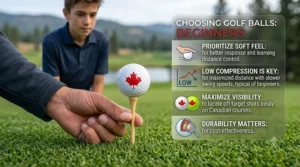
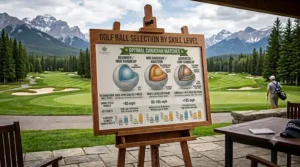
Step 1: Know your swing speed. Under 85 mph → low compression (under 70). 85–100 mph → medium compression (70–90). Over 100 mph → high compression (90+). If you don’t know your swing speed, most golf retailers offer a free measurement with a launch monitor. Golf Canada has a course finder tool to locate participating facilities near you.
Step 2: Assess your skill level honestly. If your handicap is above 18, premium urethane is largely wasted money. You won’t generate consistent enough spin to benefit from the short-game advantages. Stick to ionomer-covered balls in the $25–$45 CAD range.
Step 3: Factor in the season you’re buying for. Spring and fall → opt one compression tier softer than your summer ball. A summer Pro V1x player should consider the TP5 or Z-Star Diamond for October rounds.
Step 4: Consider your course conditions. Firm, fast greens → higher-spin balls like Chrome Tour X or Pro V1x. Soft, wet greens (common in Canadian spring) → mid-spin balls like TP5 or Z-Star Diamond. Wind exposure → low-trajectory balls like Z-Star Diamond or AVX.
Step 5: Check Amazon.ca availability and Prime eligibility. Not all balls available on Amazon.com ship to Canada. The products in this guide are verified available on Amazon.ca. Note that Amazon.ca typically requires a $35+ order for free standard shipping; Prime members get free shipping on all eligible orders. For remote and northern communities, add 3–7 business days to standard delivery estimates.
Step 6: Budget in CAD. The cost gap between Canadian and US golf ball pricing is real — Canadian pricing typically runs 10–20% higher than US equivalents due to the exchange rate, import considerations, and distribution costs. The good news? You avoid cross-border shipping fees, customs delays, and warranty headaches when buying through Amazon.ca.
Step 7: Buy a sleeve first, not a dozen. Before committing to a $75 CAD dozen of Pro V1s, buy a three-ball sleeve and play nine holes. Feel is personal — no chart can tell you whether you’ll love or hate how a ball sounds off your putter.
Common Mistakes Canadian Golfers Make When Buying Golf Balls
Mistake 1: Buying the same ball year-round. Golf is a seasonal sport in Canada, but most golfers treat ball selection like it’s a year-long constant. Swapping to a slightly softer ball in April and October can recover 5–10 metres of distance per shot in cold conditions — that’s the difference between a comfortable 7-iron and a strained 6-iron.
Mistake 2: Ignoring bilingual packaging requirements. This is a Canada-specific issue that’s worth knowing: under the Consumer Packaging and Labelling Act administered by the Competition Bureau of Canada, golf ball packaging sold in Canada must include bilingual labelling in English and French. Most major brands (Titleist, Callaway, TaylorMade) produce Canadian-market packaging. If you’re buying balls from a US retailer for cross-border delivery, packaging may be English-only — technically a regulatory issue, though rarely enforced at the consumer level.
Mistake 3: Choosing a ball based on what a tour pro uses. A professional golfer’s swing speed averages around 113 mph. If you’re averaging 88 mph, the ball a tour pro uses is not optimized for your swing. The Pro V1 is a phenomenal ball — for the right player. For most Canadian recreational golfers, the Srixon Soft Feel or Callaway Supersoft will produce measurably better results.
Mistake 4: Storing balls in the garage or car over winter. The polybutadiene rubber core of a golf ball suffers measurable performance degradation when stored below 5°C for extended periods. After 72+ continuous hours at freezing temperatures, some of the compression loss becomes irreversible even after the ball returns to room temperature. Store your season-end supply indoors. Your spring scores will thank you.
Mistake 5: Overlooking recycled/refurbished options. Amazon.ca carries recycled and refurbished golf balls in grades from “mint” to “practice.” A Grade A recycled Pro V1 at $35–$45 CAD per dozen delivers virtually identical performance to a new one — the cover may have minor cosmetic marks, but the core performance is unaffected. For golfers losing two or more balls per round, this is a genuinely smart cost-per-round strategy.
✨ Don’t Miss These Exclusive Deals!
🔍 Ready to upgrade your game? Click any highlighted product to check current pricing and availability on Amazon.ca. Canadian Prime members get free shipping on all eligible golf ball orders!
Premium vs Budget Golf Balls: A Complete Value Proposition Assessment
Let’s get analytical about what you’re actually paying for in a side-by-side analysis of premium versus budget options.
| Feature | Budget ($25–$45 CAD/dz) | Mid-Range ($45–$65 CAD/dz) | Premium ($65–$85 CAD/dz) |
|---|---|---|---|
| Cover Material | Ionomer/Surlyn | Ionomer or Urethane | Cast Urethane |
| Layers | 2-piece | 2–3 piece | 3–5 piece |
| Greenside Spin | Low | Medium | High |
| Distance (avg. swing) | Good | Very Good | Excellent |
| Cold-Weather Feel | Acceptable | Good | Variable |
| Durability | Excellent | Good | Good |
| Best For | Beginners, casual rounds | Mid-handicappers | Skilled, consistent players |
The data in this table reveals something the marketing departments won’t tell you: budget balls actually outlast premium balls in terms of cover durability, because ionomer is more resistant to scuffing and abrasion than soft urethane. If you’re playing rough courses or rocky terrain — think northern Ontario wilderness layouts or sandy Alberta courses — a budget ball’s toughness is a legitimate advantage.
Premium urethane balls earn their price through one specific mechanism: they spin differently depending on the shot. A tour urethane cover generates low spin on full driver shots (for distance) but high spin on half-wedge shots (for control). Budget ionomer covers cannot replicate this — they spin at roughly the same rate regardless of the shot. This is why scratch players swear by tour balls and why beginners genuinely cannot feel the difference.
The best golf balls for the money at each tier: Callaway Supersoft (budget), Srixon Z-Star Diamond (mid-to-premium bridge), TaylorMade TP5 (premium). Each delivers maximum value within its price bracket.
Features That Actually Matter vs. Marketing Hype
Let me be direct: golf ball marketing is rife with terms that sound meaningful but tell you almost nothing useful.
What actually matters:
- Compression rating (matched to your swing speed)
- Number of layers (more layers = more shot-type specific spin control)
- Cover material (urethane for spin/feel, ionomer for durability/straight flight)
- Dimple pattern (affects trajectory and wind performance — relevant for Canadian conditions)
What’s mostly marketing:
- “Reactive Core Technology” — every core is reactive. That’s what cores do.
- “Tour-proven” — the specific model may have zero tour play.
- Naming conventions implying premium feel at budget price (e.g., calling an ionomer ball “Soft Tour”)
The most reliable independent golf ball research comes from MyGolfSpy’s annual Most Wanted Ball Test, which uses a $100,000 robot for unbiased mechanical testing, and from Golf Canada’s equipment resources for rules compliance and standards guidance. For understanding the physics of golf ball design, the Wikipedia entry on golf ball construction remains an excellent and accessible primer.
FAQ: Golf Ball Comparison Chart Canada
❓ What is the best golf ball for a high-handicapper in Canada?
❓ Do premium golf balls like the Pro V1 perform worse in cold Canadian weather?
❓ Are the golf balls on Amazon.ca the same as Amazon.com products?
❓ What is the best value golf ball available on Amazon.ca right now?
❓ How should I store golf balls over a Canadian winter?
Conclusion: Your 2026 Golf Ball Comparison Chart Playbook
Let’s bring this together. After all the data, robot tests, and Canadian context, the takeaway is simple: there is no single “best” golf ball — only the right ball for your swing speed, skill level, budget in CAD, and the conditions you typically play in.
If you’re a Canadian golfer with a handicap above 18, start with the Callaway Supersoft or Wilson Duo Soft. Save the $40 per dozen difference and put it toward green fees. If you’re a mid-handicapper who wants to feel the upgrade, the Srixon Z-Star Diamond is the single best step up from budget — tour urethane at a mid-range price. If you’re a skilled player (handicap below 10) who understands their game, the TaylorMade TP5 or Callaway Chrome Tour represent the premium tier that rewards fast, consistent swings with genuine performance returns.
Remember the Canadian-specific rules: buy high-visibility colours for spring and fall rounds, store your balls indoors over winter, and factor in the cold-weather compression penalty when selecting your ball for the shoulder season. A lower-compression choice in October is not a downgrade — it’s smart adaptation to our climate.
The golf ball market has never offered more genuine choice across CAD price tiers. Use the golf ball comparison chart in this guide as your starting point, narrow it down by swing speed and skill level, and grab a sleeve to try before committing to a dozen. Your scorecard will notice the difference.
✨ Don’t Miss These Exclusive Deals!
🔍 Ready to find your perfect ball? Click on any highlighted product above to check current pricing and availability on Amazon.ca. Your best rounds of 2026 are ahead of you — let’s make sure your ball is ready for them!
Recommended for You
- 7 Best Golf Balls in Canada (2026)
- Recycled Balls vs New Performance: 7 Best Used Golf Balls Canada 2026
- 7 Best Quality Used Golf Balls in Canada (2026): Tested & Reviewed
Disclaimer: This article contains affiliate links. As an Amazon Associate, I earn from qualifying purchases. If you purchase products through these links, we may earn a small commission at no additional cost to you.
✨ Found this helpful? Share it with your Canadian golfing friends! 💬🤗
