
In This Article
If you’ve ever stood on a frosty first tee in April wondering why your ball isn’t travelling the way it did last September, you already know that picking the best golf balls isn’t just a marketing exercise — it’s the cheapest, fastest equipment upgrade in your bag. Golf is officially Canada’s most popular participation sport, with nearly six million of us teeing it up each year and nationwide rounds posted to Golf Canada’s app climbing past 11 million annually. Yet most golfers spend more time picking a driver than picking the ball every single club in their bag actually touches. 🏌️♂️
So, what is the “best” golf ball? In short, it’s whichever model matches your swing speed, short-game priorities and budget — there’s no single dozen that wins for everyone. A faster swinger chasing tour-level spin wants a different ball than a weekend golfer who just wants to find the fairway and avoid the cart fee turning into a ball-shopping bill.
This guide breaks down seven real, Amazon.ca-available golf balls across premium, mid-range and budget tiers, with honest commentary on who each one actually suits — including how Canadian conditions (cold mornings, shoulder-season rounds, and a short but intense summer) change the calculus. We’ll also cover how to choose, what mistakes to avoid, and answer the most common questions Canadian golfers search for. Prices below are shown as CAD ranges rather than exact figures, since Amazon.ca pricing shifts with promotions and stock.
💬 Just one click — help others make better buying decisions too! 😊
✨ Don’t Miss These Exclusive Deals!
🔍 Take your golf game to the next level with one of these carefully selected golf balls. Click through to check current pricing and availability on Amazon.ca before you buy.
Quick Comparison Table
| Ball | Type | Best For | Price Range (CAD) |
|---|---|---|---|
| Titleist Pro V1 | Premium tour, 3-piece urethane | All-around low-to-mid handicap performance | $65–$80/dozen |
| Callaway Chrome Soft | Premium tour, soft feel | Players who want Pro V1-level control with a softer strike | $60–$70/dozen |
| TaylorMade TP5 | Premium tour, 5-layer | Mid handicappers wanting extra carry distance | $65–$80/dozen |
| Bridgestone Tour B RXS | Premium, moderate-speed tuned | Swing speeds under 105 mph wanting tour feel | $65–$75/dozen |
| Srixon Z-Star Diamond | Premium value, urethane | Tour performance without the tour price tag | $50–$65/dozen |
| Wilson Staff Model | Premium, underrated | Budget-conscious better players | $55–$65/dozen |
| Callaway Supersoft | Two-piece, low compression | Beginners, high handicappers, slower swing speeds | $25–$32/dozen |
Looking at the table, the spread between the cheapest and priciest option is roughly $50 a dozen — but that gap buys you genuinely different performance, not just a logo. The premium urethane-covered balls (Pro V1, Chrome Soft, TP5, Tour B, Z-Star Diamond, Staff Model) all reward players who can compress the ball properly with their irons and wedges; the Supersoft trades that greenside spin for forgiveness and a much lower cost per round lost in the woods. If you’re a 20-plus handicap golfer who loses three or four balls a round, the math on premium balls simply doesn’t work yet — and that’s fine.
How to Choose the Best Golf Balls in Canada
Picking a golf ball comes down to five practical questions, in this order:
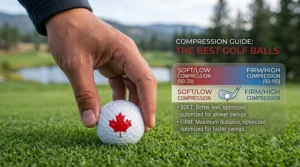
- What’s your driver swing speed? Above 105 mph, you can compress firmer, higher-compression balls (Pro V1x, TP5x, Tour B X) and unlock their full distance and spin profile. Under 95 mph, a lower-compression ball will launch easier and feel better without actually costing you yards.
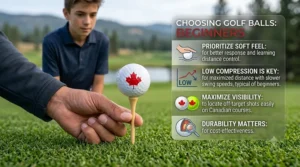
- How many balls do you lose per round? Be honest. If the answer is “more than two,” prioritize durability and price over tour-level spin — you’ll never keep a $70 dozen in play long enough to benefit from it.
- What do you want help with — the tee shot or the green? Two-piece distance balls (Velocity, Supersoft) reduce sidespin off the driver but spin less around the green. Multi-layer urethane balls do the opposite.
- What season are you buying for? Early-spring and late-fall rounds in most of Canada mean colder air and firmer ground; a slightly softer-compression ball can help offset the stiffness that comes with low temperatures.
- What’s your real budget per round, not per dozen? A $70 dozen Pro V1 lost in three rounds costs more per round than a $28 Supersoft lost in the same span. Work backwards from what you can comfortably replace.
If you answer those five honestly, you’ll land on one of the categories in our Top 7 below within a couple of models.
Top 7 Best Golf Balls in Canada: Expert Analysis
1. Titleist Pro V1 — Best Overall
The Titleist Pro V1 remains the most-played ball in professional golf, and that reputation isn’t just brand loyalty — it’s a genuinely well-rounded three-piece urethane ball built around a high-gradient core and a 388-dimple pattern designed for a flatter, more penetrating flight. In practice, that combination means the Pro V1 holds its line better than softer two-piece balls when the wind picks up on an exposed prairie or Maritime course, while still generating enough wedge spin to stop quickly on firm, fast Canadian summer greens.
What most golfers overlook about the Pro V1 is that it’s tuned for players with at least a moderate swing speed (roughly 90 mph and up) who already strike their irons consistently — buy it before you can compress it properly and you’re paying premium prices for a ball that performs like a much cheaper one in your hands. Reviewers consistently single out its all-around consistency from tee to green as the reason it sells more than any other premium ball despite intense competition.
✅ Tour-proven spin and feel
✅ Excellent in windy, exposed conditions
✅ Holds resale/trade value reputation if you’re swapping balls between rounds
❌ Premium price for higher-handicap players who lose balls often
❌ Overkill if your swing speed is under 90 mph
Price & verdict: Around $65–$80 CAD per dozen on Amazon.ca, available in white and yellow, including prior-generation models at a discount. Worth the price if you can already shape your irons; otherwise, see #5 or #7 below.
2. Callaway Chrome Soft — Best for Soft Feel with Tour Performance
The Callaway Chrome Soft is built around a Hyper Elastic SoftFast Core that’s designed to deliver tour-level speed without the firmer strike many golfers associate with premium balls. For Canadian golfers who play a lot of early and late-season rounds when greens are firmer and colder, that extra give at impact is a real, noticeable difference — particularly on long putts and chip shots where feedback through the putter face matters.
The Chrome Soft trades a small amount of the Pro V1’s wind-cutting flatness for a higher-launching trajectory, which can work in your favour on shorter, tree-lined courses common across much of Ontario and Quebec, but works against you on wide-open, breezier layouts out west. It’s an excellent fit for mid-to-low handicappers who prioritize feel over outright wind performance.
✅ Noticeably softer feel at impact
✅ Strong all-around distance and greenside control
✅ Good fit for tree-lined, sheltered courses
❌ Higher ball flight can balloon in strong crosswinds
❌ Comparable price to the Pro V1 without a clear performance edge for faster swingers
Price & verdict: Roughly $60–$70 CAD per dozen on Amazon.ca. A strong alternative to the Pro V1 if feel matters more to you than wind-cheating flight.
3. TaylorMade TP5 — Best for Extra Carry Distance
The TaylorMade TP5 uses a five-layer construction anchored by a Tri-Fast core, and the practical effect of those extra layers is added ball speed without sacrificing the soft cast-urethane cover’s greenside spin. Independent ball-robot testing has repeatedly shown the TP5 family gaining several extra yards of carry over comparable tour balls for the same swing input — useful on longer Canadian layouts where you’re regularly hitting into 400-yard-plus par 4s.
Where the TP5 earns its “expert pick” status is with mid handicappers who already have decent swing speed but want a bit more help carrying hazards or reaching greens in regulation, without dropping all the way to a pure distance ball that sacrifices wedge control. The tradeoff some single-digit players report is slightly more spin on full wedge shots than they’d like, which can mean a touch less roll-out than the Pro V1.
✅ Genuine extra carry distance for the same swing speed
✅ Strong durability through a full round
✅ Available in pix/high-visibility variants for easier tracking on grey-sky days
❌ Slightly higher wedge spin than some players prefer
❌ TP5x (the firmer sibling) is needed for the fastest swing speeds, adding a buying decision
Price & verdict: About $65–$80 CAD per dozen on Amazon.ca; TP5x runs a touch higher. A smart pick if distance off the tee is your priority without giving up short-game feel entirely.
4. Bridgestone Tour B RXS — Best for Moderate Swing Speeds
Bridgestone’s Tour B line is something of an under-the-radar choice in Canada compared to the big three above, but it has a loyal following among players who’ve actually been properly fit for it. The Tour B RXS specifically is built with a lower-compression core tuned for swing speeds under roughly 105 mph, using Bridgestone’s mantle technology to add ball speed without requiring the faster strike that the Tour B X and Pro V1x demand.
For Canadian golfers playing through a shoulder season where temperatures swing 10–15°C between a morning and afternoon round, the RXS is worth a look specifically because lower-compression cores tend to lose less feel and distance as the air and ball both cool down. It’s a genuinely good fit for the large population of recreational golfers swinging in the 85–100 mph range who’ve been buying high-compression “tour” balls simply because that’s what’s marketed hardest.
✅ Tuned specifically for moderate, not just fast, swing speeds
✅ Soft greenside feel without sacrificing too much driver distance
✅ Performs more consistently across temperature swings
❌ Lower brand visibility means fewer Amazon.ca seller options at any given time
❌ Faster swingers should look at the firmer Tour B X instead
Price & verdict: Roughly $65–$75 CAD per dozen on Amazon.ca. An excellent, slightly under-the-radar option if your swing speed sits in the middle of the pack.
5. Srixon Z-Star Diamond — Best Value Premium Ball
The Srixon Z-Star Diamond consistently gets singled out by independent reviewers as one of the most underrated balls on the market, and the reason is simple: it delivers a genuinely tour-comparable urethane cover, FastLayer core and high launch profile at a price that regularly undercuts the Pro V1 and Chrome Soft by $10–$20 a dozen. In side-by-side iron and wedge testing, the Diamond has shown spin numbers that match or beat its pricier rivals on scoring clubs.
What makes the Z-Star Diamond worth featuring here for Canadian buyers specifically is the value equation: if you’re playing a six-month season (roughly what most of the country gets outside the far south coast), stretching your golf-ball budget further without sacrificing performance adds up to real savings across a summer of rounds. It’s the ball we’d point a budget-conscious low-to-mid handicapper toward before recommending they “settle” for a pure distance ball.
✅ Tour-level urethane performance at a meaningfully lower price point
✅ Strong wedge and iron spin for scoring clubs
✅ Comes in white and tour yellow for visibility
❌ Less brand recognition can make resale/trade-in value lower
❌ Standard Z-Star (non-Diamond) lower-spin variant can be confused with this model when shopping
Price & verdict: Around $50–$65 CAD per dozen on Amazon.ca, depending on the specific generation and seller. Arguably the best price-to-performance ratio in the premium category right now.
6. Wilson Staff Model — Most Underrated Tour Ball
The Wilson Staff Model doesn’t get the marketing budget of the big three, but in robot and on-course testing it has repeatedly placed near the top of the field for tee-to-green consistency, occasionally beating its higher-profile competitors outright on ball speed and short-game spin. It’s a four-piece urethane-covered ball built around Wilson’s V-COR core, and several independent reviewers have noted that it can outperform its retail price tag by a wider margin than almost any other ball in the premium category.
For Canadian golfers, the Staff Model‘s appeal is straightforward: tour-level performance without the premium-brand price premium, which matters more here than in many golf markets given how Canadian retail pricing on premium imported sporting goods tends to run a little higher than U.S. equivalents once duties and exchange rates are factored in. It’s a particularly good fit for better players (low-to-mid handicap) who aren’t precious about playing “the” recognizable brand on the first tee.
✅ Tour-calibre performance frequently noted as exceeding its price point
✅ Tightly controlled paint/finish process for consistency
✅ Slightly softer feel than the firmer Staff Model X variant
❌ Limited colour/variant selection compared to Titleist or Callaway
❌ Some Amazon.ca third-party sellers have had inconsistent stock — buy from Amazon-fulfilled listings where possible
Price & verdict: Approximately $55–$65 CAD per dozen on Amazon.ca. If you want tour performance and don’t care about logo recognition, this is the value pick of the premium tier.
7. Callaway Supersoft — Best Budget & Beginner Ball
The Callaway Supersoft is, by a wide margin, the best-selling golf ball on Amazon in both Canada and the U.S. — and for good reason. It’s a two-piece, ultra-low-compression ball designed around Callaway’s HEX Aerodynamics pattern, and independent ball-robot testing found it to be the lowest-spinning ball of dozens tested at both average and slower swing speeds, which translates directly into straighter shots for golfers who fight a slice or hook.
The Supersoft‘s real strength for Canadian buyers — especially beginners, high handicappers, juniors, and anyone golfing through a Canadian winter at an indoor simulator bay where ball wear matters less than cost — is that it removes price as a barrier to playing a ball that’s actually engineered well, rather than a generic “practice ball.” It won’t out-spin a Pro V1 on a 30-yard pitch, but most golfers buying their first proper dozen aren’t generating enough clubhead speed to access that spin anyway.
✅ Lowest price of any ball on this list by a wide margin
✅ Genuinely reduces sidespin for slice/hook-prone swings
✅ Soft, forgiving feel that’s beginner-friendly
❌ Limited greenside spin and control for better players
❌ Less roll-out control on firm, fast fairways
Price & verdict: Roughly $25–$32 CAD per dozen on Amazon.ca — frequently Amazon’s best-selling golf ball outright. The easy starting point if you’re new to the game or buying for a junior.
Top 7 Products at a Glance
| Ball | Construction | Compression Feel | Swing Speed Fit | Price (CAD/dozen) |
|---|---|---|---|---|
| Titleist Pro V1 | 3-piece urethane | Mid-soft | 90+ mph | $65–$80 |
| Callaway Chrome Soft | 3-piece urethane | Soft | 85–105 mph | $60–$70 |
| TaylorMade TP5 | 5-layer urethane | Mid | 90–110 mph | $65–$80 |
| Bridgestone Tour B RXS | Multi-layer urethane | Mid-soft | Under 105 mph | $65–$75 |
| Srixon Z-Star Diamond | 4-piece urethane | Soft | 85–100 mph | $50–$65 |
| Wilson Staff Model | 4-piece urethane | Mid | 90+ mph | $55–$65 |
| Callaway Supersoft | 2-piece ionomer | Very soft | Any, especially under 90 mph | $25–$32 |
A quick read of this table reinforces the central buying decision: construction and compression matter more than brand name once you’re inside the premium tier, because five of these seven balls are tuned for a remarkably similar mid-to-soft feel. The real fork in the road is the Supersoft’s two-piece design, which sacrifices wedge spin specifically to maximize forgiveness and distance for slower, less consistent swings — making it a different category of product rather than simply a “cheaper” version of the others.
Real-World Scenarios: Which Ball Fits Your Game
The Toronto weeknight golfer: Squeezing in nine holes after work on a busy public course, often hitting from imperfect lies and occasionally losing a ball in the rough. A Srixon Z-Star Diamond or Wilson Staff Model gives tour-style performance without the financial sting of losing a $75 dozen during a rushed twilight round.
The Calgary or Winnipeg prairie golfer: Wide-open courses, frequent crosswinds, and a shorter playing season that compresses a lot of rounds into a few intense months. The Titleist Pro V1‘s flatter, wind-resistant flight is built for exactly this kind of layout, and its track record across temperature swings makes it a safe choice for early and late-season rounds.
The Maritime or coastal B.C. golfer: Wetter conditions, softer fairways, and a longer shoulder season than the Prairies or Ontario interior. A softer-compression ball like the Callaway Chrome Soft or Bridgestone Tour B RXS helps maintain feel and greenside control on softer, slower greens without needing tour-level swing speed to access it.
The beginner or junior golfer anywhere in Canada: Still building consistency, losing several balls a round, and not yet generating the swing speed to benefit from a urethane cover. The Callaway Supersoft removes the cost anxiety and rewards straighter contact rather than punishing mis-hits with extra curve.
Practical Usage Guide: Getting the Most from Your Golf Balls
A few habits make any ball in this list perform closer to its potential, especially given Canada’s wider seasonal temperature swings:
- Store your balls indoors, not in the trunk. A dozen balls left in a cold trunk overnight can be measurably firmer — and shorter off the tee — than the same balls kept at room temperature. This matters more in shoulder-season Canadian golf than it does in a year-round warm climate.
- Rotate two balls during cold rounds. Keep one in a jacket pocket to stay closer to body temperature while the other is in play, then swap every few holes.
- Wash your ball every few holes on wet courses. Mud and grass clippings in the dimple pattern reduce the aerodynamic design’s effectiveness — a bigger issue on the softer, wetter fairways common in spring across most of the country.
- Match the ball to the round, not the bag. It’s fine to play a Supersoft for a casual nine and a Pro V1 for a club competition; you don’t need to commit to one model year-round, especially as a developing player.
- Check your wedge grooves regularly. A urethane-covered ball can’t generate its full spin potential against worn or dirty grooves — a cheap fix that’s often more impactful than upgrading the ball itself.
What to Expect: Real-World Performance in Canadian Conditions
Cold weather affects every ball on this list, just to varying degrees. As air temperature drops, golf balls lose some elasticity and compress less efficiently at impact, while colder, denser air also adds aerodynamic drag — together, golfers can expect to lose roughly 1.5–2 yards of carry for every 10°F (about 5–6°C) drop in temperature, according to manufacturer and independent testing data. On a brisk 8°C April morning compared to a 22°C July afternoon, that can add up to a genuine 15–20 yards of lost distance with the driver alone — worth knowing before you blame your swing.
The practical takeaway for Canadian golfers: lower-compression balls (Supersoft, Z-Star Diamond, Chrome Soft) tend to hold their feel a little better in cold conditions than firmer, high-compression tour balls, simply because they were already designed to compress easily. That said, golf’s own equipment experts generally advise against switching ball models specifically for temperature, since changing your ball changes every shot in the bag — keeping the same ball warm in your pocket between shots is usually a more reliable fix than chasing a “winter ball.”
Common Mistakes When Buying Golf Balls in Canada
- Buying the ball your favourite pro plays, regardless of swing speed. A tour pro’s 115+ mph swing compresses a firm ball very differently than a 90 mph recreational swing does — buying purely on endorsement is the single most common and costly mistake.
- Ignoring how many balls you actually lose per round. If you’re consistently buying premium dozens and losing half of them, your real cost per playable ball is far higher than the sticker price suggests.
- Assuming higher price always means better performance for your game. Several mid-priced balls on this list (Z-Star Diamond, Staff Model) outperform pricier rivals for specific swing profiles.
- Not accounting for Canada’s shorter season when budgeting. With roughly six months of playable golf in most provinces, it can make sense to buy in bulk early in the season to lock in pricing before peak-season demand pushes it up.
- Overlooking Amazon.ca’s $35 free-shipping threshold. Bundling a dozen golf balls with tees, gloves, or a second dozen is an easy way to clear that minimum and avoid paying shipping on a relatively low-cost order.
Features That Actually Matter (And Those That Don’t)
Matters: Compression relative to your actual swing speed, cover material (urethane vs. ionomer) relative to how much you value greenside spin, and dimple count/pattern’s effect on flight in wind — all three directly change how the ball performs in your hands.
Doesn’t matter much for most golfers: Marginal differences in dimple count between two urethane balls (338 vs. 388, for example) rarely produce a difference the average player can feel or measure without a launch monitor. Alignment-aid stripe patterns (like Triple Track) can help with putting consistency but contribute nothing to ball flight or distance — buy them for the visual aid, not the performance claim.
Long-Term Cost & Value in CAD
Run the simple math before committing to a premium ball full-time: at roughly $70 CAD per dozen, a Pro V1 costs about $5.85 per ball. If you lose two balls a round across a 30-round Canadian season, that’s $350 a year just in lost balls — before factoring in normal wear-and-tear replacement. The same season played on Supersofts at $28 a dozen drops that lost-ball cost to about $140. For developing players or anyone golfing primarily for the social and fitness benefits rather than competitive scoring, that $200+ seasonal difference is worth weighing against the performance gap, which for most mid-to-high handicappers is smaller than marketing suggests.
Canadian Rules, Regulations & Buying Considerations
If you play in any sanctioned competition — a club championship, a Golf Canada event, or a tournament under the BDO National Golf League — your ball needs to appear on the official equipment standards lists maintained by the USGA and The R&A, the two bodies that jointly govern the Rules of Golf worldwide, including in Canada. All seven balls reviewed here are current, widely sold tour or recreational models from major manufacturers and are conforming for standard play; it’s a relevant check mainly if you’re buying an unfamiliar or off-brand ball for competitive use.
On the retail side, any golf ball box or sleeve sold at retail in Canada is required to carry mandatory label information in both English and French under the Consumer Packaging and Labelling Act — so don’t be surprised to see bilingual packaging even on a U.S.-manufactured ball once it’s sold through Amazon.ca rather than imported privately.
FAQ
❓ Can I play golf in Canada in the winter?
❓ What's the best golf ball for cold Canadian mornings?
❓ Do golf balls ship free on Amazon.ca?
❓ Is a more expensive golf ball always better for beginners?
❓ What's the difference between Pro V1 and Pro V1x?
Conclusion
There’s no single best golf ball in Canada — only the best ball for your swing speed, your short game priorities, and how many you’re realistically going to lose this season. If you want the safest, most all-around recommendation, the Titleist Pro V1 remains hard to beat for golfers with moderate-to-fast swing speeds who already strike their irons consistently. If price-to-performance is your priority, the Srixon Z-Star Diamond and Wilson Staff Model punch well above their price point. And if you’re newer to the game or playing primarily for fun and fitness, the Callaway Supersoft removes cost as a barrier without compromising on a genuinely well-engineered ball.
Whichever dozen you choose, remember that Canada’s compressed golf season and wider temperature swings make storage and in-round habits — keeping balls warm, rotating two at a time on cold mornings — just as important as the model you pick.
✨ Don’t Miss These Exclusive Deals!
🔍 Take your golf game to the next level with these carefully selected golf balls. Click on any highlighted model to check current pricing and availability on Amazon.ca. 🇨🇦⛳
Recommended for You
- Recycled Balls vs New Performance: 7 Best Used Golf Balls Canada 2026
- 7 Best Quality Used Golf Balls in Canada (2026): Tested & Reviewed
- 7 Best Maple Leaf & Team Canada-Style Golf Balls 2026
Disclaimer: This article contains affiliate links. As an Amazon Associate, I earn from qualifying purchases. If you purchase products through these links, we may earn a small commission at no additional cost to you.
✨ Found this helpful? Share it with your foursome! 💬⛳
