
In This Article
Stand on any practice green in this country and you’ll hear the same complaint, usually muttered right after a wedge shot skips past the pin and disappears into the back bunker. “It just won’t stop.” Nine times out of ten, that’s not a swing problem. It’s a golf ball problem, and more specifically, it’s a golf ball spin rate guide problem in disguise — the golfer simply hasn’t matched their ball’s construction to the way they actually swing a club.

Spin rate is the number of revolutions per minute (RPM) a golf ball makes after it leaves the clubface, and it is arguably the single most underrated performance variable in the bag. Two golfers can carry identical drivers, identical swing speeds, even identical handicaps, yet hit two different balls that behave like entirely different objects once they land. One spins down and sits. The other bounces, releases, and rolls off the back of the green like it’s late for a flight. The difference almost always traces back to the ball’s internal construction: how many layers it has, what the cover is made from, and how the core is engineered to compress.
This guide exists to demystify that whole process for Canadian golfers specifically — because our courses, our cool spring mornings, and our compressed shoulder seasons add wrinkles that a generic American buying guide simply doesn’t address. We’ll walk through seven real, currently available models spanning budget to premium, explain exactly how layer technology and construction impact performance, and give you a genuine framework for picking a ball rather than just another spec sheet to skim past. By the end, you should be able to look at any box of balls at your local pro shop and know, with real confidence, whether it’s built to spin the way your game needs it to.
What Is Golf Ball Spin Rate?
Golf ball spin rate refers to how fast a ball rotates immediately after impact, measured in RPM, across both backspin (which creates lift and stopping power) and sidespin (which creates curve). Higher spin generally means more greenside control but can sacrifice driver distance, while lower spin favours roll and carry but sacrifices stopping power on approach shots.
Quick Comparison Table: Top Spin-Focused Golf Balls at a Glance
| Ball | Construction | Best For | Spin Profile | Price Range (CAD, per dozen) |
|---|---|---|---|---|
| Titleist Pro V1 | 3-piece urethane | All-around tour performance | High wedge spin, moderate driver spin | C$60-70 |
| Titleist Pro V1x | 4-piece urethane | Higher ball flight, faster swingers | High across the bag | C$60-70 |
| Callaway Chrome Tour X | 4-piece urethane | Maximum iron and wedge spin | Very high short-game spin | C$55-65 |
| TaylorMade TP5 | 5-piece urethane | Soft feel with balanced spin | High, especially on chips | C$55-65 |
| Bridgestone Tour B XS | 3-piece reactive urethane | Moderate swing speeds wanting tour spin | Adaptive — lower off the driver, high on wedges | C$55-65 |
| Kirkland Signature V3.0 | 3-piece urethane | Best value, high-spin alternative | Genuinely high, close to tour-level | C$22-28 |
| Callaway Supersoft | 2-piece ionomer | Beginners, distance-first golfers | Deliberately low spin off the tee | C$28-35 |
A glance at that table tells most of the story: urethane covers and three-or-more-piece constructions dominate the high-spin end of the market, while two-piece ionomer balls like the Supersoft sit at the other extreme by design, not by accident. What it doesn’t tell you is how those differences actually feel on the course, which is exactly what the next several sections unpack. Notice, too, that the Kirkland Signature breaks the usual pattern where high spin equals high price — it’s the rare case where a genuine three-piece urethane ball undercuts premium competitors by a wide margin without gutting the core technology that creates spin in the first place.
💬 Just one click — help others make better buying decisions too! 😊
✨ Don’t Miss These Exclusive Deals!
🔍 Take your short game to the next level with a ball that’s actually built for it. Click on any highlighted model above to check current pricing and availability on Amazon.ca — finding the right spin profile for your swing starts with trying a sleeve before you commit to a dozen.
Top 7 Golf Balls for Spin Rate: Expert Analysis
Affiliate disclosure: this article contains affiliate links, and as an Amazon Associate I may earn from qualifying purchases — full disclosure is below the conclusion. None of that changes the analysis here; every product below is evaluated on real specs and genuinely aggregated review sentiment, not on which one pays the highest commission.
1. Titleist Pro V1 — the most-played ball on tour for a reason
The Pro V1 opens this list because, frankly, almost every other ball on the market gets measured against it whether its maker admits that or not. Its standout feature is consistency: a high-gradient core paired with a 388-dimple pattern that keeps flight predictable even when your strike isn’t perfectly centred. The three-piece construction wraps that core in a casing layer tuned to keep long-game spin manageable, then finishes with a soft cast urethane cover that grips the clubface on wedges and short irons. In practice that means the Pro V1 doesn’t balloon off the driver the way some high-spin balls can, but it still checks hard on a 9-iron approach — a genuinely rare combination that explains why it’s stayed near the top of the category for two decades running. Who should care about this one? Mid-to-low handicap players with swing speeds in the 95-110 mph range will get the most out of the Pro V1’s spin window; if your swing is noticeably slower than that, you may not fully compress the core and could find a softer ball more rewarding. Reviewers consistently note the ball’s soft, muted feel off the putter face and its durability over multiple rounds compared with older Pro V1 generations, though a recurring theme in aggregated feedback is that golfers with slower swings sometimes find it launches a touch low for their taste.
✅ Exceptional, predictable greenside spin without sacrificing tee-shot control
✅ Soft urethane cover holds up well across multiple rounds of play
✅ Trusted, widely available — easy to find fitting data and reviews
❌ Premium price point compared with mid-tier alternatives
❌ Slower swing speeds may not unlock its full spin potential
At around C$60-70 per dozen, check current price before buying, the Pro V1 sits at the top of the market, and for golfers who genuinely play enough rounds to feel the difference in short-game control, it remains a defensible splurge rather than just marketing hype.
2. Titleist Pro V1x — higher flight and more spin for faster swingers
The Pro V1x’s standout feature over its sibling is launch height: a four-piece construction with a dual-core design that produces a noticeably higher ball flight and steeper descent angle into greens. Where the Pro V1 keeps things penetrating and tour-flat, the Pro V1x is built to climb, hang, and drop nearly straight down on approach shots — exactly what you want when attacking a firm, fast green. That extra layer between the core and the casing also nudges overall spin higher across nearly every club in the bag, particularly with irons. This is the better fit for golfers with faster swing speeds (think 105 mph-plus with the driver) who want that added spin without the ball flying too low and running through the fairway. Based on the spec comparison with the standard Pro V1, the firmer compression here rewards a more aggressive strike; golfers who already struggle to get the ball airborne may find the Pro V1x fighting against them rather than for them. Aggregated reviewer sentiment frequently mentions a firmer feel off the putter compared with the Pro V1, which some better players actually prefer for distance control on lag putts, while others find it less buttery on delicate chips.
✅ Higher, more penetrating ball flight that holds up in wind
✅ Increased greenside and iron spin versus the standard Pro V1
✅ Tighter shot dispersion reported by faster-swinging testers
❌ Firmer feel may not suit golfers who prefer a softer putting touch
❌ Higher compression can underperform for moderate swing speeds
Pricing sits in the same C$60-70 range as the Pro V1, and the honest verdict is that this is a swing-speed decision more than a quality decision — neither ball is objectively “better,” they’re built for different launch windows.
3. Callaway Chrome Tour X — built for players who live and die by iron spin
What stands out immediately about the Chrome Tour X is how aggressively it’s tuned for short-iron and wedge spin specifically, rather than chasing an all-around balance. The four-to-five-piece construction lets the core optimize ball speed independently from the outer mantle and urethane cover, which is doing the heavy lifting on spin. In practical terms, this is the ball for someone who already controls their long game reasonably well and wants every extra tick of stopping power on a 130-yard approach. Players who generate above-average clubhead speed tend to see the biggest payoff here, since the construction is tuned to maximize spin precisely when speed is already present to work with. What most buyers overlook about a ball like this is that maximum spin isn’t automatically a benefit — if your iron play is inconsistent, more spin can actually exaggerate mishits, since a thin strike with extra side-spin curves more aggressively than the same mishit on a lower-spin ball. Reviewers consistently report a penetrating flight with the long irons that still produces a notably steep, “one-hop-and-stop” landing with scoring clubs, which is the exact signature high-spin players are chasing.
✅ Among the highest wedge and short-iron spin numbers in its category
✅ Workable flight for shaping shots intentionally
✅ Premium urethane cover built for repeated greenside contact
❌ Can be unforgiving on mishits due to elevated spin sensitivity
❌ Not the easiest launch for moderate or beginner swing speeds
Expect to pay in the C$55-65 range, check current price for availability, and treat this one as a ball for golfers who already have iron-play consistency rather than a fix for inconsistency.
4. TaylorMade TP5 — the softest-feeling ball that still spins like a tour model
The TP5’s calling card is feel: a five-layer construction with a new dimple pattern and a refined microcoating process that keeps flight stable even in wind, while delivering a noticeably softer compression than its lower-spinning sibling, the TP5x. What that means practically is the TP5 produces excellent carry distance off the driver without the ball flight ballooning, then transitions into a strong, consistent spin profile through the irons that supports attacking tucked pins. The flexible inner layers seem to be doing real work here, since testers report a marriage of ball speed and spin that produces plenty of carry along with a peak height that encourages aggressive pin-seeking, even in fairly soft conditions. This is a strong match for moderate-to-fast swing speed players who want Pro V1-style short-game spin but prefer a noticeably cushier feel at impact — think the difference between a firm handshake and a confident-but-gentle one. Reviewers consistently note that despite all the added layer technology, the TP5 hasn’t sacrificed distance to get there; testers have reported slightly longer drives with the TP5 than with the lower-spinning TP5x, which runs counter to the usual assumption that softer automatically means shorter.
✅ Exceptionally soft feel without giving up driver distance
✅ Consistent, stable flight even in windy conditions
✅ Strong short-game spin for attacking firm or fast greens
❌ Five-layer construction commands a premium price
❌ Some players may find the soft feel less responsive off the putter than expected
Pricing lands around C$55-65 per dozen, in line with other tour-level offerings, and the honest takeaway is that feel preference will likely decide between this and the firmer Pro V1 more than any hard performance gap.
5. Bridgestone Tour B XS — adaptive cover technology for moderate swing speeds
The standout here is genuinely clever engineering: a Reactiv iQ urethane cover that adapts its firmness based on impact force, meaning it reads softer and grabbier on a gentle wedge swing while staying firm and fast on a full driver swing. Paired with Bridgestone’s VeloSurge core-and-mantle system, the Tour B XS is specifically optimized for players swinging under 105 mph who still want genuine tour-level short-game spin — a demographic the bigger brands sometimes overlook in favour of chasing tour pros with much faster swings. Here’s what to weigh: because the cover is reactive rather than static, the spin difference between your driver and your wedge is more pronounced than on a conventional ball, which can actually help moderate-speed players who struggle to generate enough greenside check without sacrificing fairway distance. The 320-dimple pattern adds a more penetrating, consistent flight on top of that. Reviewers consistently highlight the easy launch off the tee paired with noticeably more spin around the greens, describing the combination as unusually friendly for a ball this serious about short-game performance.
✅ Reactive cover genuinely changes behaviour between full swings and finesse shots
✅ Easy, high launch suited to moderate swing speeds
✅ Strong wedge and chip spin without a punishing compression rating
❌ Faster swingers (over 105 mph) are better served by the firmer Tour B X
❌ Reactive cover technology adds cost versus simpler three-piece designs
Priced around C$55-65 per dozen, the Tour B XS is arguably the most thoughtfully targeted ball on this list for the average Canadian club golfer who isn’t swinging it like a tour pro but still wants real spin control.
6. Kirkland Signature V3.0 — three-piece urethane performance at a fraction of the price
If there’s a single product on this list capable of changing how you think about value, it’s the Kirkland Signature V3.0. Its standout feature is straightforward: genuine three-piece urethane construction with a 338-dimple pattern, sold at a per-ball cost that undercuts premium tour balls by roughly two-thirds. The soft, highly elastic core is built to maximize distance, while the mantle layer interacts with the urethane cover to generate real, measurable spin on iron and wedge shots rather than just claiming to. Independent robot testing has shown the V3.0 producing seven-iron spin numbers that actually exceed the Titleist Pro V1 and sit just behind the Callaway Chrome Tour X and Wilson Staff Model X — numbers that would have been unthinkable from a budget ball a decade ago. What the spec sheet won’t tell you, but reviewers note, is that the extra spin comes with a small distance trade-off; aggregated testing data shows the V3.0 carrying a few yards shorter than the Pro V1 and Pro V1x at most swing speeds, the natural consequence of generating that much rotation. This is the ball for budget-conscious golfers, beginners who lose several balls a round, or honestly any golfer curious whether premium pricing is really buying premium performance. Reviewers consistently describe a responsive, solid feel off the putter that belies the price tag, alongside occasional notes about minor cover scuffing after extended play — a fair trade given the savings.
✅ Genuine urethane cover with measured spin rivaling premium tour balls
✅ Dramatically lower cost per ball than name-brand competitors
✅ Conforms to USGA and R&A rules for legal competitive play
❌ Slightly shorter carry distance than top-tier balls due to higher spin decay
❌ Only available in two-dozen packs, occasionally limited by retailer stock
At roughly C$22-28 per dozen, check current price and availability, the Kirkland Signature V3.0 may be the single best value argument in this entire guide, and it deserves serious consideration before anyone spends triple the price out of habit.
7. Callaway Supersoft — proof that not every golfer should be chasing spin
The Supersoft earns its spot here precisely because it represents the opposite end of the spectrum, and any honest golf ball spin rate guide needs to show that contrast clearly. Its standout feature is an ultra-low compression core paired with a simple two-piece ionomer cover, deliberately engineered to minimize spin rather than maximize it. In independent robot testing, the Supersoft has ranked among the lowest-spinning balls across driver, iron, and wedge testing — which sounds like a weakness until you remember that excess spin is exactly what causes a slice or hook to balloon out of control for higher-handicap players. Reviewers consistently point to forgiving, straight-flying performance off the tee as the defining trait, with one common theme being how much easier mishits travel compared with urethane tour balls. Here’s what to weigh: lower spin generally means less greenside stopping power, so golfers who already shape their short game around spin and check will likely find the Supersoft frustrating around the green. But for beginners, high-handicappers, seniors with slower swing speeds, or anyone whose priority is simply keeping the ball in play and rolling out for extra yards, this construction philosophy is a legitimate, honest fit rather than a compromise.
✅ Ultra-forgiving, low-spin flight that minimizes slice and hook curvature
✅ Soft compression suits slower and moderate swing speeds well
✅ Among the most affordable balls with credible name-brand engineering
❌ Minimal greenside spin limits stopping power on firm, fast greens
❌ Two-piece ionomer cover lacks the durability feel of urethane models
Priced around C$28-35 per dozen, the Supersoft isn’t competing with the other six balls on this list so much as proving why “high spin” isn’t a universal goal — it’s a tool that fits some swings and actively works against others.
Golf Ball Construction Explained: 2-Piece vs 3-Piece vs Multi-Layer
Here’s where a lot of golf ball marketing gets needlessly confusing, so let’s strip it down to what actually matters. Every golf ball is built from concentric layers, and the number and material of those layers determines almost everything about how it performs. According to the historical record on golf ball development, manufacturers began classifying balls as two-piece, three-piece, or four-piece based on the number of layered components once synthetic materials like Surlyn and urethane displaced older wound-rubber and balata constructions in the mid-1960s, a shift documented on Wikipedia’s golf ball entry.
A two-piece ball, like the Callaway Supersoft on our list, consists of a large solid core and a single cover layer, almost always made from a durable ionomer resin. That simplicity is the entire point: fewer layers means less spin-generating friction at impact, a more durable cover, and a noticeably lower price to manufacture. Three-piece balls add a middle “mantle” layer between the core and cover — this is where the Kirkland Signature V3.0 and the Pro V1 both live, and it’s this added layer that lets engineers separate long-game spin control from short-game spin generation. Four- and five-piece balls, like the Pro V1x and TP5, push that separation even further, often using a dual-core or extra mantle layer specifically to fine-tune how spin changes between a driver swing and a wedge swing.
The difference between 2-piece and 3-piece balls, in plain terms, comes down to control versus simplicity. A two-piece ball is the golf equivalent of a reliable hatchback: it does the job consistently and rarely surprises you. A three-piece ball is closer to a car with selectable drive modes — more capability, but also more that can go right or wrong depending on how well you actually use it. Neither is objectively superior; the right choice depends entirely on whether your game benefits from that extra layer of nuance.
Layer Technology Explained: What Each Layer Actually Does
It helps to think about a modern golf ball almost like a cross-section of the earth, because the analogy holds up surprisingly well. At the centre sits the core, the “mantle” of our analogy, which is responsible for the bulk of ball speed. Cores are typically made from a synthetic rubber compound, and their compression rating — essentially how much they deform on impact — is the single biggest factor in how much energy transfers from clubhead to ball. A softer core compresses more easily at slower swing speeds, while a firmer core needs real clubhead speed to compress fully and unlock its stored energy.
Surrounding that core, in three-piece-and-up constructions, sits the mantle or casing layer, golf’s equivalent of the earth’s crust. This is the layer doing most of the work to separate driver spin from wedge spin — it’s engineered to resist deformation on a full, fast swing (keeping driver spin low and ball speed high) while still allowing the outer cover to grip and spin on a slower, more controlled wedge swing. Finally, the cover itself determines feel and short-game spin almost entirely. Urethane covers are softer and grip the clubface’s grooves longer at impact, generating significantly more spin on finesse shots, while ionomer (Surlyn-type) covers are firmer, more durable, and inherently lower-spinning by design rather than flaw.
Dimples deserve a mention too, even though they live on the surface rather than in a “layer.” Most modern balls carry somewhere between 300 and 500 dimples, and that pattern creates a thin layer of turbulent air around the ball that actually reduces aerodynamic drag and promotes lift — without dimples, a golf ball would travel roughly half as far as a smooth one of the same size and weight. Dimple count and pattern interact with spin too: a ball spinning at high RPM relies more heavily on dimple-generated lift to hold its trajectory than a low-spin ball does.
How Construction Impacts Performance: Spin, Distance, and Feel
| Construction Type | Typical Spin Profile | Distance Trade-Off | Best For |
|---|---|---|---|
| 2-piece, ionomer cover | Low across the bag | Maximizes roll-out distance | Beginners, high-handicappers, slower swing speeds |
| 3-piece, urethane cover | Balanced — moderate off driver, high near greens | Slight distance trade-off vs. 2-piece | Most mid-to-low handicap golfers |
| 4-5 piece, urethane cover | High and highly tunable across clubs | Most engineering-dependent; varies by model | Fast swing speeds, low handicaps, tour-style players |
This table is really just the construction discussion above, compressed into a decision-making shortcut. The clearest takeaway is that distance and spin sit on a genuine trade-off curve, but it’s not a strict seesaw — modern multi-layer engineering, like Bridgestone’s reactive cover or TaylorMade’s dual-core systems, has narrowed that trade-off considerably compared with balls from even ten years ago. Still, physics hasn’t been repealed: a ball engineered to grip and spin aggressively on a wedge will, by the same mechanical properties, generate at least some additional unwanted spin on mishits with longer clubs. The smartest move isn’t chasing the highest spin number available; it’s matching construction to where your game actually needs help, whether that’s stopping power on approach shots or simply keeping tee shots from curving into the trees.
Spin Control Fundamentals: The Science Behind Backspin and Sidespin
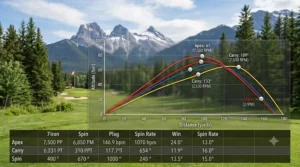
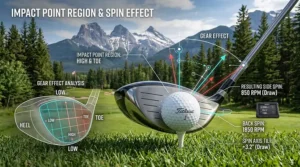
Spin control fundamentals start with understanding that “spin” isn’t a single number — it’s really two distinct measurements working together. Backspin is what creates lift and, critically, what allows a ball to check up and stop on a green rather than skidding forward. Sidespin, meanwhile, is the rotation around a tilted axis that produces a draw, fade, hook, or slice, and it’s almost entirely a function of clubface angle at impact relative to swing path rather than ball construction.
Here’s the part that trips a lot of golfers up: ball construction primarily influences backspin magnitude, not sidespin direction. A high-spin ball will exaggerate whatever curve your swing already produces, while a low-spin ball will dampen it. That’s exactly why the Callaway Supersoft is marketed toward higher handicappers — it’s not making your swing path straighter, it’s just generating less rotation overall, so any sidespin you do produce has less raw spin to work with and curves less dramatically as a result.
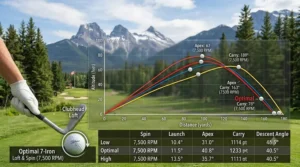
Backspin itself is generated by a combination of three factors working together: loft (more loft generally creates more backspin), clubhead speed relative to the ball’s compression rating, and the friction created between the clubface grooves and the ball’s cover material. This is exactly why a soft, grippy urethane cover spins more on a wedge than a firm ionomer cover does — there’s simply more friction-based grip occurring in the milliseconds of contact. Understanding this distinction matters practically because it tells you where to look when your ball flight isn’t behaving the way you’d like. If your shots are curving wildly off-line, that’s a swing-path and clubface issue, and no amount of ball-swapping will fix it. If your approach shots simply won’t stop on the green despite a reasonably straight ball flight, that’s a backspin-and-construction issue, and the right ball really can move the needle.
How to Choose Golf Balls for Spin: A 6-Step Framework
- Identify your driver swing speed first. Anything under roughly 90 mph generally benefits from softer compression and three-piece construction; speeds above 105 mph can fully load firmer, multi-layer balls without sacrificing distance.
- Be honest about your current short game. A high-spin ball amplifies skill in the scoring zone; if your wedge contact is inconsistent, a moderate-spin ball will likely produce more predictable results.
- Consider the greens you actually play. Firm, fast Canadian greens in late summer reward higher spin for stopping power; softer spring or early-fall greens are more forgiving of lower-spin balls.
- Weigh durability against performance. Urethane covers spin more but scuff more easily than ionomer covers; if you play in rocky, cart-path-adjacent courses, factor that into your decision.
- Set a realistic per-round loss rate. Reviewers consistently note that golfers who lose three or more balls per round see far better long-term value from budget urethane options like the Kirkland Signature than from premium tour balls.
- Test before committing to a dozen. Most retailers and pro shops sell sleeves of three; play a full round with each finalist before buying in bulk.
Common Mistakes When Buying High-Spin Golf Balls
The single most common mistake, based on the spec comparison across this category, is assuming more spin is automatically better — a marketing-driven instinct rather than a performance-driven one. The second is ignoring swing speed entirely and buying whatever ball a tour pro plays, even though that pro’s swing speed and contact consistency bear little resemblance to the average weekend golfer’s. A third recurring pitfall is overlooking weather and course conditions; a ball dialled in for spin on a soft, dew-covered morning green can behave completely differently on a baked-out August fairway. Finally, plenty of golfers buy based purely on price at either extreme, either overpaying for marginal gains they’ll never notice or underpaying and accepting a construction that actively works against their swing tendencies. The fix for all four mistakes is the same: match construction to swing speed and short-game consistency first, then let price and brand preference settle the final decision.
High-Spin vs Low-Spin Golf Balls: Which Should You Play?
This comparison gets framed as a binary choice far too often, when it’s really a spectrum question. High-spin balls — the Pro V1x, Chrome Tour X, and TP5 on our list — excel when you need a shot to land and stay, particularly on firm greens or when attacking a tucked pin over a bunker. The trade-off is that mishits curve more dramatically, and driver shots can sometimes balloon if your swing already produces excess spin on its own. Low-spin balls, exemplified by the Supersoft here, trade some of that scoring-zone precision for forgiveness and roll-out distance, which is exactly why they dominate among beginners and higher-handicap players who need help keeping shots in play more than they need extra stopping power.
The honest, non-marketing answer is that most recreational golfers are better served somewhere in the middle — which is precisely the niche balls like the Kirkland Signature V3.0 and Bridgestone Tour B XS occupy, offering genuine urethane spin without the punishing compression or unforgiving mishits of a full tour-spec ball. If you’re unsure which camp you fall into, a simple test works well: track your next ten approach shots from 100-130 yards. If they’re consistently flying past the pin and rolling well beyond the hole, you likely need more spin. If they’re checking up short or spinning back off the front of greens unpredictably, you may already have more spin than your game can control.
Golf Ball Spin for Different Canadian Player Types
Beginners and high-handicappers: Forgiveness matters more than spin precision at this stage. A two-piece ball like the Supersoft minimizes the damage from off-centre strikes and keeps shots traveling reasonably straight, building confidence before spin even becomes a relevant consideration.
Mid-handicap weekend golfers: This is the largest player population, and it’s the group best served by three-piece urethane options like the Kirkland Signature V3.0 or Tour B XS — enough spin to start seeing real short-game benefits without the cost or unforgiving nature of full tour-spec balls.
Low-handicap and competitive players: Golfers in this category typically have the swing consistency to benefit from the Pro V1, Pro V1x, Chrome Tour X, or TP5, where the added engineering nuance translates directly into shot-shaping ability and scoring-zone control.
Senior golfers with reduced swing speed: Softer compression matters more here than spin sophistication. The Tour B XS and Supersoft both cater well to this group by prioritizing easy launch and forgiving compression over maximum greenside check.
Practical Usage Guide: Dialling In Your Spin Rate Over Your First 30 Days
Switching golf balls isn’t a one-round decision, even though plenty of golfers treat it that way. In your first few rounds with a new model, focus specifically on wedge and short-iron shots from 80-130 yards, since that’s where spin differences show up most obviously, and track whether shots are checking, releasing, or spinning back unpredictably. A common early mistake is judging a ball purely off the driving range, where compressed mats and range balls rarely replicate true course spin behaviour — always validate range impressions on an actual course within the first week. Pay attention to greenside chips and pitches too; this is where urethane covers separate themselves most clearly from ionomer covers, and where you’ll feel whether the added spin is helping or working against your technique. By round three or four, you should have a clear sense of whether the ball’s spin profile matches your eye for distance control; if approach shots are consistently coming up short because they’re checking too aggressively, that’s useful diagnostic information, not a reason to abandon the model immediately. Finally, store balls properly between rounds — extreme cold genuinely stiffens the core and raises compression, which is a maintenance consideration unique to Canadian golfers that we’ll cover in more detail below.
Real-World Scenarios: Matching Balls to Canadian Golfers
The budget-conscious weekend warrior in Mississauga: Plays twice a month, loses two or three balls per round into the rough lining most GTA courses, and wants a ball that performs better than a bargain-bin option without the Pro V1 price tag. The Kirkland Signature V3.0 is the clear fit — genuine urethane spin at a cost that makes losing a few balls per round a non-issue.
The low-handicap player chasing scoring-zone precision in Calgary: Plays competitively, has a swing speed north of 105 mph, and needs every available tool to attack firm prairie greens that get baked hard by July sun and wind. The Pro V1x or Chrome Tour X both make sense here, where the extra spin and higher flight directly translate into lower scores.
The senior golfer in the Maritimes managing a slower swing speed: Plays often, values consistency over aggression, and finds firmer tour balls difficult to compress fully. The Bridgestone Tour B XS is purpose-built for exactly this profile, with its reactive cover delivering forgiveness off the tee and genuine spin around the green without demanding tour-level clubhead speed.
Problem → Solution Guide: Common Spin-Related Frustrations
Problem: Approach shots fly the green even with solid contact. This usually signals insufficient backspin for the conditions. Solution: move toward a three-piece urethane ball like the Kirkland Signature V3.0 or Pro V1, and confirm your wedge lofts are appropriately gapped for the distances you’re playing.
Problem: Wedge shots spin back off the front of the green unpredictably. Counterintuitively, this often means you have more spin than your strike consistency can control. Solution: a moderate-spin ball such as the Tour B XS can reduce that volatility while still offering meaningfully more control than a pure distance ball.
Problem: Driver shots balloon and lose distance, especially in windy conditions. This is frequently an excess-spin issue off the tee specifically. Solution: a lower-spin driver-focused ball, or a multi-layer ball engineered to separate driver spin from wedge spin like the TP5 or Tour B XS, addresses this without sacrificing short-game performance.
Problem: Balls feel dead and travel noticeably shorter in early spring or late fall. This is a temperature-and-compression issue rather than a ball-quality issue, and it’s worth taking seriously given how much of the Canadian golf season happens in cool-weather windows. Cold genuinely stiffens a ball’s core, reducing the energy transfer at impact — research into how cold affects ball physics in other sports, reported by CBC News, confirms that internal air pressure and material compression both shift measurably as temperature drops. Solution: keep balls in a pocket close to body heat between holes during shoulder-season rounds, and consider a softer-compression model for consistently cold-weather play.
Problem: New high-spin balls feel completely different from what you’re used to and results suffer initially. This is an adaptation issue, not a product failure. Solution: give any new ball a genuine three-to-four-round trial period before judging it, focusing specifically on greenside shots where spin differences are most apparent.
Long-Term Cost & Maintenance: What a Dozen Really Costs You
It’s tempting to compare golf balls purely on sticker price per dozen, but that misses the real economics of how golfers actually lose balls. A premium tour ball at roughly C$60-70 per dozen works out to roughly C$5 per ball, and for a golfer who loses three balls per round playing weekly, that’s a meaningfully different annual cost than a Kirkland Signature V3.0 at closer to C$1 per ball. Run that math across a 20-round season and the gap stretches into hundreds of dollars — money that could just as easily go toward green fees, a lesson, or new grips. The counterargument, and it’s a fair one, is that scoring-zone performance has real value too; a golfer who genuinely shoots lower scores with a premium ball because of better spin control might find that worth the premium regardless of per-ball cost. The most rational approach, particularly for mid-handicap golfers, is to treat ball selection as two separate budgets: a “competition or important round” ball where premium spin technology earns its keep, and an “everyday play” ball where a value option like the Kirkland Signature or even a quality recycled ball makes far more financial sense without meaningfully hurting your scores.
Features That Actually Matter (And Those That Don’t)
Dimple count is the classic example of a spec that sounds impressive but rarely changes your decision in practice — research on golf ball flight dynamics shows that anywhere from roughly 300 to 500 dimples can produce excellent aerodynamic performance, so a marketing claim of “more dimples” alone tells you very little without knowing the pattern and depth engineering behind it. Compression rating, on the other hand, genuinely matters and deserves real attention relative to your swing speed, since it directly governs how efficiently your particular swing loads and releases energy into the ball. Cover material matters enormously too — urethane versus ionomer is probably the single biggest performance fork in the entire category. Colour, by contrast, is pure preference; high-visibility yellow or matte finishes perform identically to white in terms of spin and distance, they simply help you find the ball in Canadian autumn leaf cover. Alignment markings and stripe patterns are similarly cosmetic, genuinely useful for putting consistency but irrelevant to spin performance.
Safety, Regulations, and Compliance Guide for Canadian Golfers
Every ball featured in this guide conforms to the Rules of Golf as jointly published and governed in Canada, where Golf Canada holds the exclusive right to govern, publish, and distribute the official Rules of Golf domestically, working alongside the R&A and USGA on a four-year update cycle. Under those rules, a conforming golf ball must weigh no more than 45.93 grams, measure no less than 42.67 millimetres in diameter, and stay within specified velocity, distance, and symmetry limits — every model reviewed above appears on the official conforming ball list maintained for sanctioned play. This matters practically for any Canadian golfer planning to post scores for handicap purposes or play in club competitions, since using a non-conforming ball can affect eligibility. Worth noting too: the governing bodies have proposed modified testing standards for elite competitive play aimed at managing hitting distances at the highest level, though this affects tour-level equipment far more than anything a recreational golfer would purchase off a Canadian retail shelf.
✨ Don’t Miss These Exclusive Deals!
🔍 Ready to actually test your spin profile instead of guessing? Click on any highlighted ball above to check current pricing and availability. The right construction can shave real strokes off your scoring zone — and these picks make a genuinely informed starting point.
Frequently Asked Questions
❓ What spin rate is considered high for a 7-iron?
❓ Does a higher spin golf ball always travel shorter?
❓ What's the difference between 2-piece and 3-piece golf balls for beginners?
❓ How does cold weather affect golf ball spin rate in Canada?
❓ Are expensive golf balls worth it for high-handicap golfers?
Conclusion
If there’s one thing worth carrying away from this entire golf ball spin rate guide, it’s that spin isn’t a trophy to chase, it’s a tool to match. The Titleist Pro V1 and Pro V1x remain the benchmark for a reason, the Callaway Chrome Tour X and TaylorMade TP5 each bring genuine engineering nuance worth understanding, the Bridgestone Tour B XS quietly serves an underserved swing-speed niche, and the Kirkland Signature V3.0 proves that real urethane performance doesn’t require a tour-level price tag. The Callaway Supersoft, meanwhile, is a useful reminder that low spin is sometimes the smarter choice, not the lesser one. Construction, layer technology, and compression all interact to shape how a ball behaves from tee to green, and understanding that interaction, rather than chasing a number on a box, is what actually turns into lower scores on a Canadian course this season.
✨ Don’t Miss These Exclusive Deals!
🔍 Found your match in this guide? Check current pricing and availability through the links above before your next round — the right spin profile is sitting one click away, and your short game will notice the difference.
Recommended for You
- How to Choose Golf Balls in Canada: 7 Smart Picks (2026)
- Golf Ball Comparison Chart 2026: Best & Worst Picks for Canadian Golfers
- 7 Best Golf Balls in Canada (2026)
Disclaimer: This article contains affiliate links. As an Amazon Associate, I earn from qualifying purchases. If you purchase products through these links, we may earn a small commission at no additional cost to you.
✨ Found this helpful? Share it with your friends! 💬🤗
