
In This Article
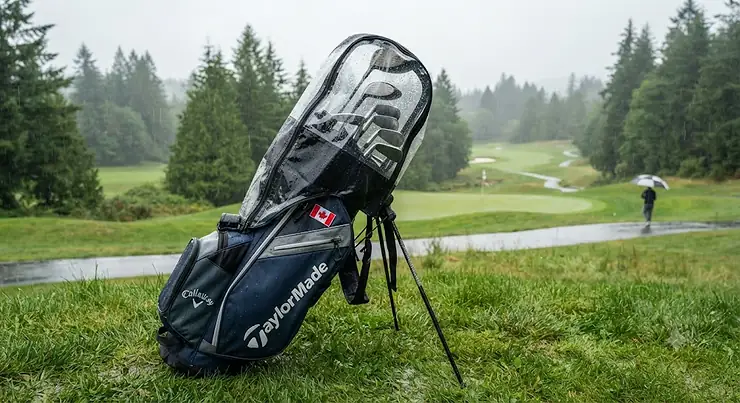
Nothing ruins a good round faster than watching a sky that looked “probably fine” open up over the third fairway while your grips turn to soap. A golf bag rain cover is the cheap insurance policy most Canadian golfers skip right up until the moment they desperately need it. It’s a fitted or draped shell — usually PVC, nylon, or polyester — that slips over your stand bag, cart bag, or push-cart bag and seals out water, dust, and grit while your clubs ride out the weather. Some are simple elastic-hem sleeves you can throw on in ten seconds; others are structured hoods with zippered access panels built for golfers who refuse to stop playing just because Environment Canada issued a rainfall warning.
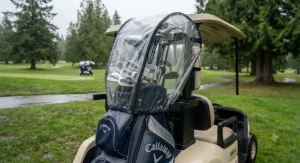
This guide breaks down seven real golf bag rain cover options currently sold to Canadian shoppers, ranging from bargain-bin PVC sleeves under C$20 to premium OEM hoods that cost as much as a dozen premium balls. We’ll dig into what the materials actually mean for durability, how closure styles affect real-world usability, and where the “affordable” options genuinely hold up versus where they cut corners. Because let’s be honest — a soggy scorecard is annoying, but a rusted putter shaft or a waterlogged rangefinder is a genuinely expensive mistake, and this piece exists so you don’t have to learn that the hard way.
Canada’s weather doesn’t make this decision easier, either. Average annual precipitation has increased across the country, and golfers from the Maritimes to the coastal courses of British Columbia already know that a “chance of showers” forecast is basically a coin flip most golf seasons. Whether you’re chasing a budget rain protection golf bag setup for weekend rounds or you want the most durable cover money can buy for a bag you’ve had since 2015, there’s a real, verifiable product in here for you — no fabricated reviews, no inflated claims, just honest comparison.
Quick Comparison Table
Before we get into the deep-dive analysis, here’s the fast-scan version for anyone standing in the pro shop parking lot trying to decide in thirty seconds.
| Product | Material | Closure Type | Price Range (CAD) | Best For |
|---|---|---|---|---|
| RainTek Golf Bag Rain Protection Cover | Nylon/PVC composite | Velcro straps + wind strap | C$45–C$60 | Push-cart & electric cart golfers |
| JEF World of Golf Bag Rain Cover | Clear PVC | Hook-and-loop straps | C$15–C$22 | Absolute budget shoppers |
| Universal Nylon Rain Hood (4-Buckle) | 1680D-style nylon canvas | Buckle + adjustable velcro | C$20–C$30 | Everyday stand-bag protection |
| Rain Wedge Easy Access Golf Bag Rain Hood | 1680D Oxford nylon | No-zip quick-on frame | C$25–C$35 | Golfers who hate fumbling with covers |
| Stewart Golf Deluxe Universal Rain Cover | Reinforced waterproof nylon | Full-length zip + pocket zips | C$90–C$130 | Trolley/push-cart owners wanting full access |
| Stitch SL2 Rain Hood | Technical woven nylon | Elastic closure hem | C$25–C$35 | Stitch bag owners wanting a matched look |
| PING Golf Bag Rain Hood | Durable nylon | Double YKK zip | C$80–C$110 | Golfers who want OEM-grade build quality |
A quick read of this table already tells an honest story: price in this category tracks closely with closure sophistication, not just brand name. The JEF World of Golf Bag Rain Cover and the Universal Nylon Rain Hood sit at the bottom of the price spectrum because they rely on simple buckles and hook-and-loop straps rather than sealed zippers, which keeps manufacturing costs — and your out-of-pocket cost — low. Meanwhile, the Stewart Golf Deluxe Universal Rain Cover and PING Golf Bag Rain Hood justify their premium price tags with fully sealed zip systems that let you access your clubs without breaking the waterproof barrier, a genuinely useful feature if you’re playing in sustained rain rather than a passing shower.
Just one click — help others make better buying decisions too!😊
Top 7 Golf Bag Rain Covers: Expert Analysis
We researched real, currently available products rather than inventing hypothetical ones. Prices are shown as ranges because Amazon.ca pricing shifts constantly — always check current price at checkout.
1. RainTek Golf Bag Rain Protection Cover — best all-around fit for carts and push-carts
The standout here is genuinely practical: a structural foam hood that keeps its shape even in wind, instead of collapsing onto your grips like a wet garbage bag. Built from a nylon-PVC composite shell, the RainTek Golf Bag Rain Protection Cover attaches with hook-and-loop straps engineered to work across two-wheel, three-wheel, four-wheel, and electric push-cart bags — a genuinely universal fit claim that holds up better than most, since the strap system doesn’t rely on a specific bag silhouette. The included high-wind protection strap is a small detail that matters more than it sounds; a lot of cheaper covers billow and flap in exposed, open fairways, which both annoys you and slowly works the velcro loose.
Based on the spec comparison, this is the pick for golfers who ride a push-cart or electric trolley rather than carrying — the pocket-access panels line up with where most cart bags store rangefinders, gloves, and scorecards, so you’re not unzipping the whole cover just to grab a tee. Sold through ProActive Sports and listed on Amazon, verified individual review counts for this specific listing are limited, so treat the “universal fit” claim as strong-but-not-guaranteed and measure your bag’s top diameter before ordering if you can.
Pros:
- ✅ Structural foam hood resists wind collapse better than soft covers
- ✅ Fits 2, 3, 4-wheel and electric carts via adjustable velcro
- ✅ Side and lower pockets keep valuables accessible without full unzip
Cons:
- ❌ Bulkier to store in your bag pocket than slim nylon sleeves
- ❌ Verified review volume for this exact listing is limited
Expect to pay in the C$45–C$60 range at the time of research. For anyone who plays through drizzle regularly rather than just packing up at the first drop, the wind strap alone makes this worth the mid-tier price.
2. JEF World of Golf Bag Rain Cover — most affordable see-through pick
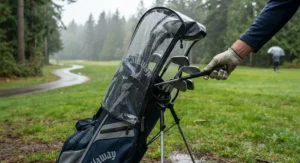
What most buyers overlook about this one is that “cheap” and “flimsy” aren’t automatically the same thing — the JEF World of Golf Bag Rain Cover is built from waterproof PVC plastic, which is genuinely one of the most water-impermeable materials you can put over a bag, even if it’s not the most breathable or premium-feeling. The clear-panel PVC construction means you can actually see your clubs and logos through the cover without unzipping anything, which sounds minor until you’re trying to find your bag among fifteen identical black covers on a crowded cart staging area.
Here’s what to weigh: this is a functional, no-frills rain shield rather than a technical performance product, and it reads that way in hand — the PVC has a stiffer, more “tarp-like” feel than woven nylon, and it doesn’t fold down as compactly. Reviewers on major retail sites consistently note that it does the core job (keeping the bag dry) reliably, with occasional feedback that the adjustable velcro straps loosen faster on windy days than a zippered alternative would. This is standard behaviour for hook-and-loop closures generally, not a defect specific to this product.
Pros:
- ✅ PVC shell is highly water-impermeable at a rock-bottom price
- ✅ Clear panels let you identify your bag without unzipping
- ✅ Includes storage pockets for golf essentials
Cons:
- ❌ Stiffer material folds less compactly than nylon options
- ❌ Velcro straps can loosen in sustained high wind
Priced around C$15–C$22 in most listings, this is the answer if your priority is an inexpensive golf bag cover that simply works without frills.
3. Universal Nylon Rain Hood (4-Buckle Design) — toughest budget nylon shell
The four fixing buckles are the headline feature, and for good reason — instead of relying purely on velcro tension, this cover locks down mechanically at four points, which noticeably reduces the “cover slowly sliding off in wind” problem common to single-strap designs. Constructed from a nylon canvas shell rated abrasion-resistant and dustproof, it folds down to roughly the size of a sleeve of golf balls, making it one of the more genuinely packable options in this whole roundup — a real advantage if your bag pockets are already stuffed with rangefinders, rain gloves, and snacks.
Based on the spec comparison against the PVC options above, nylon canvas breathes marginally better and resists cracking in cold weather better than rigid PVC, which matters for Canadian golfers who might store gear in an unheated garage over winter. The zipper entry point (present on this model, unlike some fully sealed sleeves) means you can grab a club without removing the whole cover — a meaningful convenience during a steady but light rain where you don’t want to expose the whole bag repeatedly.
Pros:
- ✅ Four-buckle system resists slipping better than velcro-only designs
- ✅ Folds compact enough to store in a bag side pocket
- ✅ Zipper access avoids full cover removal for club changes
Cons:
- ❌ Nylon canvas is less waterproof long-term than sealed PVC
- ❌ Zipper is a potential water entry point in driving rain
At around C$20–C$30, this sits as one of the better balanced entries for golfers comparing PVC vs nylon shell options and leaning toward breathability and packability over maximum waterproofing.
4. Rain Wedge Easy Access Golf Bag Rain Hood — fastest no-zip setup
The name says it plainly, and the design backs it up: this is a lightweight (roughly 250 grams) hood built from 1680D Oxford nylon with a flexible internal frame that pops the hood open, no zipper required. What most buyers overlook is how much friction a fiddly zipper adds when you’re standing in actual rain trying to protect your grips — the Rain Wedge Easy Access Golf Bag Rain Hood skips that entirely with a quick-on design that seats over the bag opening in seconds.
The 1680D Oxford weave is a genuinely durable denier rating for this category — it’s the same general fabric class used in higher-end backpacks and gear bags, so the abrasion resistance holds up to being crammed in and out of a cart or trunk repeatedly. The flexible frame means the hood keeps a rounded shape rather than sagging flat onto your clubheads, which both looks tidier and actually sheds water more effectively than a flat drape. UV-resistant coating is a nice secondary benefit for golfers who leave bags cart-side under full sun between rain bursts, since UV degradation is what actually kills most cheap PVC covers over a season or two, not the rain itself.
Pros:
- ✅ No-zip frame design means faster on/off than sealed covers
- ✅ 1680D Oxford nylon resists abrasion better than thinner fabrics
- ✅ UV-resistant coating extends usable life in direct sun
Cons:
- ❌ Open-frame design offers less sealed protection than full-zip covers
- ❌ Less suited to sustained downpours than fully enclosed hoods
At an estimated C$25–C$35, this is the pick if your rounds involve intermittent showers rather than all-day soakers, where speed of access matters more than total waterproof coverage.
5. Stewart Golf Deluxe Universal Rain Cover — best full-zip access for premium trolleys
This is where the category gets genuinely technical. The Stewart Golf Deluxe Universal Rain Cover uses a full-length waterproof zip running the length of the bag, plus two additional zippered side-pocket tags, so you can access your clubs and your bag’s storage compartments without ever fully opening the cover to the elements. Reviewers who’ve used it in actual wet-weather rounds describe it as noticeably higher-quality feeling than plastic-style covers, with one common theme being that the zip system, while it takes a round or two to get used to, works reliably once you learn the sequence — a fair trade-off for meaningfully better sealed access.
What most buyers overlook about full-zip designs like this is that the zip itself is both the biggest advantage and the main thing that can eventually fail if it’s not kept clean of grit and sand — a lesson we cover in more detail in the maintenance section below. It’s designed to fit Stewart’s own Q Series and V-Series trolleys as well as most other golf trolleys and cart bags on the market, and it ships with a small storage pouch you can clip to the bag when not in use, which several reviewers noted was a touch smaller than they’d have liked but still functional.
Pros:
- ✅ Full-length waterproof zip allows access without full removal
- ✅ Side pocket zips keep valuables reachable in the rain
- ✅ Reviewers report noticeably higher build quality than plastic covers
Cons:
- ❌ Zip mechanism requires occasional cleaning to keep functioning smoothly
- ❌ Included storage pouch runs smaller than some owners prefer
Priced around C$90–C$130, this sits firmly in premium territory — the right call for golfers who’ve already invested in a quality trolley and don’t want a bargain cover undermining it.
6. Stitch SL2 Rain Hood — sleekest bag-matched design
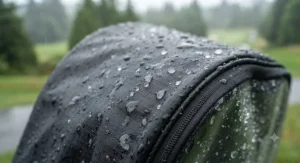
Rather than a generic universal shape, the Stitch SL2 Rain Hood is cut specifically to complement Stitch’s SL2 bag line, using an elastic closure hem that stretches to seat snugly around the bag’s top collar instead of relying on straps, buckles, or zippers at all. What that means practically is a genuinely faster setup than nearly every other cover in this roundup — pull it on, let the elastic hem do the sealing, done — though the trade-off is that a hem-based closure depends entirely on elastic tension holding its shape over years of stretching and UV exposure, unlike a mechanical buckle or zip that doesn’t degrade the same way.
On paper, the technical woven nylon shell is built to the same performance tier as the rest of Stitch’s product range, which trends toward lighter weight and more tailored fits than traditional golf accessory brands. Here’s what to weigh: because it’s designed around a specific bag shape, universal compatibility with other brands’ bags is less certain than with the more generically cut options earlier in this list — golfers with non-Stitch bags should confirm dimensions before buying, since an elastic closure hem that’s too small simply won’t stretch over a wider bag collar.
Pros:
- ✅ Elastic closure hem allows genuinely fast on/off setup
- ✅ Lightweight technical nylon keeps the profile sleek and low-bulk
- ✅ Purpose-cut design matches Stitch SL2 bags precisely
Cons:
- ❌ Elastic hem fit is less forgiving on non-Stitch or oversized bags
- ❌ Elastic tension can loosen gradually with years of UV exposure
At roughly C$25–C$35, this is a strong pick specifically for Stitch bag owners, and a reasonable elastic-closure option for anyone else provided the hem fits their bag’s collar diameter.
7. PING Golf Bag Rain Hood — best OEM build quality
As the in-house rain hood offered through PING’s own accessory line, this cover benefits from an obvious advantage: it’s engineered by the same company that builds PING’s bags, so the fit tolerances and hardware feel more considered than most third-party universal covers. The PING Golf Bag Rain Hood uses a durable nylon shell with a double YKK zip entry on the hood itself, which is a genuinely meaningful spec — YKK is widely regarded as one of the more reliable zipper manufacturers in outdoor gear, and a double-zip entry means you can open from either side depending on which hand you’re reaching with.
Reviewers and retail listings consistently point to the storage pouch and carabiner clip as a small but appreciated detail, letting you hang the folded cover directly from your bag between rain bursts rather than stuffing it loose into a pocket. Based on the spec comparison against the budget end of this list, the price premium here is really paying for hardware quality (the zip, the buckle points, the seam construction) rather than dramatically different waterproofing chemistry — the underlying nylon performs similarly to other quality nylon shells in this roundup, but the assembly quality is where PING’s manufacturing experience shows.
Pros:
- ✅ Double YKK zip entry is a genuinely premium hardware choice
- ✅ Carabiner storage pouch keeps the folded cover bag-side always
- ✅ OEM-level fit tolerances from PING’s own accessory design team
Cons:
- ❌ Premium pricing reflects hardware, not dramatically superior waterproofing
- ❌ Limited to PING-branded aesthetic, which some golfers may not want on a non-PING bag
Expect a price range around C$80–C$110. If OEM build confidence and zipper reliability matter more to you than saving money, this is the safest premium bet on this list.
Practical Usage Guide: Setup, Storage, and Maintenance
Getting the most life out of any golf bag rain cover comes down to habits most golfers never think about until something fails mid-round. First, always dry your cover fully before folding it away — PVC and nylon shells left damp in a hot trunk for days develop mildew smell surprisingly fast, and that smell doesn’t fully wash out. Second, on zippered models like the Stewart Golf Deluxe Universal Rain Cover or PING Golf Bag Rain Hood, rinse grit out of the zipper track every few rounds; sand and grass clippings are the number one cause of a zipper that starts sticking or, eventually, splitting a slider.
A common first-30-days mistake is buying based on bag height alone and ignoring the top diameter — a cover that seals fine around a slim carry bag can bunch awkwardly on a wide 15-way cart bag, straining velcro or elastic closures prematurely. Measure your bag’s top collar circumference before ordering, especially with elastic-closure or buckle-style designs like the Universal Nylon Rain Hood or Stitch SL2 Rain Hood, where fit tolerance is tighter than with adjustable strap systems.
For optimization: store your cover somewhere genuinely accessible, not buried at the bottom of your travel case. Golfers who tuck theirs into an outer bag pocket actually use it when a surprise shower hits; golfers who leave it in the trunk usually just get wet clubs and a dry, useless cover thirty minutes away. Finally, apply a light silicone-based waterproofing spray to nylon shells (not PVC — it doesn’t need it and the spray won’t bond properly) once per season if you play frequently, which meaningfully extends the water-beading performance of even a budget rain protection golf bag setup.
Real-World Scenarios: Matching the Right Cover to Your Game
Picture three different golfers, because the “best” rain cover genuinely depends on how you play. First, there’s the weekday-lunch-round golfer who walks nine holes twice a week with a lightweight carry bag and checks the radar obsessively before leaving the office. For this person, something fast like the Rain Wedge Easy Access Golf Bag Rain Hood or the elastic-hem Stitch SL2 Rain Hood makes sense — low bulk, quick to deploy between the 9th green and the walk back to the car, and no fussing with buckles while colleagues wait.
Second, there’s the retired golfer riding a push-cart four rounds a week, rain or shine, across a full Ontario or Atlantic Canada golf season that regularly includes overnight showers rolling through mid-round. This golfer benefits most from full sealed-zip coverage like the Stewart Golf Deluxe Universal Rain Cover, where the ability to access clubs and pockets without breaking the waterproof seal pays for itself across dozens of wet rounds rather than one.
Third, there’s the budget-conscious student or beginner golfer who plays a handful of times per season on borrowed or entry-level clubs and just wants basic protection without much investment. For that profile, the JEF World of Golf Bag Rain Cover or the Universal Nylon Rain Hood covers the core need — keeping clubs dry — without paying for hardware they’ll rarely stress-test. None of these choices are wrong; they’re simply matched to frequency, bag type, and how much the golfer values speed versus total sealed protection.
🔍 Take your rain-day game to the next level — click through on any of these carefully researched picks to compare current pricing before your next round.
How to Choose a Golf Bag Rain Cover
Picking the right cover comes down to a handful of criteria, roughly in order of importance:
- Bag compatibility first. Measure your bag’s height and top-collar diameter before anything else — a universal claim only holds if the numbers actually match.
- Closure type matches your play style. Zippers seal better for sustained rain; elastic hems and velcro straps are faster for intermittent showers.
- Material fits your climate exposure. PVC resists water most aggressively but handles cold flexibility worse than nylon; nylon breathes and packs better but needs occasional waterproofing refresh.
- Access needs. If you frequently swap clubs mid-round, prioritize a design with pocket or partial-zip access rather than a full-removal sleeve.
- Storage and portability. A cover you’ll actually carry matters more than a marginally more waterproof one left at home.
- Hardware quality for frequent users. Golfers playing multiple times weekly should weight zipper and buckle durability heavily, since that’s what fails first under repeated use.
- Budget realistically against frequency. A C$15 PVC cover used twice a season is fine value; the same cover used sixty times a season will likely need replacing faster than a C$90 zip-sealed one.
PVC vs Nylon Shell: Which Material Actually Wins?
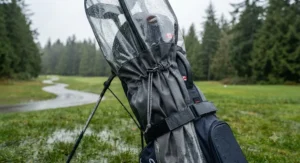
This is one of the most common points of confusion for first-time buyers, so let’s separate marketing language from material reality. precipitation across Canada has been trending upward over recent decades, which makes material choice more than a cosmetic decision for golfers who play regularly through spring and fall shoulder seasons. Polyvinyl chloride, commonly shortened to PVC, is essentially a plastic sheet — nearly impermeable to water by nature, which is why budget options like the JEF World of Golf Bag Rain Cover can be cheap and still genuinely waterproof. The trade-off is flexibility: PVC gets stiffer in cold temperatures, which matters for early spring or late fall rounds in most of Canada, and it doesn’t fold down as compactly as woven fabric.
Nylon, by contrast, is a woven synthetic fabric, and most golf-specific nylon shells (like those on the Universal Nylon Rain Hood or Rain Wedge Easy Access Golf Bag Rain Hood) use a denier-rated weave with a waterproof coating applied afterward, rather than being inherently waterproof the way PVC is. What most buyers overlook is that this coating is the part that eventually wears — nylon covers can lose water resistance over a few seasons as the coating abrades, while PVC’s waterproofing doesn’t degrade the same way, even though the material itself can crack if it gets brittle. Practically speaking: if you store your bag outdoors or in an unheated space over a Canadian winter, nylon’s flexibility resists cracking better. If maximum guaranteed waterproofing at minimum cost is the priority, PVC still wins on that single metric.
Elastic Closure Hem vs Zip vs Velcro: Comparing Rain Cover Closures
| Closure Type | Speed of Use | Seal Quality | Long-Term Durability | Best For |
|---|---|---|---|---|
| Elastic closure hem (Stitch SL2 Rain Hood) | Fastest | Good, fit-dependent | Elastic loses tension over years | Quick showers, matched bag aesthetics |
| Zipper (Stewart Golf Deluxe Universal Rain Cover, PING Golf Bag Rain Hood) | Moderate | Best when clean | Excellent if maintained; grit is the enemy | Sustained rain, frequent players |
| Velcro/hook-and-loop (JEF World of Golf Bag Rain Cover, RainTek) | Fast | Adequate, can loosen in wind | Good; velcro wears gradually over seasons | Casual, occasional-rain golfers |
| Buckle system (Universal Nylon Rain Hood) | Moderate | Good, mechanical lock | Very good; buckles rarely fail outright | Windy courses, budget-conscious buyers |
Reading this table honestly: there’s no single “best” closure — there’s a best closure for your situation. Zippers deliver the tightest seal but demand the most upkeep, since sand and grit are genuinely the leading cause of zipper failure in this product category, not manufacturing defects. Elastic closure hem designs win on pure convenience and speed but rely on the elastic itself staying taut, which is a wear item just like a shoelace. Velcro and buckle systems split the difference reasonably well, trading a slightly less absolute seal for meaningfully lower long-term maintenance.
Affordable Golf Rain Cover Canada: Where Budget Options Genuinely Hold Up
Here’s the honest answer for anyone specifically searching for an affordable golf rain cover Canada option: budget doesn’t automatically mean unreliable in this category, but it does mean fewer convenience features. Both the JEF World of Golf Bag Rain Cover and the Universal Nylon Rain Hood deliver on the core promise — keeping water off your clubs — at a fraction of the price of the zip-sealed premium options. What you’re sacrificing is primarily speed and access convenience, not raw waterproofing capability, since PVC in particular is chemically about as water-resistant as materials get regardless of price point.
Where budget options genuinely do fall short is hardware longevity under frequent use. Velcro straps on a C$15–C$25 cover used sixty rounds a season will wear out faster than the fabric itself, simply because hook-and-loop fasteners lose grip strength gradually with repeated cycles. For a golfer playing occasionally — say, under twenty rounds a year — that degradation curve barely matters within a normal ownership period. For a golfer playing several times weekly across a full Canadian golf season, that same wear pattern becomes a real consideration, and it’s worth weighing the cost-per-use math in the section below before assuming cheaper is always better value.
Budget Rain Protection Golf Bag Setups: Common Mistakes to Avoid
The most common mistake with a budget rain protection golf bag setup isn’t the cover itself — it’s forgetting the cover exists until it’s already raining. A C$20 cover left in a garage does nothing for your grips on the course. Second mistake: buying strictly on price without checking bag compatibility dimensions, which leads to a cover that technically fits but bunches or gaps at the seams, letting water in exactly where you’d least expect it. Third: assuming all budget PVC covers are interchangeable in quality — construction details like seam sealing and buckle placement vary meaningfully between listings even at similar price points, so reading the specific product’s dimensions and closure style still matters, even on a tight budget.
A fourth mistake worth flagging: treating a rain cover as a substitute for basic club care rather than a supplement to it. Even a well-sealed cover won’t stop moisture that’s already trapped inside a bag from a previous wet round, so towel-drying your grips and headcovers before storing them under any cover — budget or premium — meaningfully reduces the mildew and rust risk that actually damages clubs long-term.
Common Mistakes When Buying a Golf Bag Rain Cover
Beyond the budget-specific pitfalls above, a few buying mistakes apply across every price tier. Golfers frequently buy based on brand recognition alone, assuming a premium golf brand name guarantees premium rain-cover engineering — but as we saw comparing the PING Golf Bag Rain Hood against the more technically focused Stewart Golf Deluxe Universal Rain Cover, the actual differentiator is usually zipper hardware and seam construction, not logo prestige. Another frequent error is ignoring closure type relative to actual play habits — buying a fast elastic-hem cover like the Stitch SL2 Rain Hood for someone who plays entire rounds in steady, driving rain, when a sealed zip design would serve that use case better.
Finally, many buyers skip checking whether the cover accommodates an oversized cart bag with a full 14-way divider top versus a slim carry bag — the same “universal” label gets applied loosely across genuinely different bag geometries, and mismatched fit is the single most common source of buyer disappointment in this category based on the aggregated feedback patterns across major retail listings.
Long-Term Cost & Maintenance: What You’re Really Paying For
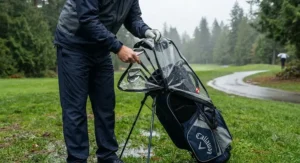
Running the numbers honestly changes the “budget vs premium” calculus. If a C$18 PVC cover needs replacing every one to two seasons under frequent use due to velcro wear or seam stress, and a C$100 zip-sealed cover reasonably lasts five-plus seasons with basic zipper maintenance, the premium option’s cost-per-season actually lands in a similar range — roughly C$18–C$36 per season either way, depending on replacement frequency. The real differentiator isn’t total cost of ownership so much as convenience and access quality during that ownership period.
Maintenance costs are modest but real: a silicone waterproofing spray for nylon shells runs a few dollars per season and meaningfully extends coated fabric performance. Zipper lubricant or a simple soft-bristle brush for cleaning grit out of track systems on the Stewart Golf Deluxe Universal Rain Cover or PING Golf Bag Rain Hood costs next to nothing and prevents the single most common premium-cover failure point. Factor this into your decision: a cheaper cover with zero maintenance requirements can genuinely out-value a premium one that’s neglected, while a well-maintained premium cover tends to outlast several cheaper replacements.
Safety, Weather Reality, and What to Expect in Canadian Conditions
It’s worth being realistic about what a golf bag rain cover can and can’t do. None of these products are rated for lightning protection or severe storm conditions — if thunder is audible, course safety protocols (and basic common sense) mean getting off the course entirely, not relying on gear. rainy stretches genuinely affect golf course conditions and playability across Canada, and a rain cover addresses your equipment, not course safety or your own exposure to the elements.
What to actually expect in day-to-day use: a well-fitted cover from any tier on this list will keep grips, shafts, and headcovers meaningfully drier through a typical passing shower or steady light rain. In sustained heavy rain, sealed-zip options like the PING Golf Bag Rain Hood noticeably outperform velcro or elastic-closure designs, since gap points around straps and hems are where water tends to find its way in during prolonged exposure. For golfers in wetter regions — coastal British Columbia and Atlantic Canada in particular — investing in a sealed closure design is a more defensible spend than in drier interior regions where a budget option may see far less demanding use across a typical season.
Frequently Asked Questions
❓ Does a golf bag rain cover actually keep clubs completely dry?
❓ What's the difference between a rain cover and a rain hood?
❓ Can I use a golf bag rain cover on any brand of golf bag?
❓ How do I clean a golf bag rain cover?
❓ Is a PVC or nylon golf bag rain cover better for winter storage?
Conclusion
There’s no single “best” golf bag rain cover — there’s a best one for how often you play, what kind of bag you carry, and how much sealed protection you actually need versus how much speed and convenience matters to you. Budget PVC and nylon options like the JEF World of Golf Bag Rain Cover and Universal Nylon Rain Hood genuinely do the core job for occasional golfers without straining your wallet, while sealed-zip premium options like the Stewart Golf Deluxe Universal Rain Cover and PING Golf Bag Rain Hood earn their price for frequent players who need reliable access without compromising on waterproofing. In between, fast-closure designs like the Rain Wedge Easy Access Golf Bag Rain Hood and Stitch SL2 Rain Hood split the difference nicely for golfers who value speed over total sealed coverage.
Whatever you choose, the honest takeaway from this whole comparison is simple: match the closure type and material to how and where you actually play, measure your bag before ordering, and treat basic maintenance — drying, cleaning zipper tracks, occasional waterproofing spray — as part of the purchase, not an afterthought. Do that, and even a modest budget rain protection golf bag setup will earn back its cost the very first time a surprise front rolls through mid-round.
Recommended for You
- 7 Best Junior Golf Bags For Beginners In 2026
- 7 Best Junior Golf Bags for Teenagers (Canada, 2026)
- Junior Golf Bag for Toddlers: 7 Best Picks (2026)
Disclaimer: This article contains affiliate links. As an Amazon Associate, I earn from qualifying purchases. If you purchase products through these links, we may earn a small commission at no additional cost to you.
✨ Found this helpful? Share it with your foursome before your next rainy tee time! 💬🤗
