
In This Article
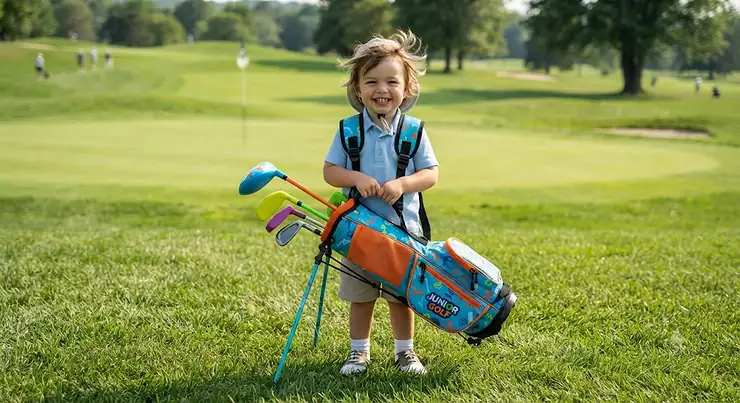
Somewhere between the driveway putting green and the first real trip to the course, every golfing parent hits the same wall: their toddler needs somewhere to put their clubs, and almost everything on the shelf is built for a nine-year-old. A junior golf bag for toddlers isn’t just a smaller version of dad’s Sunday bag — it’s a completely different piece of gear, built around a completely different set of physics. A 3-year-old’s shoulders, balance, and patience have nothing in common with a 10-year-old’s, and the bag has to respect that or it ends up abandoned in the garage by June.
Here’s the thing nobody tells you before you start browsing: most of the “junior” bags sold online are actually built for ages 6 and up, and they’ll swallow a 3-year-old whole — literally dragging on the ground and throwing them off balance. What you actually want is a purpose-built toddler category: bags under 24 inches (61 cm), weighing well under 1.5 kg (about 3.3 lb) empty, usually with a 2-3 club capacity and small, sturdy mini stand legs that keep grips out of the wet grass. According to Health Canada’s Toys Regulations, anything marketed to children under three also has to clear specific small-parts and choking-hazard rules, which quietly rules out a chunk of the toy-aisle options.
Below, we’ve dug into seven real, currently available bags spanning true toy-level starter sets up to premium stand bags a 5-year-old can grow into, comparing what the spec sheets say against what parents and reviewers actually report once the bag has spent a season getting dragged around a backyard or a par-3 course. No invented reviews, no fluffy “it’s amazing” filler — just what the materials, dimensions, and aggregated feedback tell us about who each bag actually suits.
What Is a Junior Golf Bag for Toddlers?
A junior golf bag for toddlers is a scaled-down golf bag, typically 40-61 cm (16-24 in) tall and under 1.5 kg (3.3 lb) empty, designed to hold 2 to 5 short junior clubs for children roughly ages 2 to 5. Most include mini stand legs, padded straps sized for small shoulders, and simplified tops that don’t require adult-level dexterity.
That definition matters because the category sits in an odd overlap zone. Some products in this space are genuine golf equipment scaled down — real fabric, real zippers, a real (if tiny) stand mechanism. Others are closer to a golf-themed toy: plastic clubs, foam balls, and a soft carry bag meant for the living room carpet as much as the back nine. Both can be exactly right depending on the child, which is why this guide treats “smallest junior golf bag” and “mini golf bag for kids” as two related but distinct questions rather than assuming one category fits every 2- to 5-year-old.
Quick Comparison Table
| Bag | Best For | Height | Empty Weight | Club Capacity |
|---|---|---|---|---|
| Drake & Birdie Toddler Golf Bag with Stand | Lightest true stand bag | 24 in (61 cm) | 2.1 lb (0.95 kg) | Up to 5 |
| KVV Junior Golf Stand Bag | Budget stand bag | ~24 in (61 cm) | 3 lb (1.4 kg) | 3-4 |
| VESSEL Junior Stand | Premium, grows with child | Fits golfers under 5 ft | 4.15 lb body / 0.60 lb strap | 3-way top |
| Orlimar ATS Junior Golf Stand Bag (Ages 3-5) | Proven mid-range value | 23 in (58 cm) | ~2.8 lb (1.3 kg) | 3-4 |
| Rana Golf Toddler Golf Bag (Ages 3-6) | Lightweight single strap | Fits 22-27 in clubs | Under 3 lb (1.4 kg) | 3-4 |
| U.S. Kids Golf Ultralight UL-39 Carry Bag | Best true club carrier | For 39-42 in (99-107 cm) tall child | Under 2 lb (0.9 kg) | 3 |
| 2-3 Club Mini Golf Bag Set for Toddlers | Smallest starter option | ~16-18 in (41-46 cm) | Under 1.5 lb (0.7 kg) | 2-3 |
Looking at the spread above, the gap between the Drake & Birdie Toddler Golf Bag with Stand and the 2-3 Club Mini Golf Bag Set for Toddlers basically defines the whole category: one is real golf gear sized down, the other is a soft entry point for kids who haven’t held a club yet. The VESSEL Junior Stand sits apart as the only option here built to outlast a toddler phase entirely, which explains its higher price bracket. If your child is under 3 and mostly practising in the yard, the lighter, smaller options on this list will get more actual use than anything marketed as a full “junior” bag.
💬 Just one click — help other golf parents make better buying decisions too!😊
Top 7 Junior Golf Bags for Toddlers: Expert Analysis
1. Drake & Birdie Toddler Golf Bag with Stand — lightest true stand bag for ages 2 to 5
At 2.1 lb (0.95 kg) empty, the Drake & Birdie Toddler Golf Bag with Stand is, as far as we could verify, the lightest genuine stand bag built specifically for the toddler range. That number isn’t a marketing flourish — a child should never carry more than about 10-15% of their body weight, and shaving even a pound off the empty bag makes a real difference once two or three clubs are loaded in. The 24-inch (61 cm) frame includes an automatic mini stand-leg deployment system, meaning the legs pop out the instant the bag touches the ground, keeping grips off wet grass without the child having to fumble with a manual kickstand.
Based on the spec comparison with cheaper canvas bags, the auto-deploy stand is the standout feature here: most bargain bags simply lay flat, which soaks the grips and frustrates kids who then need help every single time they set the bag down. The 5-way divided top holds up to five clubs, though the brand itself notes most 2- to 5-year-olds carry just 1 to 3 clubs at this stage, so there’s genuine room to grow into it. Reviewers and early adopters describe it as the rare toddler bag that survives daily backyard use without the straps stretching out or the fabric fraying at the seams.
Pros:
- ✅ Lightest verified stand bag in the toddler category
- ✅ Auto-deploy mini stand legs need no manual setup
- ✅ Padded dual straps distribute weight across both shoulders
Cons:
- ❌ Newer brand with a smaller review history than legacy names
- ❌ Some colourways and accessories are pre-order only
Priced in the C$80-C$95 range at the time of research, the Drake & Birdie Toddler Golf Bag with Stand earns its premium over basic canvas bags through the auto-stand mechanism alone — it’s the kind of feature that quietly saves a parent from re-explaining “just set it down gently” fifty times a round.
2. KVV Junior Golf Stand Bag — best budget 4-way stand bag
The KVV Junior Golf Stand Bag targets the 4-to-6 age bracket and weighs around 3 lb (1.4 kg) empty, making it one of the more affordable entries with an actual stand mechanism rather than a flat carry design. The 4-way top divider does double duty: it separates clubs to prevent tangled grips, and the divider itself doubles as a built-in lift handle, which matters more than it sounds like it should when a parent needs to grab the bag off a cart in a hurry.
What most buyers overlook about budget stand bags is that the stand mechanism is usually the first thing to fail — cheap hinges bend or the legs stop locking after a season. Reviewers of the KVV bag report the stand holding up reasonably well through casual, non-daily use, though it’s built for backyard and driving-range duty rather than 18 holes of walking. At four exterior pockets, it has more storage than most bags this size, which is genuinely useful for a spare glove, sunscreen, or a juice box.
Pros:
- ✅ Genuine 4-way stand mechanism at a budget price point
- ✅ Four exterior pockets for extra gear
- ✅ Divider doubles as a carry handle
Cons:
- ❌ At 3 lb, heavier than the lightest options on this list
- ❌ Stand hinges aren’t rated for heavy daily use
At roughly C$55-C$70, the KVV Junior Golf Stand Bag is a sensible entry point if your budget is tight and you still want a real stand rather than a bag that flops over in the grass.
3. VESSEL Junior Stand — premium build that grows with your golfer
VESSEL built its reputation on adult tour bags, and the VESSEL Junior Stand is essentially that same manufacturing standard scaled down — same materials, same patented double-strap system, sized for golfers under 5 feet (152 cm) tall. The self-adjusting Equilibrium strap is the standout feature: rather than a single fixed strap length, it self-adjusts across the shoulder, which means it fits a growing 4-year-old today and still fits comfortably a year or two later without a full resize.
Here’s what the spec sheet won’t tell you outright: an insulated beverage pocket and an interior valuables compartment sound like small extras, but for a family that’s out at the course for hours, they’re genuinely used features rather than gimmicks. Based on the materials and construction quality relative to other bags in this guide, the VESSEL Junior Stand is built to survive being the “hand-me-down” bag between siblings — a real cost consideration once you look past the sticker price.
Pros:
- ✅ Same premium materials as VESSEL’s adult tour bags
- ✅ Self-adjusting strap grows with the child
- ✅ Insulated pocket and secure valuables compartment
Cons:
- ❌ Highest price point of any bag in this roundup
- ❌ Sized for golfers under 5 ft, so it’s outgrown eventually
In the C$210-C$260 range, the VESSEL Junior Stand is the “buy once” option for a family committed to golf as a long-term family activity rather than a single summer experiment.
4. Orlimar ATS Junior Golf Stand Bag (Ages 3-5) — proven mid-range value pick
Orlimar has been building junior gear for decades, and the ATS Junior Golf Stand Bag for ages 3-5 sits at a comfortable 23 inches (58 cm), squarely in toddler territory rather than the taller “junior” bags meant for school-age kids. It’s a straightforward stand bag: a lightweight frame, a basic divided top, and enough structure to stay upright between shots.
Based on the spec comparison against newer entrants like Drake & Birdie, the Orlimar ATS Junior Golf Stand Bag (Ages 3-5) trades a bit of weight savings for a longer track record and wider aftermarket availability — parts, accessories, and secondhand units show up more often given how long the line has been on the market. Aggregated reviewer sentiment across retail listings consistently mentions it as a dependable “first real bag” rather than a flashy one, which, frankly, is exactly what most 3-year-olds need.
Pros:
- ✅ Long-established brand with proven junior-gear history
- ✅ Correctly sized at 23 in for the 3-5 age range
- ✅ Wide retail and secondhand availability
Cons:
- ❌ Fewer premium extras than boutique competitors
- ❌ Stand legs are basic rather than auto-deploy
At around C$85-C$110, the Orlimar ATS Junior Golf Stand Bag (Ages 3-5) is the safe, well-tested middle ground for parents who’d rather not gamble on a newer brand.
5. Rana Golf Toddler Golf Bag (Ages 3-6) — best single-strap lightweight design
Rana Golf takes a different approach with a single padded strap rather than the dual-strap systems used elsewhere on this list, paired with standing legs that let a toddler set the bag down and manage it independently. Fitting junior clubs from 22 to 27 inches (56-69 cm) long, it’s built for preschool through early-elementary golfers, and the brand states every bag weighs under 3 lb (1.4 kg).
What stands out here is the deliberate simplicity: a single strap is easier for a small child to sling on and off without help than a two-strap harness, even if it distributes weight slightly less evenly across both shoulders. Based on the stated durability testing and water-resistant materials, this is a bag built to tolerate the kind of rough handling — dropped in the driveway, dragged through wet grass — that toddler gear inevitably gets. Cleanup, according to the brand, is a damp cloth and occasionally mild dish soap, which matters more than most spec sheets admit.
Pros:
- ✅ Single strap is easier for toddlers to put on solo
- ✅ Standing legs support independent use
- ✅ Water-resistant materials wipe clean easily
Cons:
- ❌ Single strap distributes weight less evenly than dual-strap designs
- ❌ Smaller brand footprint than legacy junior golf names
Priced around C$95-C$125, the Rana Golf Toddler Golf Bag (Ages 3-6) is worth a look specifically for kids who struggle with dual-strap harnesses or simply want to do it themselves.

6. U.S. Kids Golf Ultralight UL-39 Carry Bag — best true toddler golf club carrier
U.S. Kids Golf is arguably the most trusted name in junior golf, and the Ultralight UL-39 line is sized for children roughly 99-107 cm (39-42 in) tall — squarely toddler height. Unlike most of this list, the UL-39 is a pure carry bag rather than a stand bag, functioning as a genuine toddler golf club carrier: no stand legs, no bulk, just a lightweight sleeve with a shoulder strap built to hold three clubs.
Here’s what most buyers overlook about the youngest age bracket: a stand mechanism adds weight and moving parts that a 2- or 3-year-old often doesn’t need yet, especially if most practice happens in a backyard or on a putting green rather than a full course. Based on the spec comparison, the UL-39 carry bag strips the design down to just what a genuine beginner uses, and the brand’s decades of junior-specific engineering show up in details like reinforced strap stitching that holds up to being yanked around by small, impatient hands.
Pros:
- ✅ From the most established name in junior golf equipment
- ✅ True toddler golf club carrier with minimal added weight
- ✅ Reinforced stitching built for rough daily handling
Cons:
- ❌ No stand legs, so grips can touch wet ground
- ❌ Best suited to backyard use rather than full 9-hole rounds
At roughly C$55-C$80 as a standalone bag, the U.S. Kids Golf Ultralight UL-39 Carry Bag is the pick for families who want the most trusted brand without paying for a stand mechanism a toddler isn’t ready to use yet.
7. 2-3 Club Mini Golf Bag Set for Toddlers — smallest starter bag with mini stand legs
At the very entry level sits the smallest junior golf bag category: mini golf bag sets built around a 2-3 club capacity, plastic club heads, and a soft-sided carrier with small mini stand legs. Typically around 41-46 cm (16-18 in) tall and under 0.7 kg (1.5 lb), these sets are aimed squarely at ages 2 to 5 and are often sold with plastic clubs, a couple of foam or plastic balls, and sometimes a small practice “hole” for indoor use.
Based on the spec comparison with genuine golf-branded bags, this is really a toy-golf hybrid rather than golf equipment proper — the club heads are plastic, not metal, which matters for safety around furniture and siblings but also means it won’t hold up to actual course play. Reviewers consistently describe it as a good first exposure product: a way to see whether a toddler enjoys the motion of golf before investing in a real stand bag and real junior clubs. Health Canada’s Toys Regulations specifically prohibit small, detachable parts on toys intended for children under three, so it’s worth checking the manufacturer’s stated age range rather than assuming “toddler” automatically means “safe for a 2-year-old.”
Pros:
- ✅ Lowest cost entry point into the category
- ✅ Genuinely the smallest, lightest option on this list
- ✅ Mini stand legs and soft materials suit indoor use
Cons:
- ❌ Plastic components won’t survive real course conditions
- ❌ Not a substitute for real clubs once skills progress
Usually priced under C$40, the 2-3 Club Mini Golf Bag Set for Toddlers is less an investment and more a litmus test — a cheap way to find out if your toddler actually wants to keep playing before buying anything on this list that costs more than a takeout dinner.
✨ Don’t miss these exclusive Amazon.ca deals!
🔍 Take your search for the perfect junior golf bag for toddlers to the next level — click on any bag above to check current pricing and availability before you commit.
Setting Up Your Toddler’s First Golf Bag
Getting a new bag right on day one saves weeks of frustration later. Start by adjusting both straps to their shortest comfortable setting rather than assuming factory length works — most bags ship adjusted for an “average” child, which is rarely your child. Have your toddler put the bag on empty first, walk a few steps, and check that the bottom of the bag doesn’t bang against the back of their knees; if it does, shorten the strap further.
Next, load only the clubs your toddler will actually use in the first month — usually a putter and one short iron — rather than filling every slot in a 2-3 club capacity top. A half-empty bag is lighter and easier to manage, and you can always add clubs as grip strength improves. If the bag has mini stand legs, practice the “set down and stand” motion together a few times before the first real outing; kids often yank the bag rather than setting it down gently, which can bend cheaper stand hinges within the first few uses.
For maintenance, wipe down the base and straps after any wet-grass session — moisture trapped against fabric is the single biggest cause of early mildew smell in kids’ bags. Check the stand legs’ pivot points monthly for grit buildup, since sand and grass clippings work their way into the hinges faster than most parents expect. The most common first-30-days mistake is over-loading the bag with extra “just in case” clubs, which defeats the entire purpose of choosing a toddler-sized carrier in the first place.
Real Families, Real Bags: Matching the Right Setup to Your Toddler
Picture a 2-year-old who’s shown interest in golf mainly by swinging a pool noodle at anything round — for that stage, a 2-3 Club Mini Golf Bag Set for Toddlers with plastic clubs is genuinely the right call. There’s no reason to spend on real stand mechanisms or metal club heads before you know whether the interest sticks, and the low cost means it’s an easy toy to retire without regret if golf turns out to be a two-week phase.
Now picture a 4-year-old who’s been to the driving range with a parent a handful of times and can already make contact with a ball most swings — that’s the sweet spot for something like the Orlimar ATS Junior Golf Stand Bag (Ages 3-5) or the Drake & Birdie Toddler Golf Bag with Stand. Both are light enough to carry independently and structured enough to hold real (if junior-sized) clubs, and the stand legs teach the habit of setting a bag down properly rather than tossing it in the grass.
Finally, consider a golf-enthusiast family with a 3-year-old and a 6-year-old sharing gear, planning to keep at least one child in the sport long-term — that’s where the VESSEL Junior Stand earns its higher price, since its self-adjusting strap and durable construction are designed to be handed down rather than replaced every season. Organizations like Golf Canada, which runs junior programming through initiatives such as CN Future Links, note that early, low-pressure exposure is what keeps kids engaged with the sport over years rather than a single summer.
Your Toddler Golf Bag Decision Framework
Rather than scrolling through every option again, use this simple framework:
- If your toddler is under 3 and has never swung a club, choose a mini golf bag for kids with plastic clubs, because the low cost and soft materials make it a safe, low-stakes way to test interest.
- If your toddler is 3 to 5 and shows consistent interest, choose a genuine stand bag with mini stand legs, because it teaches proper club care habits without adding real weight.
- If you’re outfitting more than one child over several years, choose a premium build like the VESSEL Junior Stand, because the total cost per year of use drops sharply with a bag built to be handed down.
- If most practice happens in the backyard rather than on a course, choose a toddler golf club carrier without a stand, because the reduced weight and simplicity matter more than a feature your child won’t use yet.
- If budget is the primary constraint, choose a mid-range option like the KVV Junior Golf Stand Bag or Orlimar ATS Junior Golf Stand Bag (Ages 3-5), because both deliver a working stand mechanism without the premium price tag.
How to Choose a Junior Golf Bag for Toddlers
Choosing the right bag comes down to a handful of measurable factors rather than brand reputation alone. Here’s how to work through it:
- Measure your child’s height, not just their age. A 3-year-old at the 90th percentile for height may need a slightly taller bag than a same-age peer, and matching height to the manufacturer’s stated range matters more than the age label on the box.
- Weigh the empty bag against the 10-15% rule. A child shouldn’t carry more than roughly 10-15% of their body weight loaded, so a lighter empty bag leaves more room for actual clubs before hitting that ceiling.
- Decide between a carrier and a stand bag. A toddler golf club carrier suits backyard practice; a bag with mini stand legs suits actual course visits where grips need to stay off wet ground.
- Check the club capacity against your plans. A 2-3 club capacity is plenty for a true beginner, while a 4-5 club divided top gives more room to grow without needing a second bag in a year.
- Inspect the strap adjustment range. Straps that adjust across a wide range extend the useful life of the bag by a year or more compared with fixed-length straps.
- Confirm the materials are water-resistant. Wet grass is unavoidable, and non-resistant fabric absorbs moisture that leads to mildew smell and grip damage over a season.
- Verify the age range against Health Canada’s toy safety rules if buying a toy-style set. Products aimed at children under three must meet specific small-parts restrictions, so cross-check the manufacturer’s stated minimum age.
Common Mistakes When Buying a Toddler Golf Bag
The single most common mistake is buying up — choosing a bag labelled for ages 6-8 because “they’ll grow into it.” In practice, an oversized bag drags, throws off a toddler’s balance, and gets abandoned faster than a correctly sized one that’s outgrown in a year. Bigger is not better when the bag is actively working against a small child’s centre of gravity.
A second frequent error is prioritizing brand name over sizing specifics. A well-known brand’s junior line may start at age 6, and buying its smallest option for a 3-year-old often means the same oversized-bag problem under a more recognizable label. Always check the stated height range in centimetres or inches rather than assuming “junior” automatically means toddler-appropriate.
Third, parents often skip the stand-leg durability question entirely, assuming any bag that stands up will keep standing up. Cheap hinge mechanisms are the most common point of failure in this category, and a bag that won’t stand after a month of use quietly becomes a bag that lies in the grass — defeating the entire reason for choosing a stand bag over a basic carrier in the first place.
Junior Golf Bag vs Toy Golf Set: Which Does Your Toddler Actually Need?
| Factor | Junior Stand Bag (e.g., Orlimar ATS Junior Golf Stand Bag) | Toy Golf Set (e.g., 2-3 Club Mini Golf Bag Set for Toddlers) |
|---|---|---|
| Materials | Real fabric, metal-reinforced hardware | Plastic clubs, soft-sided bag |
| Best For | Kids with proven, ongoing interest | First exposure, testing interest |
| Course-ready | Yes | No — backyard/indoor only |
| Typical price | C$55-C$260 depending on tier | Under C$40 |
| Longevity | 1-3 years before resizing | Retired once skills progress |
The analysis here is fairly clear-cut: a toy golf set is the right first purchase for almost every family, because it answers the only question that matters before spending more — does this toddler actually want to keep swinging a club? Once that’s confirmed, moving up to a genuine junior stand bag with mini stand legs and real (if short) clubs is the natural next step, and skipping straight to a premium stand bag for an untested 2-year-old is, frankly, a bet most families don’t need to make.
What to Expect: Real-World Performance on the Course
Spec sheets describe weight, height, and pocket count, but they don’t describe what actually happens on the ninth hole when a toddler is tired, hungry, and no longer interested in carrying anything. Realistically, expect a mix: strong independent carrying for the first few holes, followed by a request for help or a full handoff to a parent by the back nine. This is normal and not a sign the bag is wrong — it’s a sign the child is, in fact, a toddler.
Reviewers of lighter bags like the Drake & Birdie Toddler Golf Bag with Stand and the U.S. Kids Golf Ultralight UL-39 Carry Bag consistently note longer stretches of independent carrying before fatigue sets in, which tracks with the empty-weight numbers in the comparison table above. Heavier bags in this list still function well but tend to shift to “parent carries it” mode sooner in a session, particularly in warmer weather or on hilly courses.
Stand legs also perform differently in the real world than on a showroom floor. Auto-deploy mechanisms, like the one on the Drake & Birdie Toddler Golf Bag with Stand, tend to hold up better because there’s no manual step for a toddler to skip or fumble. Manual stand legs on budget bags work fine on flat, dry ground but can struggle on soft or uneven turf, occasionally tipping over if not fully extended — worth practising at home before a first real round.
Features That Actually Matter (And Those That Don’t)
Marketing copy for this category loves to list features, but not all of them affect how the bag actually performs for a 3-year-old. Padded dual straps matter — they genuinely reduce shoulder strain compared with a single unpadded strap, especially for longer sessions. Auto-deploy stand legs matter too, since they remove a fine-motor step that toddlers frequently botch. An insulated beverage pocket, while a nice-to-have, matters more for parent convenience than child performance.
On the other hand, a high pocket count is often oversold. A toddler doesn’t need four exterior pockets; two is usually plenty, and extra zippers just add weight and cost without adding functional value at this age. Similarly, colour-coordinated matching sets (bag, headcover, glove) look appealing in product photos but don’t affect usability at all — they’re a style choice, not a performance one, and shouldn’t push a buying decision if the underlying bag specs don’t otherwise fit.
Rain hoods are a genuinely useful, frequently underrated feature — Canadian golf seasons involve a fair amount of unpredictable weather, and a bag left out during a sudden shower without one can end up with soaked grips by the next use.
Safety, Choking Hazards, and Canadian Toy Regulations
Anything marketed to a toddler in Canada — including toy-style golf sets with plastic clubs and balls — falls under Health Canada’s Toys Regulations, which set mandatory requirements for mechanical hazards including choking, strangulation, and sharp edges. As Health Canada explains, toys intended for children under three cannot legally be sold in Canada if they contain small parts that could be swallowed, which is directly relevant to any mini golf bag for kids that ships with small plastic accessories like tees or practice balls.
This matters in practice because not every product marketed with “toddler” in its name has actually been designed or tested for the under-3 bracket specifically — some are aimed at the 3-to-5 range and simply use “toddler” loosely as a marketing term. Health Canada has, in recent recall notices, flagged children’s products sold through major online retailers for exactly this kind of small-parts issue, underscoring why it’s worth checking the manufacturer’s stated minimum age rather than assuming the product listing’s title is precise.
Parachute, Canada’s national injury-prevention charity, recommends checking that any children’s product is free of sharp edges and points, is in good condition if bought secondhand, and hasn’t been subject to a recall — all reasonable habits to apply before handing a toddler any golf-adjacent gear, real or toy. For real stand bags with metal-reinforced hardware, the relevant safety consideration shifts slightly: check for pinch points around stand-leg hinges, since small fingers can get caught in the mechanism during deployment.
Long-Term Cost and Value: Is a Toddler Golf Bag Worth It?
| Bag Tier | Price Range (CAD) | Expected Useful Life | Cost Per Year of Use |
|---|---|---|---|
| Toy set (e.g., 2-3 Club Mini Golf Bag Set for Toddlers) | Under C$40 | 6-18 months | Under C$30 |
| Budget stand bag (e.g., KVV Junior Golf Stand Bag) | C$55-C$70 | 1-2 years | ~C$35-C$45 |
| Mid-range (e.g., Orlimar ATS Junior Golf Stand Bag) | C$85-C$110 | 1-2 years | ~C$50-C$60 |
| Premium (e.g., VESSEL Junior Stand) | C$210-C$260 | 2-4 years, often handed down | ~C$65-C$85 |
Looking at cost per year of actual use rather than sticker price alone changes the value picture considerably. The VESSEL Junior Stand looks expensive upfront, but if it’s handed down between two or three children over several years, its annualized cost lands closer to the mid-range options — while genuinely outlasting them. Conversely, a toy set costing under C$40 delivers excellent value if it does its one job: confirming interest before a bigger purchase.
The real long-term cost consideration isn’t the bag at all — it’s the club replacement cycle. Junior clubs typically need upgrading every 12-18 months as a toddler grows, so pairing an expensive bag with a fast growth spurt can mean the bag itself becomes the smaller expense over a three-year window. Budget-conscious families are often better served buying a modest bag and reserving more of the budget for correctly sized clubs, which affect swing development directly in a way the bag itself doesn’t.
Frequently Asked Questions
❓ What size golf bag does a toddler need?
❓ How many clubs should a toddler's golf bag hold?
❓ Are toy golf sets safe for a 2-year-old?
❓ Do toddler golf bags need a stand?
❓ How much should I spend on a junior golf bag for toddlers?
Conclusion
Choosing a junior golf bag for toddlers really comes down to matching the bag to where your child actually is, not where you hope they’ll be in two years. A toddler who’s never swung a club doesn’t need the VESSEL Junior Stand‘s premium hardware any more than a genuinely committed 5-year-old needs to keep dragging around an oversized bag built for someone twice their age. Start with an honest read of your child’s interest and height, use the comparison tables above to narrow by weight and stand-leg quality, and don’t be afraid to start cheap with a toy-level mini golf bag for kids before committing to real gear.
Every bag on this list has a legitimate use case, from the smallest junior golf bag options built around a 2-3 club capacity all the way up to premium builds designed to be handed down between siblings. What matters most — more than any single spec — is that the bag actually gets picked up and used, week after week, without becoming another piece of sporting equipment gathering dust in the garage.
Recommended for You
- 7 Best Lightweight Junior Golf Bags for Kids in 2026
- 7 Best Women’s Golf Bags for Beginners in 2026 (Honest Picks)
- 7 Best Junior Golf Stand Bags in Canada (2026): Complete Guide
Disclaimer: This article contains affiliate links. As an Amazon Associate, I earn from qualifying purchases. If you purchase products through these links, we may earn a small commission at no additional cost to you.
✨ Found this helpful? Share it with your friends! 💬🤗
