
In This Article
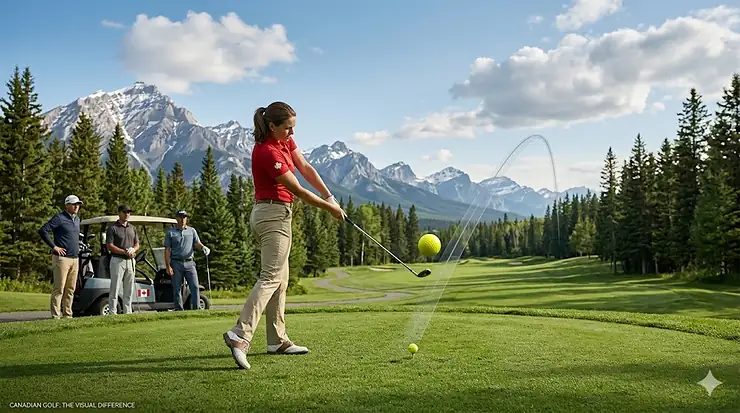
You’ve probably heard it at the clubhouse, on the first tee, maybe even from that one guy in your foursome who insists on playing a neon yellow ball every single round: “Yellow balls fly differently.” But do yellow golf balls fly differently — or is this just another piece of golf folklore passed around alongside swing tips nobody asked for?

Here’s the short answer: no, yellow golf balls do not fly differently than white ones. From a physics standpoint, colour has zero effect on aerodynamics, compression, or spin. A yellow Titleist Pro V1 is, at its core — literally — identical to the white one sitting next to it in the box. The pigment that gives a ball its bright hue does not change the dimple geometry, the rubber core, or the urethane cover. What it does change, however, is how you interact with the ball — and in a game where confidence and focus are half the battle, that’s not a trivial difference.
This guide digs into the real science behind do yellow golf balls fly differently, breaks down what optical yellow technology actually offers, and helps you decide whether a yellow ball deserves a spot in your bag. I’ll also walk you through seven of the best yellow golf balls currently available on Amazon.ca, with expert analysis tuned to Canadian playing conditions — because a golfer in Kelowna on a smoky August afternoon has very different visibility needs than one teeing off at a grey Halifax morning in September.
All prices referenced are in CAD. Let’s get into it.
Quick Comparison: Top 7 Yellow Golf Balls Available on Amazon.ca
| Product | Type | Best For | Price Range (CAD) | Compression |
|---|---|---|---|---|
| Titleist Pro V1 Yellow | Premium (4-piece) | Low handicappers, control | $70–$80/dozen | Mid (87) |
| Callaway Chrome Soft Yellow | Premium (4-piece) | Mid-handicappers, soft feel | $65–$75/dozen | Low (75) |
| Srixon Q-Star Tour Yellow | Mid-range (3-piece) | Mid-handicappers, value | $45–$55/dozen | Mid (72) |
| TaylorMade Tour Response Yellow | Mid-range (3-piece) | Distance + feel balance | $45–$55/dozen | Mid (70) |
| Callaway Supersoft Matte Yellow | Budget (2-piece) | Beginners, slow swings | $30–$40/dozen | Low (38) |
| Wilson Duo Optix Yellow | Budget (2-piece) | High-handicappers, forgiveness | $28–$38/dozen | Low (35) |
| Titleist TruFeel Yellow | Budget (2-piece) | Feel-seekers on a budget | $30–$40/dozen | Low (60) |
Looking at the table above, the premium tier (Titleist Pro V1, Callaway Chrome Soft) delivers tour-level performance and is worth every dollar if you’re a sub-15 handicapper who can actually feel the difference in short-game spin. The mid-range options from Srixon and TaylorMade offer roughly 80% of that performance at about 60% of the price — a compelling proposition for the weekend golfer. Budget picks like the Supersoft Matte and Wilson Duo Optix are ideal for beginners who lose a sleeve a round; you shouldn’t be playing $75 CAD balls until you can keep them in the fairway consistently.
💬 Just one click — help others make better buying decisions too! 😊
✨ Don’t Miss These Exclusive Deals!
🔍 Take your golf game to the next level with these carefully selected yellow balls. Click on any highlighted item to check current pricing and availability on Amazon.ca. These picks will help you play with more confidence and find your ball faster on every hole!
Top 7 Yellow Golf Balls for Canadian Golfers: Expert Analysis
1. Titleist Pro V1 Yellow
The Pro V1 is the gold standard of golf balls, and the yellow version is every bit its equal — just more visible against those trademark overcast Maritime skies. Built with a four-piece construction, a cast urethane elastomer cover, and Titleist’s proprietary 388 tetrahedral dimple design, this ball is engineered to within microns of perfection.
What those specs mean in practice: the 87 compression rating delivers a piercing, mid-trajectory flight that resists the wind better than a high-launching two-piece ball — useful in coastal British Columbia or the gusty Alberta prairie. The urethane cover grips wedge grooves with genuine authority, giving you the kind of spin control that helps you stop the ball on firm summer greens. The yellow pigment here is not an afterthought; Titleist uses the same optical-grade dye process as their high-visibility range, meaning it won’t fade or chalk out by the third round.
Canadian golfers should note that the Pro V1 Yellow is Prime-eligible on Amazon.ca, meaning it qualifies for free shipping without hitting the standard $35 CAD threshold. In my experience, this is the ball for the serious player who has simply grown tired of squinting at white dots against a grey Nova Scotia sky.
- ✅ Tour-level spin and distance
- ✅ Excellent fade resistance in wind
- ✅ Bright optical yellow holds colour through 18 holes
- ❌ Premium price point — around $70–$80 CAD per dozen
- ❌ Not ideal for swing speeds under 85 mph
Price range: $70–$80 CAD/dozen. Check current price on Amazon.ca.
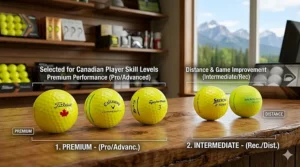
2. Callaway Chrome Soft Yellow
If the Pro V1 is a precision instrument, the Chrome Soft Yellow is a forgiving partner. Callaway’s four-piece graphene-infused core is the real story here — the ultra-soft 75 compression means players with moderate swing speeds (75–95 mph) generate more ball speed from the same effort, which translates to measurable distance gains.
The Chrome Soft’s party trick is its Hyper Elastic SoftFast Core, which creates a counterintuitive combination: low driver spin for distance, higher iron spin for approach control. That’s not just marketing language. In real terms, it means you lose fewer shots to ballooning drives in Canadian wind while still being able to flight a 7-iron into a tight pin. The yellow variant uses Callaway’s “Triple Track” technology on select models, adding alignment lines that make putting setup noticeably more intuitive.
Canadian golfers who play early morning rounds in the shoulder season — April in Alberta, say, when the air is still cold and the dew point is high — will appreciate that the soft compression doesn’t get boardy in cool temperatures the way some firmer balls do. Spring thaw rounds can be brutal on ball feel; the Chrome Soft Yellow largely avoids that issue.
- ✅ Outstanding feel at all temps including cool spring/fall rounds
- ✅ Triple Track alignment aid on select models
- ✅ Best-in-class visibility against overcast Canadian skies
- ❌ Urethane cover shows scuff marks faster on mishits
- ❌ Not the longest ball off the tee for high swing speeds
Price range: $65–$75 CAD/dozen. Check current price on Amazon.ca.
3. Srixon Q-Star Tour Yellow
The Q-Star Tour is the “smart buy” in this roundup — a three-piece ball with genuine tour-level technology that sits at roughly half the price of the Pro V1. Srixon’s 72 compression sits right in the sweet spot for mid-handicappers, and the ball’s 338 dimple pattern is borrowed almost directly from the $80+ Z-Star Diamond lineup.
Here’s what most Canadian buyers overlook about this model: Srixon’s Spin Skin+ coating on the cover is applied to the ionomer cover (not urethane like the premium tier), but the spin numbers on short irons and wedges are surprisingly close to the Chrome Soft in robot testing. That means real-world greenside control that competes a full price tier above it. The yellow colouration on the Q-Star Tour is sharp and high-contrast — I’d put it on par visually with anything in the premium tier.
For the Canadian golfer playing 25–40 rounds per year who loses three or four balls a season, the Q-Star Tour offers the best value equation available on Amazon.ca. You’re getting 80% of Pro V1 performance at 55% of the cost, in a visibility-optimized colour that genuinely helps on grey overcast days.
- ✅ Exceptional value vs. performance ratio in CAD
- ✅ Genuine spin on short game, not just marketing
- ✅ Vibrant yellow tracks well in all lighting conditions
- ❌ Slightly firmer feel than Chrome Soft in cold weather
- ❌ Distance off the tee trails premium options by ~5 yards
Price range: $45–$55 CAD/dozen. Check current price on Amazon.ca.
4. TaylorMade Tour Response Yellow
TaylorMade quietly makes one of the best mid-range golf balls on the market, and the Tour Response Yellow rarely gets the attention it deserves. Built with a three-piece construction, 70 compression, and a 100% cast urethane cover — unusual at this price point — the Tour Response punches well above its tier on the greens.
In real-world performance, that urethane cover means soft, check-stopping chips and pitches that you’d normally only get from a $70+ CAD ball. TaylorMade achieves this by using a slightly thinner cover than the premium TP5, which keeps manufacturing costs down while preserving the tactile and spin benefits. The 322-dimple pattern delivers a mid-high trajectory that works particularly well for Canadian course conditions — not too low to stall in cold spring air, not so high that it balloons in a maritime headwind.
The yellow here is a classic optic yellow rather than a neon variant — bright enough to track easily, subtle enough that it doesn’t look like a construction zone warning cone on the tee. A good compromise for the golfer who wants visibility without quite the fluorescent boldness.
- ✅ 100% urethane cover at mid-range price — rare and valuable
- ✅ Excellent feel on chips and pitch shots
- ✅ Mid-high trajectory suits wide range of Canadian course conditions
- ❌ Not available in matte finish
- ❌ Slightly lower driver distance vs. Chrome Soft for slower swings
Price range: $45–$55 CAD/dozen. Check current price on Amazon.ca.
5. Callaway Supersoft Matte Yellow
The Supersoft Matte Yellow is where accessibility meets visibility in one genuinely clever package. The matte finish is the key differentiator here: instead of the glossy coat on standard balls, the textured surface scatters light rather than reflecting it, which dramatically reduces glare on bright summer afternoons. The result is a ball that’s not just highly visible — it’s comfortably visible, without the occasional flash that can cause you to lose the ball for a split second at impact.
At 38 compression, this is one of the softest golf balls in existence. That’s ideal for golfers with swing speeds below 85 mph, which includes a large portion of recreational Canadian players, and specifically seniors who may have lost some clubhead speed over the years. Lower compression means more energy transfer for slower swings — in practical terms, more distance without changing anything about the swing. It won’t deliver tour-level spin, but for a beginner or high-handicapper at a weekend muni, that’s not the priority.
Amazon.ca typically carries the Supersoft Matte in both 12-ball and 15-ball packs. The 15-ball pack represents solid value and is often Prime-eligible.
- ✅ Ultra-soft feel — best on this list for slow swing speeds
- ✅ Matte finish reduces glare, excellent in full sun
- ✅ Very affordable in CAD; budget-friendly entry point
- ❌ Very low spin limits short-game control
- ❌ Not suitable for swing speeds above 95 mph
Price range: $30–$40 CAD/dozen. Check current price on Amazon.ca.
6. Wilson Duo Optix Yellow
Wilson doesn’t get the marketing budget of Callaway or Titleist, but the Duo Optix Yellow quietly earns its place as one of the most forgiving low-handicap-accessible balls available at this price. The 35-compression core (one of the lowest you’ll find on the market) creates an almost cloud-like feel at impact — dramatically reducing the sting on mishits that beginners encounter constantly.
The Duo Optix uses a two-piece construction with Wilson’s proprietary Reactive Speed Core, which the company claims generates higher initial ball velocity despite the soft compression. I’d temper expectations on the distance claims, but the carry numbers are genuinely competitive for its price bracket. The “Optix” in the name refers to the colouration technology — Wilson uses a photo-reactive dyeing process that keeps the yellow vibrant through multiple rounds rather than chalking out after 9 holes, as cheaper coloured balls sometimes do.
For new Canadian golfers taking their first lessons and not yet sure which direction the game will go, the Duo Optix Yellow at $28–$38 CAD per dozen is the lowest-risk entry into yellow golf balls.
- ✅ One of the lowest compressions on the market — very forgiving
- ✅ Photoreactive dye stays vibrant longer than budget alternatives
- ✅ Excellent price point for beginners in CAD
- ❌ Limited spin at the green — chips and pitches won’t stop quickly
- ❌ Not for any handicapper below 15; you’ll outgrow it quickly
Price range: $28–$38 CAD/dozen. Check current price on Amazon.ca.
7. Titleist TruFeel Yellow
The TruFeel is Titleist’s “everyday performance” ball — a two-piece construction with a larger TruFlex core and an ionomer cover that provides a softer feel than most balls in its tier. The 60 compression sits in a middle ground between the ultra-soft Supersoft and the firmer Pro V1, making it arguably the best all-rounder on a budget.
What impresses me about the TruFeel Yellow is that Titleist has not cut corners on the dimple design. The 376-dimple pattern is a simplified version of their ACT (Aerodynamic Construction Technology) system, providing a penetrating flight that holds its line in moderate wind — not tour-level performance, but noticeably better than the shapeless floaters you get from some budget alternatives. The yellow version is especially well-suited to Canadian autumn rounds: against the gold and orange leaf canopy of a September Ontario course, an optic yellow ball stands out in a way that white simply does not.
Canadian Prime members will typically find the TruFeel Yellow available with free shipping on Amazon.ca, often in value packs.
- ✅ Best budget ball with genuine Titleist aerodynamics
- ✅ Penetrating flight that handles moderate Canadian wind
- ✅ Excellent autumn visibility against fall foliage
- ❌ Ionomer cover cannot match urethane spin performance
- ❌ Yellow may appear slightly more muted than Chrome Soft or Q-Star equivalent
Price range: $30–$40 CAD/dozen. Check current price on Amazon.ca.
The Real Science: Why Do Yellow Golf Balls Feel Like They Fly Differently?
Here’s where things get interesting — and where most golf content misses the point entirely.
Technically, aerodynamically, physically: yellow golf balls do not fly differently. Colour pigment is a surface-level application that doesn’t affect the ball’s dimple geometry, core construction, or cover hardness. According to research published on ScienceDirect, drag coefficients among commercially available golf balls vary significantly due to dimple geometry — not colour. That’s the definitive scientific answer.
But here’s what the physics textbook doesn’t account for: perception shapes performance.
Studies on visual tracking show that players can follow a coloured golf ball in flight up to 50% more effectively than a white one on 200-yard drives, according to research aggregated by golf visibility experts. The reason is grounded in ophthalmology: the human eye contains more colour-sensitive cone receptors tuned to the yellow-green portion of the visible spectrum than to any other wavelength. Scientific studies confirm yellow-green is the most visible colour to the human eye in daylight, which is precisely why tennis balls and softballs abandoned white decades ago.
What this means on a Canadian golf course: when you can track your ball through a full 200-metre drive instead of losing it at the 150-metre mark against a grey sky, you arrive at your ball with better information. You saw the apex. You saw the draw or fade. You watched it kick forward or plug in the rough. That information shapes your next shot — and that is a genuine, measurable performance advantage.
The “yellow balls fly differently” myth, then, is actually a garbled version of a real truth: yellow balls let you experience the flight differently, and that experiential difference has downstream effects on shot planning and scoring.
How to Choose Yellow Golf Balls in Canada: A Practical Framework
Choosing the right yellow ball isn’t complicated if you ask the right questions first. Here’s a five-step decision framework tuned to the Canadian golfer’s reality.
1. Match compression to your swing speed. If you swing a driver under 85 mph, you want compression under 60 (Supersoft, Duo Optix). Between 85–100 mph, the mid-compression range (60–80) is your zone (TruFeel, Q-Star Tour, Tour Response). Above 100 mph, you’ll benefit from higher compression (Pro V1, Chrome Soft).
2. Decide what you value: distance or short-game control. Two-piece balls favour distance and forgiveness. Three- and four-piece balls give back short-game spin. If you’re scrambling for par from 30 metres regularly, spend the extra $20–$30 CAD per dozen for a urethane cover.
3. Consider your typical playing conditions. Canadian golfers have a uniquely wide range of conditions — from humid Ontario summers to dry Alberta prairie wind to the persistent marine layer on the West Coast. In overcast conditions (very common across most of Canada), high-optic yellow with a glossy finish is your best friend. In full prairie sun with minimal cloud, a matte yellow like the Supersoft Matte reduces glare and actually improves tracking.
4. Think seasonally. During autumn rounds in Ontario or Quebec, optic yellow stands out against fallen leaves far better than white. In late-season rounds at northern courses where grass is browning, yellow also outperforms. For spring rounds when the rough is lush green and fairways are vibrant, yellow provides maximum contrast.
5. Factor in budget honestly. Canadian pricing on golf balls runs roughly 10–15% higher than US equivalents due to exchange rate and import factors. A premium yellow ball at $75 CAD per dozen is the same in performance as its US counterpart — you’re not getting a worse product, just paying the Canadian market rate. If budget is a real constraint, the Q-Star Tour Yellow at $45–$55 CAD delivers the most performance per dollar on this list.
 Yellow vs. White Golf Balls: Real-World Performance in Canadian Conditions
Let’s settle this with a practical scenario breakdown. Imagine three different Canadian playing scenarios and how colour affects the experience.
Scenario 1: Early September round at a Muskoka resort, 8 AM tee time. The sky is a flat grey. The fairways are still damp from overnight fog. You hit a driver down a tree-lined corridor. A white ball enters that grey wall and disappears from your sight after 150 metres. A yellow ball stays locked in your peripheral vision through the full flight arc. You arrive at your ball having watched it release forward — saving a minute of searching and giving you better information on your lie. Yellow wins unambiguously here.
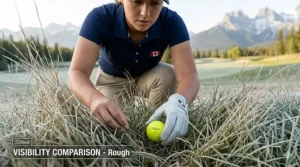
Scenario 2: Midsummer round at a sunny Okanagan course, 1 PM. The sky is a deep blue, the fairways are dried golden-brown. Both white and yellow track reasonably well through the blue sky. On the ground, however, a yellow ball against dry BC summer rough is notably easier to spot. White blends with the sun-bleached grass. Advantage yellow — but modest.
Scenario 3: October round at a Quebec City municipal course, 3 PM. Leaves are down, the rough is a mix of orange, brown, and gold. A white ball lands in the rough and disappears instantly — it matches the leaf litter perfectly. A yellow ball stands out against that background with significant contrast. Yellow wins again.
The consistent finding: in typical Canadian conditions — low light, overcast skies, autumn foliage, spring rough — yellow offers a genuine practical advantage that white cannot match.
✨ Explore the Best Yellow Balls Right Now!
🔍 Whether you’re a weekend warrior or a serious competitor, the right yellow golf ball makes every round more enjoyable. Click any highlighted product to check the latest pricing and availability on Amazon.ca!
Common Mistakes Canadian Golfers Make When Buying Yellow Golf Balls
Mistake 1: Assuming all yellow balls are created equal
The colour is the least important variable in a golf ball purchase. A yellow two-piece Supersoft and a yellow four-piece Pro V1 are fundamentally different products that happen to share a pigment. Buying a yellow ball without knowing its compression, cover material, and construction is like buying a car based on paint colour.
Mistake 2: Over-spending on premium balls before the game is ready
A $75 CAD per dozen Pro V1 Yellow in the hands of a 28-handicapper is wasted money. At that skill level, the short-game spin differences between urethane and ionomer covers are largely imperceptible — and you’ll lose the ball before you play more than three holes with it. The sweet spot for most recreational Canadian golfers is the mid-range tier ($45–$55 CAD per dozen).
Mistake 3: Ignoring cold-weather compression shifts
Here’s something the product descriptions won’t tell you: compression ratings are measured at room temperature. In cool Canadian spring or fall conditions — say, 10–12°C (50°F) — a ball’s effective compression increases noticeably. A 70-compression ball can feel like an 85-compression ball on a brisk October morning in Saskatchewan. If you play year-round, lean toward lower nominal compression than you think you need, so it doesn’t harden up when the temperature drops.
Mistake 4: Buying without verifying Amazon.ca availability
Some yellow ball variants listed on Amazon.com don’t ship to Canada, or carry significant import fees. Always confirm the listing shows “Fulfilled by Amazon.ca” or “Ships to Canada” before adding to cart. Several limited-edition yellow variants from Vice Golf and Volvik, for example, are occasionally unavailable on the Canadian platform.
Mistake 5: Overlooking matte vs. glossy finish
Matte yellow and glossy yellow have meaningfully different visibility profiles. Matte reduces glare in direct sunlight — a real asset on bright Alberta or BC summer days. Glossy reflects more light and tracks better in overcast conditions — the majority of Canadian playing days. Know which condition you play most in before choosing a finish.
Yellow Golf Ball Technology: What “Optical Yellow” Actually Means
The phrase “optical yellow” gets thrown around in marketing copy without much explanation. Here’s what it actually refers to.
Standard yellow paint reflects yellow wavelengths of light (roughly 570–590 nm on the visible spectrum). Optical yellow, sometimes called “high-optic yellow,” goes a step further by using fluorescent pigments that absorb ultraviolet light and re-emit it as visible yellow light. The result is a ball that appears to glow slightly — not literally, but perceptually — because it’s emitting more photons of yellow light than a standard yellow object would under the same illumination.
The human eye is particularly sensitive to the yellow portion of the visible light spectrum, and optical yellow exploits that sensitivity by amplifying the signal the eye receives. On an overcast Canadian day when total photon count is low, this matters. The optical yellow ball is providing a stronger signal to your visual system than a standard yellow, which in turn means better tracking at distance and faster ground location.
The practical upshot: when you see the term “optical yellow” or “optic yellow” on a golf ball, it indicates this fluorescent amplification process. It’s not a gimmick — it’s backed by the same visual science that drives high-visibility safety vests, emergency vehicle markings, and sports equipment across every discipline.
Brands that use genuine optical-grade pigments in their yellow balls include Titleist, Callaway, and Srixon in their premium and mid-range lines. Some budget manufacturers use basic yellow dye without the fluorescent component — the ball looks yellow in a shop but doesn’t carry the same in-flight visibility benefit.
Performance Myths Debunked: What Yellow Balls Don’t Do
Since we’re here to give you straight information, let’s clear up the most persistent myths.
Myth: Yellow balls fly farther because players try harder when they can see the ball. This is occasionally cited as a real performance advantage. There’s no scientific basis for the claim that colour-induced psychological effects change swing mechanics reliably enough to translate to measurable distance gains. Any placebo-style distance increase is in the range of measurement noise.
Myth: Yellow balls are less aerodynamic because the pigment changes the surface. The pigment layer on a golf ball is applied below the clear coat, not on top of it. The surface you’re interacting with aerodynamically is the clear coat — identical between yellow and white versions of the same ball. From a construction standpoint, yellow golf balls are identical to their white versions — the core, mantle layers, cover material, and dimple pattern remain the same. The colour pigment simply does not change aerodynamics.
Myth: Yellow balls are only for beginners or high-handicappers. This one is particularly frustrating. Tour players use yellow golf balls. Titleist manufactures yellow Pro V1s for professional play. Srixon’s Z-Star Diamond — Brooks Koepka’s tour ball — is available in yellow. High visibility is advantageous for every golfer, regardless of handicap. The idea that coloured balls are a “beginner’s crutch” is pure snobbery with no basis in performance data.
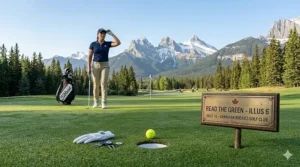
Myth: Yellow balls are harder to read on the putting green. Some golfers claim they find yellow balls visually confusing during putting alignment. This is genuinely individual — it depends on your specific colour perception and how your brain processes contrast at short distances. If you find yellow visually distracting when reading a putt, use a white ball on the green and switch to yellow off the tee. Some golfers actually carry both.
FAQ
❓ Do yellow golf balls perform the same as white golf balls?
❓ What are the best yellow golf balls for overcast days in Canada?
❓ Are yellow golf balls available on Amazon.ca with free shipping?
❓ Do yellow golf balls perform differently in cold Canadian weather?
❓ Is optical yellow technology worth paying more for in a golf ball?
Conclusion: So, Do Yellow Golf Balls Fly Differently?
The verdict is clear: aerodynamically, no — yellow golf balls do not fly differently than white ones. The science is unambiguous on this point. Colour pigment has no effect on dimple geometry, core construction, or cover hardness, and it’s those three variables that determine how a golf ball moves through the air.
What does change is your ability to see and track the ball — and in a game built on information, that matters more than most golfers realize. In the overcast, low-light, and leaf-strewn conditions that characterize a large portion of the Canadian golf season, an optical yellow ball is a genuine practical upgrade. You track better, find faster, and make better decisions about your next shot.
For Canadian golfers choosing between options on Amazon.ca, the Titleist Pro V1 Yellow leads the premium tier, the Srixon Q-Star Tour Yellow offers the best value in CAD, and the Callaway Supersoft Matte Yellow handles beginners and slower swing speeds with grace. Whatever your handicap, playing yellow is a no-downside decision: same ball, better visibility, faster rounds, fewer lost balls per season.
If you’ve been on the fence, let this be your nudge. Pick up a sleeve of your usual model in yellow, compare it back-to-back on your next round, and see what your eyes tell you.
✨ Ready to Play Smarter?
🔍 Browse all seven of these yellow golf ball picks on Amazon.ca and find the one that suits your game. Free shipping for Prime members — check current pricing and availability before your next round!
Recommended for You
- Yellow Golf Balls Visibility: Best 7 for Canadians (2026)
- 7 Best Tour Level Balls for Scratch Golfers Canada 2026
- 7 Best Golf Balls for Single Digit Handicap Players Canada 2026
Disclaimer: This article contains affiliate links. As an Amazon Associate, I earn from qualifying purchases. If you purchase products through these links, we may earn a small commission at no additional cost to you.
✨ Found this helpful? Share it with your friends! 💬🤗
