
In This Article
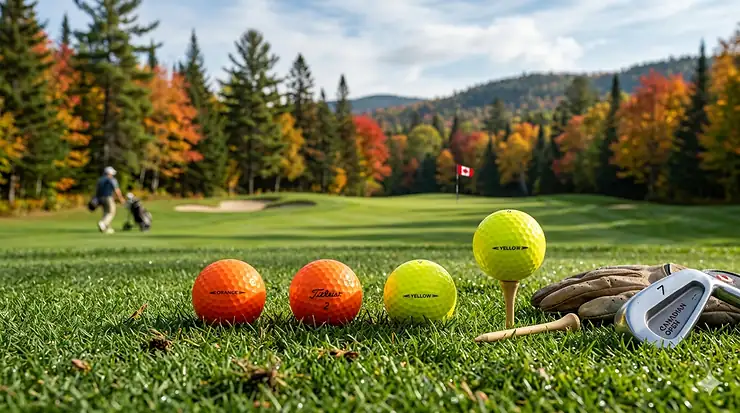
If you’ve ever squinted into a grey October sky somewhere over a soggy Ontario fairway, watching your ball disappear into the cosmos, this article is for you. The orange vs yellow golf balls debate sounds like a trivial colour argument — the kind of thing you settle over a post-round pint — but it’s actually rooted in real optics, seasonal conditions, and the very specific way the Canadian landscape chews up and hides golf balls that aren’t the right colour for the moment.
Here’s the quick answer: yellow golf balls are the single most visible colour to the human eye under normal daylight conditions, peaking right around the eye’s photopic sensitivity of 555 nanometres. But — and this is the “but” that keeps things interesting — orange golf balls are frequently better in autumn, overcast skies, and low-angle light, because they create sharper contrast against the brown, red, and gold backgrounds that define fall in Canada. Neither colour wins universally. The winner depends on when and where you’re playing.
Canada’s golf season is famously compressed. From the spring thaw in April to the final desperate rounds before Thanksgiving weekend, Canadian golfers squeeze every shot out of roughly 20–24 weeks of weather that actually cooperates. That means you’re not just buying a golf ball for sunny July afternoons at Muskoka. You’re buying for flat grey skies at Banff in early June, for the riot of fallen maple leaves in Quebec in mid-September, for dusk scrambles at a Winnipeg muni on the last warm evening of the year. Visibility matters more here than almost anywhere else.
This guide breaks down the orange vs yellow golf balls question with actual science, real-world lighting scenario analysis, and a carefully researched look at the 7 best options available on Amazon.ca right now — ranging from tour-level performers to wallet-friendly dozen packs. All prices are in CAD. Let’s get into it.
Quick Comparison: Orange vs Yellow Golf Balls at a Glance
| Feature | Orange Golf Balls | Yellow Golf Balls |
|---|---|---|
| Best Lighting | Overcast, low-angle sun, dusk | Bright midday sun, blue sky |
| Best Background | Brown/autumn leaves, dry grass | Green fairways, blue sky |
| Human Eye Response | Strong contrast vs green & blue | Peak photopic sensitivity (~555nm) |
| Fall/Autumn Use | ⭐⭐⭐⭐⭐ | ⭐⭐⭐ |
| Low Light (Dusk) | ⭐⭐⭐⭐ | ⭐⭐⭐⭐ |
| Bright Sun | ⭐⭐⭐⭐ | ⭐⭐⭐⭐⭐ |
| Tracking in Flight | Excellent | Excellent |
| Sand Bunker Visibility | Moderate | Good |
| Best For | Fall golf, overcast Canada | Spring/summer, sunny rounds |
The table tells most of the story, but what it can’t convey is how much the difference matters in practice. On a bright Saskatchewan afternoon with a blue sky overhead, yellow balls are almost unfairly easy to track — they seem to glow against the backdrop. But walk onto an Ontario course in early October with fallen leaves carpeting the rough, and that same yellow ball can melt right into the golden brown. Orange, on the other hand, holds its contrast through conditions that yellow can’t quite manage.
What most Canadian golfers overlook is that they don’t actually need to pick one colour for the entire season. Buy both. Use yellow for your summer rounds and switch to orange from Labour Day onward. Your eyes — and your scorecard — will thank you.
💬 Just one click — help others make better buying decisions too! 😊
Top 7 Orange and Yellow Golf Balls: Expert Analysis for Canadian Golfers
1. Volvik Vivid Matte Orange Golf Balls
If there’s one ball that turned the colour-golf-ball conversation from a novelty into a legitimate performance choice, it’s the Volvik Vivid. The Matte Orange version has become something of a cult favourite in Canada, and the reason isn’t hard to understand once you play a round with them. The low-glare matte finish means you’re not squinting at light bouncing off a glossy surface on bright days — the ball just sits there, looking unmistakably orange against whatever background it lands in.
Specs-wise, this is a 3-piece construction with a 75–85 compression rating, which puts it comfortably in the mid-compression range — fast enough for moderate swing speeds but forgiving enough that you won’t feel like you’re punching a rock. The ionomer cover strikes a reasonable balance between greenside spin and durability. In Canadian terms, what matters most is that the matte finish significantly reduces the cold-season haze problem: glossy balls in dim morning light can look almost metallic and grey; this one stays vividly, obviously orange.
For fall golf specifically — September through Thanksgiving weekend — the Volvik Vivid Matte Orange is arguably the best-value choice in the game. Against the classic backdrop of Ontario or BC fall golf courses, where red and gold maples dump leaves across every rough you dare visit, this ball stands out with almost aggressive clarity. Canadian reviewers on Amazon.ca consistently praise it for exactly this use case.
✅ Brilliant low-glare matte finish eliminates sun-glare issues
✅ 3-piece construction delivers solid feel on chips and pitches
✅ Extreme colour saturation holds in overcast and fall conditions
❌ Matte finish can wear slightly faster than gloss on cart paths
❌ Not a tour-level spin performer for elite players
Price range: $35–$50 CAD per dozen. Prime-eligible on Amazon.ca. Solid value at this price tier — especially when you consider how many fewer balls you’ll lose when you can actually see them.
2. Callaway Supersoft Matte Orange Golf Balls
The Callaway Supersoft line is one of the bestselling golf ball families in Canada for one simple reason: it gives recreational players a genuinely soft, forgiving ball at a price that doesn’t require a second mortgage. The Matte Orange version is exactly what the name promises — ultra-soft (36 compression, which is among the lowest in the market), aerodynamically efficient, and bright enough to track through most conditions a Canadian golfer will face between May and October.
The low compression is the key spec here, and it has a real practical implication for Canadians: on cold mornings in early spring or late fall, when air temperature drops to 10–15°C (50–59°F) and your ball is already slightly stiff from sitting in a chilly cart bag, a 36-compression ball loses far less distance than a firmer 70+ compression option. Cold temperatures reduce compression efficiency — a 90-compression ball can perform more like a 100+ when it’s cold. The Supersoft’s already-soft core means the distance penalty in cool Canadian conditions is noticeably smaller.
Golfers who are newer to the game or who play a few times per season (rather than three times a week) will find this ball forgiving, consistent, and bright enough that finding it in light rough becomes noticeably easier than with a white ball. Not a ball for low-handicappers wanting tour-level spin control — but that’s not who it’s designed for.
✅ 36 compression — minimal distance loss in cool Canadian temps
✅ Matte orange finish with great contrast against green and grey skies
✅ Very widely available on Amazon.ca, often in multi-pack deals
❌ Limited greenside spin for advanced players
❌ Cover durability is below average compared to premium urethane options
Price range: $30–$42 CAD per dozen. Frequently Prime-eligible. Arguably the best value orange ball on Amazon.ca for recreational players.
3. Srixon Soft Feel 14 Brite Orange Golf Balls
Srixon doesn’t get the marketing splash of Callaway or Titleist in Canada, which is genuinely baffling because the Soft Feel 14 is a quietly excellent ball. The Brite Orange version, in particular, is one of the most underrated high-visibility options on Amazon.ca — a ball that punches well above its budget price tag in terms of performance and visibility.
The 14th generation of the Soft Feel features a 60-compression FastLayer Core, which is considerably firmer than the Callaway Supersoft but still soft enough for most moderate-swing-speed golfers. The aerodynamic 338-dimple pattern promotes a penetrating, stable flight that holds up well in the gusty prairie winds you’ll find on Alberta and Manitoba courses. The Brite Orange finish is genuinely vibrant — not a washed-out “kind of orange” but a saturated, high-contrast colour that works equally well against green turf and autumn browns.
What I think most Canadian buyers overlook about this ball is its specific value for golfers over 50, or anyone whose swing speed has naturally come down a bit. The mid-compression core and the responsive cover give enough feel feedback to develop a short game, without the punishing feedback of a rock-hard distance ball. It’s also frequently available in two-dozen packs on Amazon.ca, which drops the per-ball cost significantly.
✅ 338-dimple pattern delivers stable flight in prairie wind
✅ Vibrant Brite Orange — genuinely high-contrast colour
✅ Great value — frequently available in multi-dozen packs
❌ Less spin separation between long game and short game vs premium balls
❌ Slightly harder feel than ultra-soft competitors
Price range: $25–$38 CAD per dozen. One of the best budget-tier orange options on Amazon.ca for Canadian golfers.
4. Titleist Pro V1 Yellow Golf Balls
The Titleist Pro V1 is the most played ball on the professional tour for a reason — and when Titleist added a high-visibility yellow option in 2019, they were essentially admitting what recreational players had known for years: being able to see your ball is a fundamental competitive advantage. The 2025/2026 Pro V1 Yellow features an advanced high-gradient core, a urethane elastomer cover, and a 388-dimple aerodynamic pattern that delivers what Titleist calls Drop-and-Stop short-game control.
What does all that mean for a Canadian golfer? The high-gradient core produces a soft feel without sacrificing ball speed — you’re not giving up distance for that buttery wedge sensation. The urethane cover generates the kind of greenside spin that lets you attack pins rather than just land-and-run to the back edge. And the yellow colour, at the peak of photopic vision (~555nm), is objectively the easiest colour to track against a blue sky or over a green fairway.
The honest caveat: the Pro V1 Yellow is a premium ball at a premium price, and it’s best suited to golfers with swing speeds above 90 mph (145 km/h) who actually take advantage of its low long-game spin and precision short-game control. If you’re a 24-handicap enjoying weekend rounds, this ball will still be beautiful and visible — but you’d get equivalent visibility benefits from a ball that costs half as much.
✅ Tour-proven performance with genuine visibility advantage
✅ Urethane cover delivers elite greenside spin and feel
✅ Optimum yellow colour for bright-sky, summer Canadian rounds
❌ Premium price — hardest to justify unless swing speed warrants it
❌ Less effective visibility advantage in fall/overcast vs orange alternatives
Price range: $75–$90 CAD per dozen on Amazon.ca. Worth every cent if your game demands it.
5. Callaway Chrome Soft Yellow Golf Balls
The Callaway Chrome Soft Yellow sits in an interesting sweet spot: it’s a tour-calibre ball (used by a number of PGA Tour and LPGA Tour professionals) with a price point slightly below the Pro V1, and a yellow colour that makes it genuinely functional as a high-visibility option without sacrificing a molecule of performance. The 2026 model introduces a new Hyperfast Soft Core for increased ball speed, paired with a Hyper Elastic SoftFast Cover that generates impressive spin separation — lower spin on driver shots, higher spin on approach shots and chips.
The practical Canadian angle here: the Chrome Soft’s cross-over dimple pattern (built on both hexagonal and spherical dimples) delivers exceptional stability in windy conditions. This matters enormously on exposed courses in Atlantic Canada, or anywhere on the prairies where a steady 30 km/h (18 mph) crosswind is just called “Tuesday.” The yellow colour, meanwhile, is one of the most saturated on the market — not a pale yellow, but a bold, almost fluorescent hue that maintains contrast even in overcast skies.
For mid-handicap Canadian golfers who’ve been playing a soft distance ball and are ready to graduate to something with genuine tour-DNA, the Chrome Soft Yellow is the most logical step up. The visibility benefit is real, the performance jump is real, and the price premium over budget balls is real — but so is the satisfaction.
✅ Tour-level spin separation + stability in crosswind — essential for exposed Canadian courses
✅ Bold, saturated yellow — superior contrast vs sky in spring and summer
✅ 2026 Hyperfast Soft Core increases ball speed without sacrificing feel
❌ Higher price point than mid-range alternatives
❌ Softer feel may not suit golfers preferring firmer feedback
Price range: $65–$80 CAD per dozen on Amazon.ca. One of the best high-visibility tour balls available.
6. TaylorMade Distance+ Yellow Golf Balls
There is a certain type of Canadian golfer for whom the TaylorMade Distance+ Yellow is basically perfect: someone who plays 15–20 rounds a year, loses roughly a sleeve per round, wants a ball that goes as far as possible, and would prefer not to spend tour-ball money on balls that end up in the water hazard on the 14th. The Distance+ Yellow answers all of those requirements admirably.
The REACT Speed Core is the centerpiece of this ball — a two-piece construction at 77 compression that prioritizes ball speed and carry distance above everything else. The 342-dimple aerodynamic pattern reduces drag and promotes a mid-to-high launch that maximises carry on full shots. In plain Canadian English: it’s a distance ball that genuinely goes. And in yellow, it’s surprisingly easy to track through most of the conditions you’ll face from May to September.
What TaylorMade’s spec sheet won’t tell you: the ionomer cover on the Distance+ is noticeably more durable than lower-compression competitors at this price. In Canada’s shoulder seasons — when cart paths are frequently wet or gritty with spring sand — a ball that holds up for more than three holes matters. The Distance+ yellow handles cart path dings and rough-grass scuffs better than you’d expect for the price.
✅ REACT Speed Core delivers genuine distance gains for moderate swing speeds
✅ Durable ionomer cover holds up through Canadian cart path wear
✅ Strong yellow visibility — affordable high-contrast option
❌ Limited greenside spin — short game finesse is not this ball’s strength
❌ Two-piece construction means less separation between shots types
Price range: $25–$38 CAD per dozen on Amazon.ca. Prime-eligible. The best bang-for-ball dollar for distance-first Canadian golfers.
7. Wilson Staff Duo Soft Orange Golf Balls
The Wilson Staff Duo Soft is a quiet legend in the Canadian recreational golf market — a ball with a genuinely remarkable 29–33 compression rating (among the absolute softest available anywhere), available in orange, and priced at a level that makes stocking up for a full Canadian season essentially painless. Coastal Golf Canada carries these regularly, and they’re available through Amazon.ca as well.
The near-ultralow compression means the Duo Soft orange is genuinely outstanding for seniors, juniors, or any golfer with a slower swing speed (under 85 mph / 137 km/h). The velocity-boosting core is engineered to transfer maximum energy at lower swing speeds — meaning you actually get appreciable distance without needing to swing out of your shoes. Pair that with the orange colour’s excellent contrast against the brown, gold, and rust tones of Canadian fall golf, and you have a ball that’s specifically ideal for the September-October portion of the season when many Canadians are squeezing in their last rounds of the year.
Canadian reviewers consistently highlight how this ball feels different from typical distance balls — there’s a cushioned, almost buttery sensation at contact that slower-swinging players find genuinely encouraging. It won’t win any spin awards around the green, but it won’t punish you either.
✅ Ultralow 29–33 compression — ideal for seniors and slower swing speeds
✅ Orange colour excels in fall Canadian conditions
✅ Outstanding price-to-performance ratio; easy to stock up
❌ Not suitable for fast swing speeds — can feel mushy at high ball speeds
❌ Minimal short-game spin for precision shot-shaping
Price range: $22–$35 CAD per dozen. The most budget-friendly option on this list, and easily the best choice for senior Canadian golfers.
How to Pick the Right Colour for Your Course Conditions
This is the section Amazon product listings genuinely cannot give you. Choosing between orange and yellow isn’t just brand preference — it’s a contextual decision based on light, background, and season.
Step 1: Identify Your Primary Playing Season
If you play most of your golf between May and August, yellow wins on nearly every metric. The sky is bluer, the fairways are greener, the mornings are brighter, and the photopic yellow range (~555nm) performs exactly as the science predicts it should. The Titleist Pro V1 Yellow, Callaway Chrome Soft Yellow, or TaylorMade Distance+ Yellow will all track beautifully under these conditions.
If you play regularly in September and October — and let’s be honest, Canadian golfers will take every round they can get before the snow arrives — switch to orange. The fall foliage that makes Quebec and BC so spectacular is also the single worst background for a yellow ball. Orange creates dramatically better contrast against red maples, brown oak leaves, and dormant grass.
Step 2: Know Your Typical Sky Condition
Grey, overcast skies are the default for much of Canada’s shoulder seasons. Under an overcast sky, neither colour is at its absolute peak, but orange tends to hold up slightly better because its longer wavelength (585–620nm) maintains more subjective brightness than yellow when the contrast backdrop (sky) is no longer a deep blue. On a bright blue-sky day, yellow is unquestionably superior.
Step 3: Consider Your Vision
Colour vision deficiency affects approximately 8% of males and 0.5% of females. For golfers with red-green colour vision deficiency, high-optic yellow typically performs better because it remains distinguishable regardless of colour perception variation. If you’ve ever struggled with orange balls blending into the background in ways your playing partners don’t understand, this may be why.
Step 4: Match Compression to Your Swing Speed
Colour is the visibility choice; compression is the performance choice. Use the guide below:
- Under 85 mph swing speed: Wilson Duo Soft Orange, Callaway Supersoft Matte Orange
- 85–95 mph: Srixon Soft Feel Brite Orange, TaylorMade Distance+ Yellow, Volvik Vivid Orange
- Over 95 mph: Titleist Pro V1 Yellow, Callaway Chrome Soft Yellow
Step 5: Budget Accordingly in CAD
Canadian golf ball pricing runs notably higher than US equivalents due to import costs and currency exchange. Budget $25–$42 CAD for recreational options, $60–$90 CAD for tour-level balls. Prime membership on Amazon.ca (which includes free shipping over $35 CAD) is worth calculating when comparing per-dozen prices.
🧠 The Science Behind Colour Visibility: Why Your Eyes Vote for Yellow (But Sometimes Change Their Mind)
Understanding why the orange vs yellow golf balls debate even exists requires a short detour into visual neuroscience — and it’s genuinely fascinating, not just filler.
The human eye contains two types of photoreceptors: cones (active in daylight, responsible for colour) and rods (active in low light, responsible for luminance but not colour). Under bright daylight conditions — photopic vision — cone cells dominate, and their combined peak sensitivity falls at approximately 555 nanometres, right in the yellow-green range. This is why high-optic yellow has been the safety colour of choice for decades: tennis balls, road construction vests, school buses. The eye is literally wired to notice it.
Orange occupies the 585–620nm range — perceptually warmer, somewhat further from peak photopic sensitivity. So in pure photometric terms, yellow “wins” under bright daylight. But contrast matters more than raw brightness. A yellow ball on a yellow-brown autumn fairway has low contrast; an orange ball on that same fairway has high contrast. Contrast is what actually determines whether your eye locks onto an object quickly.
As light decreases — think dusk, deep overcast, early morning — vision shifts toward scotopic mode (rods dominate), and peak sensitivity actually shifts to around 507nm, in the blue-green range. Neither yellow nor orange is optimally visible at that point, which is why dedicated twilight golf balls often use UV-reactive finishes. For practical purposes, both orange and yellow perform similarly in low-light dusk conditions, with orange having a slight edge because of its contrast advantage against darker backgrounds.
The practical upshot for Canadian golfers: in the golden, amber light of a September afternoon at a course lined with turning maples, orange is performing visual work that yellow simply cannot. In the crystalline blue-sky afternoons of July at a lush green Saskatchewan course, yellow is the rational choice. The science supports the seasonal switch.
For a deeper dive into human colour perception, the Britannica article on human eye colour vision explains the cone sensitivity ranges clearly. The Wikipedia entry on colour vision covers the wavelength ranges in detail: orange runs 590–625nm, yellow at 565–590nm.
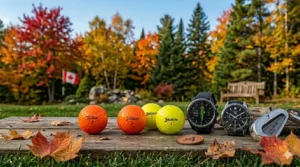
Orange vs Yellow Golf Balls in Canadian Conditions: Real-World Scenarios
The Toronto Weekend Golfer: October at Don Valley
Daniel, a 16-handicap from Scarborough, plays Don Valley Golf Course three or four times a month from May through mid-October. By September, the course’s tree-lined fairways are exploding with fall colour — red, gold, amber, brown — and Daniel had been losing two or three balls per round, not because of bad shots, but because his white balls simply disappeared into the undergrowth.
He switched to the Volvik Vivid Matte Orange in September 2025 and immediately noticed the difference. Lost balls dropped from 2–3 per round to 0–1. The orange colour sits in completely different tonal space from fall leaves; it actually reads as a separate colour category against that background, whereas yellow can fool the eye into thinking it’s just another piece of dry grass. Daniel keeps a sleeve of TaylorMade Distance+ Yellow in his bag for the rare blue-sky October day, but orange is his default from Labour Day onward.
Best match: Volvik Vivid Matte Orange or Wilson Staff Duo Soft Orange.
The Banff Weekend Golfer: Short Season, Maximum Colour
Sarah plays at Banff Springs Golf Course a handful of times each summer — she’s in Calgary, so it’s a Saturday trip — and her challenge is entirely different from Daniel’s. The Rocky Mountain backdrop creates incredible visual complexity: grey rock faces, green pines, blue glacial lakes, distant white peaks. Against that backdrop, both orange and yellow perform well, but Sarah finds yellow easier to track in flight against the mountain skyline, while orange works better when balls land in the rough near tree lines.
Her compromise: Callaway Chrome Soft Yellow for her primary ball (she’s a 10-handicap with a fast swing), with a few Srixon Soft Feel Brite Orange balls as backup for tree-lined holes.
Best match: Callaway Chrome Soft Yellow (main), Srixon Soft Feel Brite Orange (backup).
The Manitoba Senior Golfer: Flat Courses, Early Season
Gary is 68, plays a course near Brandon, MB, three times a week from ice-out (late April) until Thanksgiving. His swing speed has come down to around 78 mph (126 km/h), and the flat prairie courses he plays mean visibility is primarily a question of low-angle morning light and the occasional wet, grey overcast. He tried the Wilson Staff Duo Soft Orange based on a recommendation and was genuinely surprised by how much further it went compared to his previous firmer ball — the ultralow compression is exactly right for his swing speed. The orange is easy to see against prairie course rough, which tends toward tan and brown earlier in the season.
Best match: Wilson Staff Duo Soft Orange.
Colour Preference by Canadian Golfer Profile: A Decision Guide
| If You Are… | Choose This Colour | Best Ball Pick |
|---|---|---|
| Recreational, plays May–Sept | Yellow | TaylorMade Distance+ Yellow |
| Recreational, plays into Oct | Orange (Sept onward) | Callaway Supersoft Matte Orange |
| Senior with lower swing speed | Orange | Wilson Staff Duo Soft Orange |
| Mid-handicap seeking upgrade | Yellow (summer), Orange (fall) | Chrome Soft Yellow / Volvik Orange |
| Tour-performance buyer | Yellow | Titleist Pro V1 Yellow |
| Budget-conscious, plays rough courses | Orange | Srixon Soft Feel Brite Orange |
| Colour-vision deficiency | Yellow | Any high-optic yellow option |
After reviewing the table above, the strongest theme emerges: your playing season is the single most important variable. Canadian golfers who play exclusively in summer almost never need to think about orange; golfers who stretch into September and October will find orange significantly more practical than yellow during those months.
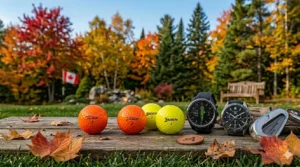
Common Mistakes Canadian Golfers Make When Choosing Ball Colour
Mistake 1: Treating Colour as Purely Cosmetic
This is by far the most common error. Many Canadian golfers choose orange or yellow because they like the look, rather than because they’ve considered their playing conditions. The visibility science is real — on 200-yard drives, players can track coloured balls in flight roughly 50% better than white balls — but the colour you choose matters. Picking orange for a midsummer, blue-sky course in June is a reasonable choice, but picking yellow for a fall round in a maple-lined Ontario course is leaving significant contrast advantage on the table.
Mistake 2: Ignoring Compression in Cold Weather
This one genuinely costs Canadian golfers distance. A 90-compression ball in 8°C (46°F) morning conditions can behave more like a 100+ compression ball. If you’re playing early-morning spring or late-fall rounds, a softer compression ball (under 70) will maintain more distance and feel than a firmer ball — regardless of colour. The Callaway Supersoft and Wilson Duo Soft, both available in orange, are specifically built to mitigate this cold-weather compression loss.
Mistake 3: Buying Colour Without Checking Amazon.ca Availability
Not every colour variant available on Amazon.com ships to Canada, or ships without prohibitive cross-border charges. Always verify on Amazon.ca directly. When a specific colour variant isn’t available, Amazon.ca typically offers the closest alternative. Prime membership (free shipping on orders over $35 CAD) makes ordering a full season’s supply at once cost-effective for Canadians outside major urban centres, where local pro shop selection can be limited.
Mistake 4: Using One Colour All Season
Canada’s seasons are dramatic enough that a one-colour-all-year approach is genuinely suboptimal. A sleeve of yellow for summer, a sleeve of orange for fall — it costs nothing extra and provides a meaningful visibility advantage in the shoulder season. Think of it like switching to winter tyres: technically optional, practically obvious.
Mistake 5: Overlooking Brand Quality Within Colour Choice
Not all orange or yellow balls are created equal. A cheap, faded orange ionomer ball will have noticeably less colour saturation than a Volvik Vivid Matte — to the point where the practical visibility advantage partially disappears. Colour quality matters. Matte finishes, in particular, resist glare better than gloss finishes and maintain their perceived brightness in overcast conditions. If visibility is your primary reason for choosing a colour ball, invest in a brand that takes colour engineering seriously.
✨ Don’t Miss These Exclusive Deals!
🔍 Take your golf game to the next level with these carefully selected balls. Click on any highlighted product to check current pricing and availability on Amazon.ca. These options will help you keep your ball in sight — and your scorecard in check!
How to Adapt to Changing Light on the Course: Practical Colour Tips
Canadian golfers deal with light conditions that shift dramatically within a single round. An 8 AM tee time in September means playing the opening holes in golden, low-angle light that hits the course almost horizontally — essentially dusk-equivalent in terms of contrast — before the light normalises by the back nine. Here’s how to adapt:
Early Morning (Before 9 AM): Orange outperforms yellow in the warm, low-angle morning light of late summer and fall. The longer wavelength maintains contrast against shadows and dewy rough. Yellow can wash out against dew-bright fairways in this light.
Midday (10 AM – 3 PM): Yellow is at its absolute peak. Blue sky overhead, high sun angle, green fairways — this is the exact scenario yellow ball science was built for. Chrome Soft Yellow or Pro V1 Yellow are ideal.
Late Afternoon (After 4 PM): As the sun drops, the light warms and the shadow patterns lengthen. Orange begins to reassert its contrast advantage. Both colours remain highly functional here, but orange is slightly easier to track in longer shadows.
Overcast All Day: Orange edges yellow here. The grey sky removes yellow’s primary advantage (contrast against blue), while orange’s stronger red-wavelength component maintains more perceptual brightness against neutral grey backgrounds.
Autumn Rounds (September–October): Orange wins clearly. The colour science is explicit: high contrast against warm-toned fall foliage backgrounds. This is where the Volvik Vivid and Srixon Soft Feel Brite Orange earn their keep.
A useful resource for understanding how environmental conditions affect colour perception is the GolfNow blog’s analysis of best golf ball colours for visibility, which provides good practical context for the science we’ve covered here.
Do Coloured Golf Balls Perform the Same as White?
Short answer: yes, for all practical purposes. The colour of a golf ball is an application of pigment to the cover — it does not change the dimple pattern, core construction, compression rating, or aerodynamic properties. A Titleist Pro V1 Yellow performs identically to a Titleist Pro V1 White. A Callaway Supersoft Matte Orange performs identically to a Callaway Supersoft White.
The misconception that coloured balls are “lesser” products persisted for years largely because the early coloured ball market was dominated by lower-quality novelty options. That’s no longer the case. Every major manufacturer — Titleist, Callaway, TaylorMade, Bridgestone, Srixon — now offers their performance lines in high-visibility colours. The stigma has evaporated.
There’s one performance-adjacent note worth making: matte finish balls (like the Volvik Vivid Matte and Callaway Supersoft Matte) can feel very slightly different from gloss balls off the clubface, because the surface texture is marginally different. For the vast majority of players, this is imperceptible. At tour level, some players note a very subtle difference in greenside spin — but this is true of any cover texture difference, and the practical effect at recreational swing speeds is essentially zero.
FAQ
❓ Which is more visible in low light — orange or yellow golf balls?
❓ Are there orange or yellow golf balls available on Amazon.ca for Canadian buyers?
❓ Do orange golf balls work better in the fall in Canada?
❓ What compression orange or yellow ball should a senior golfer in Canada choose?
❓ Can colour-vision deficient Canadian golfers benefit from coloured golf balls?
Conclusion
The orange vs yellow golf balls question has a genuinely satisfying answer for Canadian golfers, precisely because Canada’s dramatic seasonal shifts make the choice clear rather than arbitrary. Yellow belongs to your summer game — the crystalline blue-sky rounds of June, July, and August when the photopic science lines up perfectly. Orange belongs to your fall game — and in Canada, fall golf is a whole distinct experience worth optimising for.
The best strategy isn’t to pick one and stick with it for the entire season. It’s to recognise that visibility is a seasonal variable, not a fixed preference, and stock your bag accordingly. A dozen Callaway Supersoft Matte Orange balls from June through Labour Day, then switched to Volvik Vivid Matte Orange from September onward — paired with a sleeve of Titleist Pro V1 Yellow or Chrome Soft Yellow for those perfect blue-sky summer days when you want to play your best ball — and you have a colour strategy that actually responds to the conditions you’re playing in.
Every ball on this list is available on Amazon.ca. Canadian pricing runs slightly higher than US equivalents due to import costs and currency exchange, but you avoid cross-border shipping fees, customs delays, and the warranty headaches that come with purchasing through American retailers. Prime members get free shipping on eligible orders over $35 CAD — worth factoring in when comparing total costs.
Go find your ball. It’s orange. Or yellow. Depends what month it is.
✨ Don’t Miss These Exclusive Deals!
🔍 Browse our top picks and check current pricing and availability on Amazon.ca. These carefully selected orange and yellow golf balls will keep you finding shots — and saving strokes — all season long!
Recommended for You
- 7 Best Orange Golf Balls Canada 2026: High Visibility Picks
- Do Yellow Golf Balls Fly Differently? 7 Best in Canada 2026
- Yellow Golf Balls Visibility: Best 7 for Canadians (2026)
Disclaimer: This article contains affiliate links. As an Amazon Associate, I earn from qualifying purchases. If you purchase products through these links, we may earn a small commission at no additional cost to you.
✨ Found this helpful? Share it with your friends! 💬🤗
