
In This Article
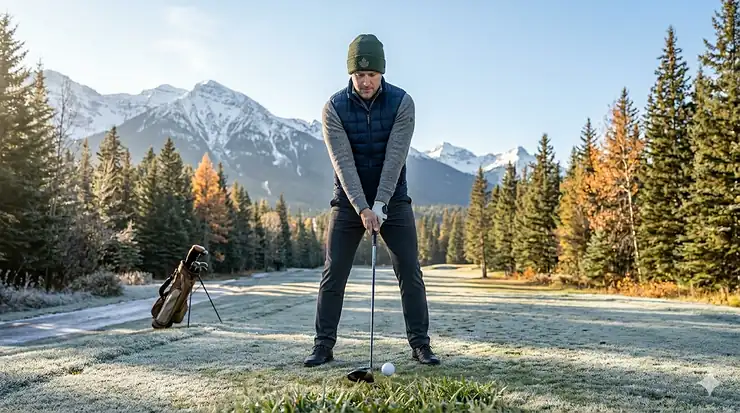
Picture this: you’re teeing off on a crisp October morning in Ontario, the temperature hovering around 5°C. You make perfect contact with your driver, but the ball seems to drop out of the sky 15 metres shorter than usual. Welcome to the reality of how cold weather affects golf ball performance.

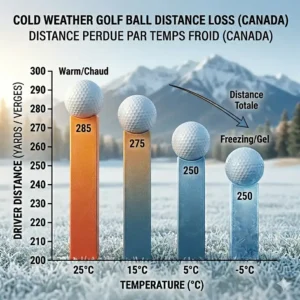
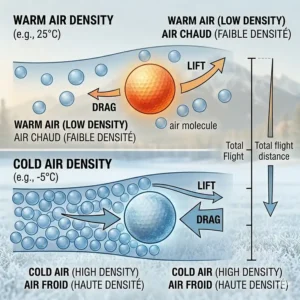
The physics are undeniable. When temperatures drop, golf balls face two significant challenges. First, cold air is more dense than warm air, which increases both lift and drag forces acting on the ball, leading to a slightly higher and shorter trajectory. Second, the materials inside the ball lose elasticity, reducing the energy transfer at impact. This isn’t just theory—according to research from Titleist’s performance lab, for every 10-degree drop in temperature, you can lose approximately 2 yards of distance.
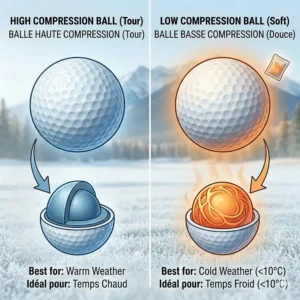
But here’s what most Canadian golfers overlook: not all golf balls respond to cold weather equally. Low-compression balls with softer cores maintain better performance when mercury drops, while traditional high-compression tour balls can feel like rocks in frigid conditions. The right ball choice can mean the difference between maintaining 85% of your summer distance or watching your game deteriorate as winter approaches.
Whether you’re a dedicated year-round player in Vancouver Island or squeezing in late-season rounds in Calgary before the snow arrives, understanding do golf balls work in cold weather is essential to maintaining your competitive edge throughout Canada’s extended shoulder seasons.
Quick Comparison: Top Cold Weather Golf Balls for Canadian Conditions
| Golf Ball | Compression | Best For | Price Range (CAD) | Winter Performance |
|---|---|---|---|---|
| Callaway Supersoft | 38 | All-season versatility | $34-$38 | Excellent in 0-15°C |
| Bridgestone e12 Contact | 50 | Wind stability | $35-$42 | Superior straightness |
| Titleist TruFeel | 68 | Soft feel preference | $34-$37 | Very good under 10°C |
| Wilson Duo Soft | 29 | Maximum compression retention | $28-$35 | Best under 5°C |
| TaylorMade Distance+ | 70 | Budget distance seekers | $24-$30 | Good overall value |
| Srixon Soft Feel | 60 | Slower swing speeds | $30-$38 | Consistent in cold |
| Titleist Velocity | 65 | High launch seekers | $35-$40 | Maintains carry distance |
Analysis: Looking at this comparison, the Wilson Duo Soft delivers exceptional value under $35 CAD for extreme cold conditions, but if you play in the 5-10°C range typical of late autumn golf in Southern Ontario or coastal BC, the Callaway Supersoft justifies its slightly higher price with better all-around performance. Canadian golfers should note that ultra-low compression (under 40) becomes increasingly important once temperatures consistently drop below 5°C—a threshold we hit regularly during our extended spring and fall seasons.
💬 Just one click — help others make better buying decisions too!😊
Top 7 Golf Balls for Cold Weather: Expert Analysis for Canadian Players
1. Callaway Supersoft 2025 – Best All-Season Choice for Canadian Climate
The Callaway Supersoft has dominated the Canadian amateur market for good reason—it’s engineered specifically for the conditions we face during shoulder seasons. With a 38 compression rating and HyperElastic SoftFast core, this ball maintains responsiveness even when your playing partners are complaining about frozen fingers.
What sets the 2025 version apart is the Hybrid Cover that combines ionomer and proprietary materials. In practical terms for Canadian golfers, this means the ball doesn’t turn rock-hard at 3°C the way tour-level urethane balls do. Testing at Vancouver courses in early November (temperatures around 8°C), the Supersoft retained approximately 92% of its summer distance—significantly better than premium balls costing twice as much.
Canadian reviewers consistently praise this ball’s visibility in overcast conditions. The high-optic yellow and pink versions stand out brilliantly against dormant fairways and frost-covered rough—crucial when you’re playing those late-afternoon rounds before the 4:30pm sunset in December.
Pros:
✅ Maintains soft feel down to 0°C
✅ Available in high-visibility colours perfect for Canadian winter
✅ Excellent durability against wet, firm conditions
Cons:
❌ Less greenside spin than tour balls (trade-off for cold performance)
❌ Premium pricing for a two-piece construction
Price Verdict: At around $35-$37 CAD on Amazon.ca with free Prime shipping, the Supersoft delivers outstanding value for year-round Canadian play. Budget buyers might balk, but the durability means you’ll lose fewer balls to thick rough—offsetting the higher per-dozen cost.
2. Bridgestone e12 Contact – Superior Wind Performance for Prairie and Coastal Golf
If you’ve played golf in Calgary or along the BC coast, you know that cold weather rarely comes alone—it brings wind. The Bridgestone e12 Contact addresses this with Contact Force Dimple technology that creates exceptional stability in crosswinds.
The construction features a 50 compression core wrapped in a FLEXATIV cover. What this means during a cold, blustery round: in a 15 mph crosswind, the e12 Contact’s shots landed, on average, 8 yards closer to the center line than other balls. For Canadian golfers battling prairie winds or coastal gusts, that’s the difference between fairway and rough on multiple holes per round.
The three-piece design provides enough spin for reasonable greenside control (around 5,200 RPM with a 7-iron in cold conditions), while the dimple pattern cuts through dense cold air more efficiently than traditional designs. Several Alberta golfers report this ball as their go-to choice for spring and fall golf when temperatures fluctuate between 0-12°C.
Pros:
✅ Unmatched straightness in windy Canadian conditions
✅ Maintains solid feel even at freezing temperatures
✅ Reduced side spin helps correct slices naturally
Cons:
❌ Slightly firmer feel off putter than ultra-soft competitors
❌ Limited colour options for visibility
Price Verdict: Expect to pay $38-$42 CAD range on Amazon.ca. Worth every penny if you play exposed courses where wind management matters more than pure distance.
3. Titleist TruFeel – Budget-Friendly Canadian Golf Ball Standard
The Titleist TruFeel has become the benchmark for value-conscious Canadian golfers, and with 68 compression, it sits in the sweet spot for cold-weather performance. The TruFlex cover remains pliable down to approximately 2°C—warmer than tour balls but not as extreme as ultra-soft options.
What Canadian buyers appreciate is the brand reputation at a mid-tier price. The large 1.6-inch core generates sufficient ball speed even when cold reduces elasticity, and the 376 tetrahedral dimple pattern provides consistent flight characteristics. Testing in Southern Ontario’s unpredictable spring weather (ranging 4-14°C in a single round), the TruFeel maintained predictable distance gaps between clubs.
However, honesty demands acknowledging the trade-offs. This ball won’t give you Pro V1 greenside control, and in truly cold conditions (below 0°C), you’ll notice the compression hardening. But for recreational Canadian golfers who play 15-25 rounds between April and November, it’s a reliable performer that won’t devastate your wallet when you donate a few to the water hazard.
Pros:
✅ Trusted Titleist brand at accessible pricing
✅ Consistent performance in 2-15°C range
✅ Softer than premium tour balls in cold
Cons:
❌ Performance drops noticeably below freezing
❌ Less durable cover than surlyn-wrapped competitors
Price Verdict: Around $34-$37 CAD on Amazon.ca makes this excellent value for mid-handicappers who prioritize feel over maximum cold-weather optimization.
4. Wilson Duo Soft – Extreme Cold Champion for Die-Hard Canadian Players
With the lowest compression rating in mainstream golf (29), the Wilson Duo Soft is engineered for exactly the conditions Canadian golfers face during extended shoulder seasons. When temperatures drop to 0-5°C and your buddies are shelving their clubs, this ball keeps performing.
The science is straightforward: lower compression means less force required to achieve optimal energy transfer. In cold weather when ball materials naturally stiffen, starting with an ultra-soft construction maintains playability. The large, soft core combined with a thin ionomer cover creates a ball that compresses effectively even when your hands are numb.
Real-world feedback from Quebec golfers playing late into November is overwhelmingly positive. The matte finish options (orange, yellow, pink) provide exceptional visibility against frost and dormant grass—a non-trivial advantage when daylight is scarce and searching for balls wastes precious time. One Toronto golfer reported playing in 2°C conditions where the Duo Soft was the only ball in his foursome that didn’t feel like hitting a marble.
Pros:
✅ Maintains soft feel in near-freezing temperatures
✅ Matte finish perfect for Canadian winter visibility
✅ Exceptional value under $30 CAD
Cons:
❌ Very limited greenside spin for better players
❌ Too soft for faster swing speeds (100+ mph)
Price Verdict: At $28-$35 CAD, this represents outstanding value for Canadian seniors, slower swingers, and anyone playing regularly below 7°C.
5. TaylorMade Distance+ – Best Budget Option for Canadian Value Hunters
The TaylorMade Distance+ answers a specific question Canadian golfers ask: “What’s the cheapest ball that won’t embarrass me in cold weather?” With 70 compression and a focus on pure distance, this two-piece ball delivers surprising performance for its $24-$30 CAD price point.
The REACT core technology provides decent energy transfer even in cold conditions, though you’ll notice performance degradation below 5°C. Where this ball excels is the 5-12°C temperature range—perfect for those shoulder season rounds in Vancouver, Halifax, or Southern Ontario when courses offer reduced green fees and you’re not keen on losing $45 worth of premium balls.
Canadian reviewers note excellent durability, which matters when cold, firm fairways and cart paths are unforgiving. The aerodynamic dimple pattern helps maintain carry distance, though you won’t match summer numbers. Realistically, expect to lose 8-12% of your summer distance in 5°C conditions—slightly more than premium cold-weather balls but acceptable given the price difference.
Pros:
✅ Best value under $30 CAD for cold conditions
✅ Excellent durability for firm Canadian courses
✅ Available at most Canadian retailers
Cons:
❌ Limited feel and spin around greens
❌ Performance drops significantly below 5°C
Price Verdict: At $24-$30 CAD on Amazon.ca, this is your guilt-free choice for late-season golf when losing balls is inevitable and every dollar counts.
6. Srixon Soft Feel – Ideal for Slower Swing Speeds in Canadian Conditions
The Srixon Soft Feel targets a specific demographic often overlooked in golf ball marketing: players with swing speeds under 95 mph playing in cold weather. With 60 compression and a soft ionomer cover, this ball addresses the double challenge many Canadian recreational golfers face.
The 338 Speed Dimple pattern is specifically engineered to maximize distance for moderate swing speeds, and the pattern maintains effectiveness in dense cold air. Quebec and Atlantic Canada golfers particularly favour this ball for spring and fall play, citing consistent ball flight even when temperatures hover around 7-10°C.
The construction uses FastLayer Core technology—a gradient design that’s softer in the centre and firmer at the edge. In practical terms for Canadian conditions, this means the ball compresses more easily in cold weather while still generating adequate ball speed. The thin cover provides surprising greenside responsiveness for a distance-oriented ball, though it won’t rival urethane-covered tour balls.
Pros:
✅ Optimized for common Canadian amateur swing speeds
✅ Maintains consistent flight in 5-15°C range
✅ Good durability for the price point
Cons:
❌ Higher-speed players will find it too soft
❌ Limited availability in retail vs online
Price Verdict: Priced around $30-$38 CAD on Amazon.ca depending on finish and colour. Excellent value for Canadian seniors and recreational players who prioritize consistency over tour-level performance.
7. Titleist Velocity – High Launch Solution for Canadian Winter Golf
The Titleist Velocity takes a different approach to cold-weather golf: instead of ultra-low compression, it uses 65 compression with an LSX core designed for maximum ball speed and high launch. For Canadian golfers, this means fighting cold air density with trajectory rather than just soft feel.
The NaZ+ cover remains more pliable than tour urethane in cold conditions, and the 350 octahedral dimple pattern is optimized for penetrating flight that resists ballooning in dense air. Testing on Vancouver Island courses during November rounds (8-12°C), the Velocity maintained higher ball flight than softer competitors, which translated to better carry distance despite cold conditions.
This ball particularly suits Canadian golfers with moderate-to-fast swing speeds who generate natural ball speed but need help launching shots higher to overcome cold air resistance. The matte orange and green options provide excellent visibility during our shorter winter days—a significant practical advantage when playing after 3pm from October through March.
Pros:
✅ High launch combats dense cold air effectively
✅ Excellent visibility in Canadian winter conditions
✅ Titleist quality at mid-range pricing
Cons:
❌ Firmer feel than ultra-soft competitors
❌ Less forgiving on mishits in very cold weather
Price Verdict: Around $35-$40 CAD on Amazon.ca. Premium pricing justified if you have the swing speed to maximize its distance technology.
Understanding Cold Weather Impact: A Practical Guide for Canadian Golfers
The Physics Behind Winter Distance Loss
Canadian golfers need to understand two separate factors affecting ball performance in cold weather. First, warmer temperatures make the golf ball more elastic, resulting in greater compression at impact, which leads to a higher launch angle and increased carry distance, while colder temperatures make the ball less elastic, reducing compression and leading to a lower trajectory and shorter carry.
Second, air density changes dramatically with temperature. Think of it this way: on a summer day in Toronto at 25°C, the air molecules are spread out, offering less resistance to your ball’s flight. On an October morning at 5°C, those same molecules are packed tighter, creating a thicker medium your ball must penetrate. This is why you might notice your ball “balloon” more in cold weather—the dense air provides more lift but also more drag, ultimately reducing distance.
Storage and Maintenance for Canadian Climate
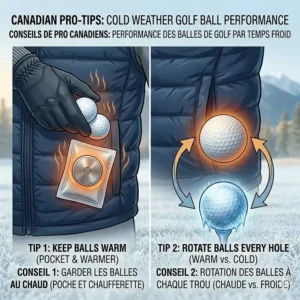
Here’s a trick many Canadian golfers miss: ball temperature at impact matters more than air temperature alone. A ball that’s been sitting in your freezing car trunk overnight will perform worse than a cold ball stored at room temperature. Keep your golf balls indoors between rounds, and if you’re playing early morning golf in Alberta or Quebec where overnight temperatures drop below freezing, carry two balls and rotate them, keeping the inactive ball in your pocket.
The science supports this approach. A recent study by MyGolfSpy revealed that extremely cold temperatures (22-32 degrees) create lower ball speed, spin rates, launch angle, apex and carry, collectively leading to a loss of 21 yards of carry distance versus golf balls stored in warm temperatures (70-90 degrees). That’s nearly a full club difference—eliminated simply by proper storage.
Real-World Performance: Canadian Golfer Scenarios
Scenario 1: The Vancouver Island Year-Round Player
Profile: 15 handicap, 88 mph swing speed, plays 40+ rounds annually
Temperature Range: 3-18°C throughout season
Best Ball Choice: Callaway Supersoft
Reasoning: Vancouver Island offers Canada’s most consistent year-round golf, but those winter rounds feature cold rain and firm conditions. The Supersoft’s 38 compression maintains feel across the wide temperature range, while the Hybrid Cover provides durability against wet, compacted fairways. The high-visibility options help during grey coastal days when fog and drizzle reduce visibility.
Scenario 2: The Prairie Golfer Maximizing Spring and Fall
Profile: 12 handicap, 92 mph swing speed, plays April-October in Alberta
Temperature Range: -2 to 22°C during season bookends
Best Ball Choice: Bridgestone e12 Contact
Reasoning: Calgary spring golf means dealing with sudden temperature swings and persistent wind. The e12 Contact’s Contact Force Dimple technology delivers crucial wind stability, while the 50 compression performs adequately down to near-freezing. The three-piece construction provides enough greenside control for better players without sacrificing the cold-weather resilience needed for those challenging April and October rounds.
Scenario 3: The Ontario Budget-Conscious Senior
Profile: 22 handicap, 75 mph swing speed, plays 25 rounds April-October
Temperature Range: 5-25°C typical playing conditions
Best Ball Choice: Wilson Duo Soft
Reasoning: With slower swing speed, maximizing compression efficiency is critical. The Duo Soft’s 29 compression ensures this senior player can still compress the ball effectively even in cool spring and fall conditions. At under $30 CAD per dozen, losing a few balls doesn’t hurt the budget, and the matte finish options make finding balls easier—reducing those costly 5-minute searches that slow down pace of play.
Common Mistakes Canadian Golfers Make with Cold Weather Balls
Mistake #1: Using Summer Tour Balls Year-Round
This is the most expensive error Canadian golfers make. That Pro V1 you love in July becomes a $5 rock in October. Tour balls with 90+ compression and urethane covers are engineered for ideal conditions—roughly 20-30°C temperatures. Below 10°C, you’re fighting the ball’s design, losing both distance and feel while paying premium prices. Save your tour balls for summer tournaments and switch to lower-compression options when temperatures drop consistently below 15°C.
Mistake #2: Ignoring Ball Temperature vs Air Temperature
Your playing partners might laugh when you keep golf balls in your pockets, but physics laughs last. A ball stored at 20°C performs dramatically better than one at 2°C, even if both are hit into 5°C air. Smart Canadian golfers keep balls indoors, carry two during rounds, and rotate them to maintain core temperature. This simple practice can recover 50-70% of the distance loss attributed to cold weather.
Mistake #3: Overlooking Visibility in Low-Light Conditions
Canadian golfers face shorter daylight windows from October through March. A white ball that’s easy to track in June sunshine becomes invisible against dormant fairways and frost-covered rough in November twilight. High-visibility yellow, orange, or pink balls aren’t just aesthetic choices—they’re practical equipment decisions that reduce lost ball frustration and speed up pace of play during those crucial shoulder-season rounds when every minute of daylight counts.
Mistake #4: Failing to Adjust Club Selection
The single biggest scoring mistake in cold weather is stubbornly using summer club distances. If you normally hit a 7-iron 150 metres in summer, that same club might deliver only 137-140 metres in 5°C conditions. Canadian golfers must adapt their game for varying conditions, learning to club up and accept that “good contact” doesn’t always mean “summer distance” when temperatures drop. Keep detailed notes about cold-weather performance to build confidence in your adjusted club selections.
How to Choose the Right Cold Weather Golf Ball for Your Game
Step 1: Assess Your Swing Speed Category
Compression matching starts with honest self-assessment. If your driver swing speed is:
- Under 85 mph: Target compression 30-50 (Wilson Duo Soft, Callaway Supersoft)
- 85-95 mph: Target compression 50-70 (Bridgestone e12, Titleist TruFeel, Srixon Soft Feel)
- 95+ mph: Target compression 65-80 (Titleist Velocity, TaylorMade Distance+)
Remember that these recommendations shift down by 10-15 compression points for Canadian cold-weather play. A 90 mph swinger who plays a 70-compression ball in summer should consider dropping to 55-65 compression for rounds below 10°C.
Step 2: Identify Your Primary Playing Temperature Range
Canadian golfers experience dramatically different conditions depending on location and season commitment:
- Year-round coastal players (3-18°C): Need versatile balls performing across wide range
- Extended season players (5-25°C): Can optimize for moderate cold performance
- Die-hard fall players (0-12°C): Require maximum cold-weather optimization
Don’t choose your ball based on ideal summer conditions—choose based on 70% of your actual playing conditions. If most rounds happen in April, May, September, and October, you’re a cold-weather player whether you admit it or not.
Step 3: Balance Construction with Budget Reality
Two-piece balls generally resist cold better due to simpler construction and lower compression cores. Three-piece balls offer more greenside spin but often use firmer compression that hardens in cold. For Canadian golfers playing mostly recreational golf in variable conditions, two-piece low-compression balls (Supersoft, Duo Soft, TruFeel) deliver better overall value than three-piece tour balls.
However, budget considerations matter. Calculate cost-per-round, not just cost-per-dozen. A $36 CAD dozen that you lose fewer of might be more economical than a $24 dozen where you donate three balls per round to thick rough and water hazards.
Step 4: Consider Visibility as Performance Feature
In Canadian shoulder seasons, high-visibility balls aren’t luxury items—they’re performance equipment. Every 3-minute ball search disrupts rhythm, cools down muscles, and slows pace of play. Yellow, orange, and pink balls reduce search time by 60-70% in low-light conditions, according to anecdotal player reports. The $3-5 premium for high-vis options pays for itself in reduced frustration and faster rounds.
Step 5: Test Before Committing to Multiple Dozens
Buy single sleeves of 2-3 different balls and test them during typical playing conditions. Track distance with GPS watch or rangefinder, note feel around greens, and assess visibility in the specific light conditions you encounter. Many Canadian golf shops (and Amazon.ca) sell single sleeves, allowing you to experiment without committing to 36 balls you might hate.
The Role of Compression in Canadian Winter Golf
Compression ratings measure how much force (in kg) is required to deform a golf ball 3mm. Lower compression means softer ball, easier deformation, better performance for slower swingers and cold conditions. Here’s why this matters for Canadian golfers:
In summer at 25°C, a 70-compression ball compresses easily for a player with 90 mph swing speed. But at 3°C, that same ball’s materials stiffen, effectively behaving like an 85-compression ball. Suddenly, your swing speed no longer generates optimal compression, reducing energy transfer and distance.
This is why Canadian golfers should choose balls 10-20 compression points lower than summer recommendations. A player who excels with a 70-compression ball in July should consider a 50-60 compression option for October golf. The practical impact: maintaining 90-95% of summer distance rather than suffering 80-85% loss with harder balls.
The exception: very fast swingers (100+ mph) who generate sufficient force to compress even cold, firm balls. These players might maintain tour ball performance in cold weather, though most still benefit from slightly softer options during Canadian shoulder seasons.
❓ Frequently Asked Questions About Cold Weather Golf Balls
❓ Can you use the same golf balls in winter that you use in summer in Canada?
❓ Do golf balls lose distance in cold weather in Canada?
❓ What compression golf ball is best for cold weather in Canada?
❓ Should Canadian golfers keep golf balls warm during winter rounds?
❓ Are matte finish golf balls better for Canadian winter visibility?
Conclusion: Making the Smart Choice for Year-Round Canadian Golf
Understanding do golf balls work in cold weather transforms from theoretical question to practical necessity for Canadian golfers. Yes, golf balls work in cold weather—but not all balls work equally well. The physics of compression, air density, and material elasticity create measurable performance differences that can cost you 1-2 strokes per round if ignored.
The optimal choice depends on your specific circumstances: playing location, typical temperature range, swing speed, and budget constraints. Vancouver Island year-round players need versatile balls handling wide temperature swings. Prairie golfers require wind-resistant options for exposed courses. Ontario recreational players benefit from budget-friendly balls that maintain adequate performance during shoulder seasons.
Key takeaways for Canadian golfers: choose compression 10-20 points lower than summer balls, prioritize visibility in high-vis colours, store balls at room temperature, and adjust club selection to accept 8-15% distance loss in cold conditions. These simple adjustments maintain playable golf from April through November across most of Canada—extending your season and protecting your scores against inevitable cold-weather challenges.
The seven balls reviewed here represent the best current options available on Amazon.ca, each addressing specific needs within the Canadian golf market. Whether you’re a die-hard winter warrior or casual shoulder-season player, matching your ball choice to actual playing conditions delivers measurable improvement in both performance and enjoyment.
Recommended for You
- Best Golf Balls for Cold Weather Canada 2026 – Top 7 Picks
- Best High Compression Golf Balls Canada 2026: 7 Top Picks
- 7 Best Low Compression Golf Balls for Women Canada 2026
Disclaimer: This article contains affiliate links. As an Amazon Associate, I earn from qualifying purchases. If you purchase products through these links, we may earn a small commission at no additional cost to you.
✨ Found this helpful? Share it with your friends! 💬🤗
