

In This Article
Somewhere between the trunk of your car and the first tee, every golfer has had the same thought: why am I hauling this thing like a sack of cement? wheeled golf bags exist to answer exactly that question, and in 2026 the category has quietly split into two very different tribes — bags with a genuine built-in wheel system bolted to the base, and wheeled travel covers built for the parking lot and the airport carousel rather than the fairway. Both solve the same core problem: getting fourteen clubs, a dozen balls, and your questionable choice of rain gear from point A to point B without wrecking your shoulder.

A wheeled golf bag, put simply, is any golf bag with wheels attached directly to its frame, letting a golfer skip a separate push cart entirely — this is the no-cart-needed design that budget and travel brands have leaned into hard. This article dissects seven real, currently available options across budget, mid-range, and premium tiers, breaks down what a “built-in wheel system” actually buys you over a traditional push cart, and walks through the transformation content — setup, maintenance, and real-world buyer scenarios — that a plain Amazon listing simply won’t give you. According to Golf Canada’s 2024 participation report, nearly six million Canadians played the game last year, and a good chunk of them are hauling gear across gravel lots and airport curbs more often than they’d like — so getting this choice right matters more than the spec sheet suggests.
We’ll cover what separates a genuinely self-standing bag from a cart bag that only pretends to be one, when a wheeled golf bag beats a push cart outright (and when it doesn’t), and how to avoid the buying mistakes that leave golfers with a bag that rattles, tips, or dies after one season.
Quick Comparison Table
| Product | Type | Weight | Best For |
|---|---|---|---|
| MacGregor Golf VIP Cart Bag | Built-in wheel system | ~4.5 kg (10 lbs) | Budget buyers wanting real wheels |
| Ram Golf FX Cart Bag | Built-in wheel system | ~3.4 kg (7.4 lbs) | Lightest budget wheeled option |
| Paradax AI-1 All-In-One | Built-in 3-wheel push cart | ~9 kg (20 lbs) | No-cart-needed convenience |
| Sun Mountain ClubGlider Meridian | Wheeled travel bag | ~6.4 kg (14 lbs) | Frequent flyers, premium protection |
| OGIO Renegade Travel Cover | Wheeled travel bag | ~5.4 kg (12 lbs) | Rough handling, off-road wheels |
| CaddyDaddy First Class | Wheeled travel bag | ~5.9 kg (13 lbs) | Maximum club-head protection |
| Club Glove Burst-Proof | Wheeled travel bag | ~5.7 kg (12.5 lbs) | Tour-level durability reputation |
Looking at the spread above, the split is really a split in purpose: the MacGregor Golf VIP Cart Bag and Ram Golf FX Cart Bag are built to be played out of, wheels included, while the Sun Mountain ClubGlider Meridian, OGIO Renegade Travel Cover, CaddyDaddy First Class, and Club Glove Burst-Proof exist to protect an existing bag between the closet and the golf course, or the closet and an airport in Cancún. The Paradax AI-1 is the outlier, folding an entire push cart into the bag itself. If you only remember one thing from this table, remember that “wheeled golf bag” covers two genuinely different jobs — pick the category before you pick the brand.
💬 Just one click — help others make better buying decisions too!😊
Top 7 Wheeled Golf Bags: Expert Analysis
1. MacGregor Golf VIP Cart Bag — best budget pick with true built-in wheels
The MacGregor Golf VIP Cart Bag is one of the few genuinely affordable bags on the market with real wheels bolted to the base rather than a wheel accessory sold separately. At 36.5 inches with a full 14-way divider system, it’s built for golfers who want organization without a premium price tag. The 14 full-length dividers matter more than the number suggests — in practice, it means graphite shafts don’t clatter against steel irons every time you go over a cart path bump, which is the single most common complaint about cheaper 4-way tops. Based on the spec comparison, this bag trades weight for structure: at roughly 4.5 kg (10 lbs) empty, it’s noticeably heavier than a walking stand bag, but that weight comes from a telescoping handle and wheel assembly sturdy enough to survive repeated loading into a trunk. This is the pick for a golfer who rides carts most rounds, wants to avoid buying a separate push cart, and doesn’t want to spend premium-bag money to get there. Reviewers consistently note that the seven pockets — including a dedicated valuables pocket — are generously sized for a bag at this price, though a few mention the telescopic handle needs a firm tug to lock into place the first few times.
Pros:
- ✅ Genuine built-in wheels at a genuinely budget price point
- ✅ Full 14-way divider system prevents club-to-club clanging
- ✅ Seven pockets, including a lockable-style valuables compartment
Cons:
- ❌ Heavier than most stand bags at around 4.5 kg (10 lbs)
- ❌ Limited colourways compared to premium brands
Expect this bag in the lower price bracket for wheeled cart bags — think roughly C$180-C$230 at the time of research, though prices may vary, so check current price before buying. For a golfer who rides more than they walk, the value here is hard to beat.
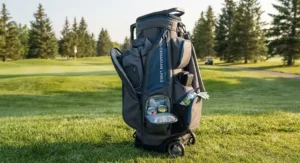
2. Ram Golf FX Cart Bag — lightest built-in wheel design in its price class
The Ram Golf FX Cart Bag answers the biggest objection to wheeled cart bags — that the wheel assembly makes everything heavier — by coming in at roughly 3.4 kg (7.4 lbs), noticeably lighter than most bags in its category with wheels attached. It carries the same 14-way full-length divider layout as its budget rivals, along with a telescoping handle designed to make loading and unloading from a trunk a one-motion task rather than a wrestling match. What most buyers overlook about this model is that shaving weight from the frame without dropping the divider count is a genuine engineering trade-off — lighter frame materials generally mean the bag won’t take the abuse of daily cart-path curbs quite as long as a heavier build. Still, for golfers who ride carts occasionally but also want to carry the bag from the garage to the car without feeling it, this is a smart middle ground. Aggregated buyer sentiment for this style of budget wheeled bag tends to praise the price-to-feature ratio while flagging that stitching and zipper hardware are the first things to show wear after a season or two of heavy use.
Pros:
- ✅ Significantly lighter than most wheeled cart bags at ~7.4 lbs
- ✅ Full-length 14-way divider protects clubs during transport
- ✅ Telescoping handle simplifies loading and unloading
Cons:
- ❌ Lighter materials may show wear faster under heavy use
- ❌ Smaller brand footprint means fewer long-term durability reviews
At around C$190-C$240 (prices may vary — always check current price), this is the pick for a golfer who wants wheels without the extra kilogram.
3. Paradax AI-1 All-In-One Golf Bag — best 3-wheel push cart built right into the bag
The Paradax AI-1 takes a genuinely different approach: instead of small fixed wheels on the base, it hides a complete 3-wheel push cart inside the bag itself, deploying in roughly 20 seconds according to the manufacturer. The front wheel folds and tucks away when you don’t need it, which on paper means you get the stability of a proper push cart and the compactness of a stand bag depending on the day. Key specs here matter in practice: it holds a full 14 clubs even with jumbo grips, includes an insulated front pocket for drinks, and the push handle itself carries a cup holder plus phone and rangefinder storage — extras that a bare cart bag simply doesn’t offer. Based on the spec comparison against the MacGregor and Ram Golf entries above, the Paradax trades simplicity for versatility; it’s a heavier, bulkier unit at roughly 9 kg (20 lbs), but it replaces a C$150-C$250 push cart purchase outright. Reviewers who’ve used multiple two-wheel pull carts and three-wheel push carts over the years describe this as the first all-in-one design that’s actually held up to repeated use, though several note the assembly takes a bit of practice the first few rounds.
Pros:
- ✅ Eliminates the need to buy a separate push cart entirely
- ✅ Three-wheel stability closer to a dedicated push cart than a cart bag
- ✅ Insulated pocket and rangefinder/phone storage on the handle
Cons:
- ❌ Premium price reflects the built-in cart mechanism
- ❌ Bulkier to store and load than a simple wheeled cart bag
Positioned in the premium tier, expect a price in the C$400-C$480 range at the time of research — a legitimate value case once you factor in the push cart you’re not buying separately.
4. Sun Mountain ClubGlider Meridian — best premium travel bag with retractable wheeled legs
Rather than a playing bag, the Sun Mountain ClubGlider Meridian is a wheeled travel case, and it’s routinely ranked among the best in that category for a reason. Its retractable leg mechanism bears the weight of a fully loaded bag while pivoting wheels handle direction changes through crowded airport terminals — the kind of engineering that turns a 23 kg checked bag from a dead weight into something you can steer with two fingers. What the spec sheet won’t tell you, but reviewers note, is that the tension in the retractable legs takes a bit of muscle to deploy the first time, though that same tension is exactly what keeps the mechanism locked securely in its molded tray during rough baggage handling. Dense foam padding lines the interior for club protection, which matters enormously given how airline baggage handlers treat golf bags in practice. For golfers who fly with their clubs more than once or twice a year, this is the bag that turns dreaded curbside check-in into a genuinely easy process — you’re gliding it, not dragging it.
Pros:
- ✅ Pivoting wheels and retractable legs make airport transport effortless
- ✅ Dense foam padding protects clubs through rough handling
- ✅ Backed by Sun Mountain’s reputation for durable construction
Cons:
- ❌ Retractable leg mechanism takes some effort to learn at first
- ❌ Premium price compared to basic soft-sided travel covers
Expect this in the higher end of the travel-bag range — roughly C$420-C$480 at the time of research, prices subject to change.
5. OGIO Renegade Travel Cover — toughest off-road wheels for rough handling
Testers have nicknamed the OGIO Renegade Travel Cover the “4×4 of golf travel bags,” and the description holds up under scrutiny. Its oversized off-road wheels are built to handle curbs, gravel lots, and uneven pavement without the wobble smaller wheels develop over time, while the SLED impact-resistant base absorbs the drops and shoves that airline baggage handling inevitably delivers. Key specs translate directly into peace of mind here: protected corners and heavy-duty grab handles mean the bag survives being tossed onto a luggage cart rather than gently placed, and it still collapses flat for storage in a closet or trunk between trips. Despite its rugged build, the Renegade keeps a slender profile that comfortably fits stand bags through full-sized cart bags. Based on the spec comparison against softer duffel-style travel covers, the trade-off is bulk — this isn’t the bag you fold into a suitcase — but for golfers whose clubs regularly face rough handling, that rigidity is exactly the point.
Pros:
- ✅ Oversized off-road wheels handle curbs and gravel with ease
- ✅ SLED impact-resistant base absorbs rough baggage handling
- ✅ Collapses flat for easy storage between trips
Cons:
- ❌ Slender profile may be snug for oversized cart bags
- ❌ Bulkier to store fully assembled than a soft cover
Typically priced in the mid-range travel bracket — around C$260-C$320 at the time of research — this is a strong middle ground between the budget cart bags and the premium ClubGlider.
6. CaddyDaddy First Class Travel Bag — best club protection with wheels
The CaddyDaddy First Class Travel Bag leans hard into protection, and its spec sheet reflects that priority. Built from 1000D ballistic nylon — about as thick a denier rating as you’ll find in golf travel gear — the shell is reinforced with quad-riveted handle connection points and a custom semi-rigid EVA-molded upper shell to guard club heads specifically, the part of a set that takes the worst abuse in transit. The wheels themselves borrow their design from inline skates, which in practice means smooth rolling across carpet, tile, concrete, and brick without the jerky stop-start of cheaper caster wheels. What most buyers overlook is the two-year replacement warranty, which explicitly covers damage caused by airlines — a detail that matters far more than colour options once your clubs have survived a rough connection at Pearson. Reviewers consistently mention an internal strap that secures the golf bag in place once loaded, though more than one has admitted to a “brief wrestling match” getting a full bag back out after a long flight.
Pros:
- ✅ Inline-skate-style wheels roll smoothly across most surfaces
- ✅ EVA-molded shell provides serious club-head protection
- ✅ Two-year warranty explicitly covers airline-caused damage
Cons:
- ❌ Available in black only, with no colour choice
- ❌ Internal securing strap takes a round or two to get used to
Sitting just over the C$260 mark at the time of research (prices may vary), it’s a strong value against travel bags that charge noticeably more for similar protection.
7. Club Glove Burst-Proof Wheeled Golf Travel Bag — most trusted tour-proven wheeled travel bag
The Club Glove Burst-Proof Wheeled Golf Travel Bag carries a reputation built over years of use among touring professionals and serious amateurs who fly with their clubs constantly — and reputation, in a category full of one-and-done budget covers, actually means something here. Its burst-proof design addresses the specific failure point that ends most travel bags’ lives early: seams and zippers giving way under the combined stress of a fully loaded set and careless baggage handlers. The wheels are built for the same repeated-use scenario, holding up to weekly or monthly airport trips rather than the occasional vacation. Based on the spec comparison against newer entrants like the OGIO Renegade, the Club Glove doesn’t chase off-road ruggedness so much as consistent, proven reliability — it’s the bag golf instructors and travelling amateurs recommend precisely because it rarely shows up in complaint threads. The trade-off, as with most tour-proven gear, is a price tag that reflects the reputation rather than flashy extra features.
Pros:
- ✅ Long-standing reputation for durability among touring golfers
- ✅ Burst-proof construction reduces seam and zipper failure risk
- ✅ Wheels built for frequent, repeated airport and course use
Cons:
- ❌ Premium pricing reflects the tour-level reputation, not extra features
- ❌ Not the lightest bag to carry when stairs or sand rule out wheels
Expect a price point in the C$300-C$360 range at the time of research — this is the safe, proven choice for golfers who travel with clubs often enough that reliability outweighs novelty.
Practical Usage Guide: Getting the Most from Your Wheeled Golf Bag
Buying the right wheeled golf bag is only half the job — how you set it up and maintain it determines whether it lasts three seasons or ten. Start by loading heaviest items (rangefinder, extra balls, rain gear) low and centred over the wheel axle rather than up top; this keeps the bag balanced when you’re pulling it across a sloped fairway or a curb, instead of tipping every time the terrain shifts. On a genuine built-in wheel system like the MacGregor Golf VIP Cart Bag or Ram Golf FX Cart Bag, check that the telescoping handle locks fully into position before your first round — a handle that isn’t seated can slip mid-pull and catch you off guard. For wheeled travel covers such as the Sun Mountain ClubGlider Meridian or CaddyDaddy First Class, always secure the internal strap around your playing bag before zipping closed; skipping this step is the single most common reason clubs shift and clank during transit.
Maintenance is minimal but not optional. Wipe wheel axles clean of grass clippings and dirt every few rounds, since built-up debris is what eventually causes wheels to stick or squeak. Once a season, check zipper teeth for grit and lubricate them lightly if they start to stick — a jammed zipper on a wheeled travel bag at airport check-in is not a problem you want. A common mistake in the first 30 days of ownership is over-tightening compression straps on travel bags like the OGIO Renegade Travel Cover, which can warp the internal frame over time; snug is enough, crushing is not necessary.
✨ Don’t Miss These Exclusive Deals!
🔍 Take your golf bag search to the next level with these carefully selected picks. Click on any highlighted item to check current pricing and availability on amazon.ca. These bags will help you get authentic, hassle-free rounds your foursome will envy!
Real-World Scenarios: Which Wheeled Golf Bag Fits Your Game
Consider three genuinely different Canadian golfers. The retired weekday player in Kelowna who rides a cart four rounds a week doesn’t need a travel-grade shell — the MacGregor Golf VIP Cart Bag or Ram Golf FX Cart Bag covers everything they need at a fraction of the cost of a premium option, and the built-in wheels mean one less thing to load into the cart storage rack. Compare that to the university student in Waterloo who plays maybe twice a month but wants to skip buying a separate push cart entirely — the Paradax AI-1 solves exactly that problem by folding the cart into the bag, making a single purchase do double duty on a tight budget.
Then there’s the golf trip regular — someone flying to Scottsdale or Myrtle Beach two or three times a year with a group of friends. For that golfer, a playing bag alone isn’t enough; they need a wheeled travel cover on top of it, and the choice comes down to priorities. If club protection through rough handling is the top concern, the CaddyDaddy First Class or OGIO Renegade Travel Cover earn their keep with EVA-molded shells and off-road wheels. If this golfer flies constantly and wants the smoothest possible airport experience, the Sun Mountain ClubGlider Meridian‘s retractable legs and pivoting wheels are worth the extra cost, and a golfer who has already worn through one or two lesser bags will appreciate the proven track record of the Club Glove Burst-Proof Wheeled Golf Travel Bag.
How to Choose a Wheeled Golf Bag
Choosing the right wheeled golf bag comes down to matching the bag’s purpose to how you actually play. Here’s the short version, step by step:
- Decide your primary use first. A bag for course play (built-in wheel system) and a bag for transport (wheeled travel cover) solve different problems — most golfers eventually need one of each, not one bag that tries to do both.
- Weigh the wheel assembly honestly. Built-in wheels add roughly 1-2 kg (2-4 lbs) over a comparable stand bag; if you occasionally carry the bag, that weight matters more than the spec sheet implies.
- Check divider count against your bag habits. A full 14-way top is worth the extra cost if clanking clubs bother you; a 4-way top is fine if the bag mostly sits in a cart.
- Match pocket layout to what you actually carry. An insulated pocket matters in July; a rangefinder holster matters if you use one every hole.
- Confirm wheel material for your typical terrain. Off-road wheels (like the OGIO Renegade) earn their keep on gravel lots; smaller caster wheels are fine on paved cart paths.
- Factor in warranty coverage for travel bags specifically. Airline handling is rough — a warranty that explicitly covers airline damage, like the CaddyDaddy First Class offers, is worth more than it looks on paper.
- Set a real budget band before browsing. Budget wheeled cart bags start under C$250; premium travel covers with retractable legs run past C$400 — decide which tier fits before falling for extra features you won’t use.
Wheeled Golf Bag vs Push Cart: Which Wins?
This is the comparison most golfers actually need answered before they buy anything. A wheeled golf bag with a true built-in wheel system, like the MacGregor Golf VIP Cart Bag or Ram Golf FX Cart Bag, wins on simplicity — there’s nothing to fold, store separately, or forget in the garage. It’s one object, wheels included, and it goes straight from the trunk to the cart or the fairway. A traditional push cart, on the other hand, generally offers better stability on hills and rougher terrain because the wheel base sits wider than a bag’s built-in wheels, and three- and four-wheel push carts are purpose-built for walking an entire round rather than short transport hops.
The honest trade-off: golfers who ride carts most rounds and only need to move the bag short distances (car to cart, cart to green) are well served by a built-in wheel system — you’re not walking the bag far enough for a push cart’s superior stability to matter. Golfers who walk most of their rounds are almost always better off with a dedicated push cart or a hybrid design, because a wheeled bag’s small integrated wheels weren’t engineered for kilometres of fairway travel. The Paradax AI-1 occupies the genuinely interesting middle ground here, since it’s a full three-wheel push cart that happens to live inside the bag rather than beside it — worth a serious look for anyone who can’t decide between the two categories.
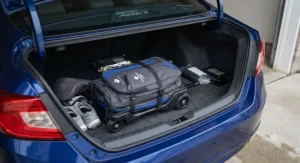
Built-In Wheel Systems Explained: What the Spec Sheet Doesn’t Tell You
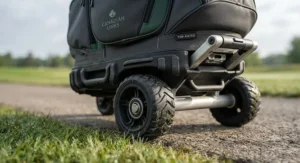
A “built-in wheel system” sounds like a single feature, but it’s really three components working together: the wheels themselves, the axle and mounting bracket, and the handle mechanism that lets you steer — the same basic engineering trade-offs that show up across wheeled cart designs generally, just scaled down to fit onto a bag instead of a full riding vehicle. The wheels on budget bags like the Ram Golf FX Cart Bag are typically small, hard-plastic casters — fine for smooth pavement, less fine for gravel or wet grass, where they can bog down. Premium wheeled travel covers upgrade to larger, softer-rubber wheels (the off-road style on the OGIO Renegade Travel Cover is a good example) specifically because they’re expected to handle curbs and rough baggage-handling surfaces, not just a flat cart path.
The mounting bracket matters more than most buyers realize. On the MacGregor Golf VIP Cart Bag, the wheel assembly is reinforced at the base to handle the combined weight of a full set plus repeated loading into a trunk — a weak mounting point is the most common reason cheap wheeled bags fail within a season, well before the fabric itself wears out. The handle mechanism, whether it’s a simple telescoping pole or the retractable-leg design on the Sun Mountain ClubGlider Meridian, determines how much control you actually have while pulling — a locked, rigid handle steers predictably, while a loose or wobbly one makes the bag fishtail on anything but flat ground. When comparing built-in wheel systems, ask about all three components, not just whether the bag “has wheels.”
Self-Standing Wheeled Bags: The No-Cart-Needed Design Explained
A self-standing bag is exactly what it sounds like — a bag engineered to remain upright on its own base or built-in legs without leaning against a cart, wall, or golf partner’s shoulder. Paired with a built-in wheel system, this creates what the industry calls a no-cart-needed design: the bag rolls to where you need it, then plants itself upright and stays there while you pull clubs. This matters more in practice than it sounds like it should. A bag that tips over every time you set it down on a slope wastes time and, worse, can damage grips or dent club heads on hard cart-path surfaces.
Most true wheeled cart bags, including the MacGregor Golf VIP Cart Bag and Ram Golf FX Cart Bag, achieve self-standing stability through a wider wheel base combined with a flat rear foot, so the bag balances on three contact points rather than teetering on two thin wheels alone. The Paradax AI-1 takes this further by using its full three-wheel cart chassis as the standing base, which makes it notably more stable on uneven ground than a bag relying on wheels alone. For golfers specifically shopping for the no-cart-needed promise, test the self-standing claim on a slope, not just a flat showroom floor — that’s where cheaper designs reveal their limits.
Common Mistakes When Buying a Wheeled Golf Bag
The most common mistake is buying based on wheel presence alone without checking wheel size and material — small hard-plastic wheels struggle on gravel parking lots and wet grass, which describes a huge share of Canadian golf courses outside of peak summer. A close second is ignoring total loaded weight; a bag that weighs 4.5 kg (10 lbs) empty can easily hit 9-11 kg (20-25 lbs) once clubs, balls, and rain gear go in, and golfers who plan to lift the bag into a trunk regularly should test that weight before buying, not after. Buyers also frequently underestimate divider count needs — a 4-way top might seem fine until sixty rounds of clanging graphite shafts convince you otherwise.
For travel bags specifically, a widespread mistake is skipping the fit-check against your actual playing bag. The OGIO Renegade Travel Cover, for instance, fits stand bags through cart bags comfortably, but oversized cart bags can be a snug squeeze — checking dimensions in advance saves a frustrating repacking session at 5 a.m. before a flight. Finally, plenty of golfers skip warranty terms entirely, only to discover after airline damage that their coverage doesn’t apply — the two-year airline-damage warranty on the CaddyDaddy First Class is the kind of detail that should factor into the purchase decision, not an afterthought read after something breaks.
Long-Term Cost & Maintenance
Total cost of ownership on a wheeled golf bag extends well past the sticker price. A budget wheeled cart bag in the C$180-C$240 range will typically need wheel bearing or axle replacement within three to five seasons of regular cart-path use, a repair that generally runs a modest amount at a local pro shop rather than requiring full bag replacement. Premium travel covers like the Sun Mountain ClubGlider Meridian or Club Glove Burst-Proof cost considerably more upfront, but their reinforced stitching and warranty coverage typically mean fewer mid-life repairs, which evens out the cost-per-trip for golfers who fly several times a year.
Cost-per-use is the more useful lens than sticker price alone. A golfer who plays 40 rounds a season riding a cart every time gets excellent value from the roughly C$200 Ram Golf FX Cart Bag — that works out to a few dollars per round over a typical bag’s lifespan. A golfer flying to three golf trips a year, by contrast, gets more genuine long-term value from investing in the CaddyDaddy First Class or Sun Mountain ClubGlider Meridian, since a cheap travel cover that fails on a single flight and damages an expensive driver instantly erases any upfront savings.
Safety, Regulations & Airline Travel Guide
If your wheeled golf bag doubles as travel gear, a few Canadian-specific rules are worth knowing before your next trip. Most Canadian airlines, including Air Canada’s sports equipment policy, accept one golf bag containing roughly 14 clubs, 12 balls, and a pair of shoes as a standard checked bag, with no oversize charge applied — though standard overweight fees kick in if the packed bag exceeds the airline’s weight limit, generally 23 kg (50 lb). That weight limit is exactly why choosing a wheeled travel cover with genuine impact protection, rather than a basic sock-style cover, matters — airlines aren’t gentle with sports equipment, and a bag rated for rough handling protects your investment far better than one that isn’t.
On the course itself, there’s no federal regulation specific to wheeled bags, but golf courses across Canada increasingly restrict where push carts and wheeled bags can go near greens and tee boxes to protect turf — a rule worth checking locally before your first round with a new bag. It’s also worth noting the physical upside of choosing a wheeled bag over carrying: CBC News coverage of walking speed and mobility research from McMaster University underscores how much steady, low-impact movement — exactly what a round of golf with a wheeled bag in tow provides — contributes to long-term health, without the strain of shouldering a fully loaded stand bag for eighteen holes.
FAQ
❓ What's the difference between a wheeled golf bag and a cart bag?
❓ Can wheeled golf bags be checked as airline luggage?
❓ Do self-standing wheeled bags tip over on hills?
❓ Is a built-in wheel system better than buying a separate push cart?
❓ How much heavier is a wheeled golf bag than a regular stand bag?
Conclusion
The right wheeled golf bag depends entirely on what problem you’re actually trying to solve. If you ride a cart most rounds and want to skip buying a separate push cart, a true built-in wheel system like the MacGregor Golf VIP Cart Bag or Ram Golf FX Cart Bag gets the job done without overspending. If you can’t decide between a stand bag and a push cart, the Paradax AI-1 genuinely bridges that gap. And if your clubs see more airport carousels than fairways, a dedicated wheeled travel cover — the Sun Mountain ClubGlider Meridian, OGIO Renegade Travel Cover, CaddyDaddy First Class, or Club Glove Burst-Proof — protects an investment that’s usually worth a lot more than the bag itself.
None of these seven picks is objectively “the best” wheeled golf bag; each earns its spot for a specific kind of golfer and a specific kind of trip. Match the bag to how you actually play — how often you ride versus walk, how often you fly, how much you’re willing to carry — and the right choice becomes obvious fast. Whichever one you land on, always check current pricing and availability directly on amazon.ca before buying, since prices shift regularly.
Recommended for You
- Golf Bags Compatible With Push Carts: 7 Best Picks for 2026
- 14 Way Golf Bags: 7 Best Picks for 2026
- Lightweight Golf Bag for Seniors: 7 Best Picks for 2026
Disclaimer: This article contains affiliate links. As an Amazon Associate, I earn from qualifying purchases. If you purchase products through these links, we may earn a small commission at no additional cost to you.
✨ Found this helpful? Share it with your friends! 💬🤗
