
In This Article
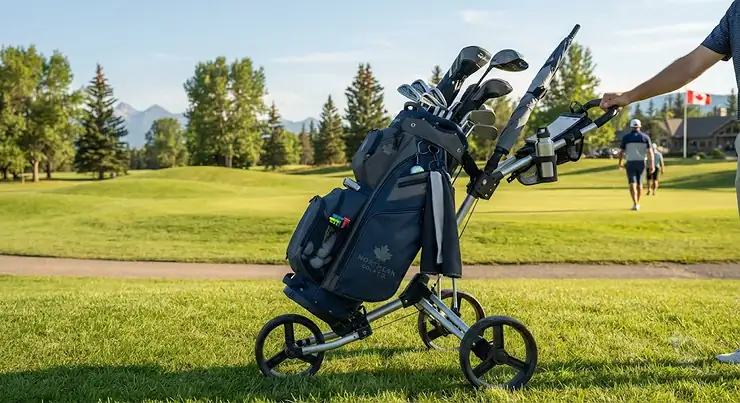
Every golfer who has ever wrestled a wobbly bag onto a three-wheeled trolley knows the problem isn’t the cart. It’s the bag. golf bags compatible with push carts need to do something a shoulder-carry stand bag was never designed to do: sit flat, stay put over bumpy fairways, and let you reach every pocket without unclipping anything. Get the fit wrong and you’ll spend your round nudging a leaning bag back into place instead of reading your putts.
This guide walks through seven real, currently available bags that pair well with common push carts — from the Sun Mountain C-130 to budget-friendly options from Datrek — with honest commentary drawn from published specs and aggregated reviewer feedback, not fabricated hands-on claims. We’ll also dig into strap systems, attachment points, and the small compatibility checks that separate a bag that rides smoothly from one that rattles loose by the ninth hole.
What are golf bags compatible with push carts? They’re cart-style golf bags built with a flat, wide base and reinforced strap loops or lock-in mechanisms so they sit securely on a manual trolley’s bag rest, rather than a rounded stand-bag base meant for shoulder carry. Golf remains hugely popular here — Golf Canada’s 2023 participation data shows Canadians played 74 million rounds that year, a 24% jump from 2019, and a meaningful share of that growth is happening among walkers pushing their own gear. As always with Amazon.ca listings, treat any price you see as a snapshot — check current price before buying, since Amazon adjusts pricing constantly.
Quick Comparison Table
| Bag | Weight | Strap/Mount System | Best For |
|---|---|---|---|
| Sun Mountain C-130 | ~6.6-6.9 lbs (3 kg) | Smart Strap dual-Velcro pass-through | Best all-rounder |
| Sun Mountain Sync | ~6 lbs (2.7 kg) | Bungee pass-through, anti-twist base | Push-cart-specific fit |
| Bag Boy Chiller Pro | ~5.4-6 lbs (2.5 kg) | Top-Lok lock-on (2017+ Bag Boy carts) | Strap-free security |
| Titleist Cart 15 | ~6.5 lbs (3 kg) | Premium single strap, 15-way top | Organization-focused |
| Callaway ORG 14 | ~6.5-7 lbs (3 kg) | Dual adjustable padded straps | Balanced weight/pockets |
| Datrek Lite Rider 2.0 | Lightweight class | Top-Lok compatible | Budget buyers |
| Motocaddy Lite Series | ~4.85 lbs (2.2 kg) | Elasticated universal straps | Lightest overall |
Looking at the spread above, weight and strap system matter more than pocket count once a bag is actually mounted: the Bag Boy Chiller Pro and Motocaddy Lite Series trade some storage for a lighter push, while the Sun Mountain C-130 and Titleist Cart 15 lean into organization at the cost of a pound or two. If your push cart already has a locking bracket (like Bag Boy’s Top-Lok carts), a bag built for that exact system will out-perform a generic strap-on option every time.
💬 Just one click — help others make better buying decisions too!😊
Top 7 Golf Bags Compatible With Push Carts: Expert Analysis
1. Sun Mountain C-130 Cart Bag — the veteran all-rounder that fits almost any cart
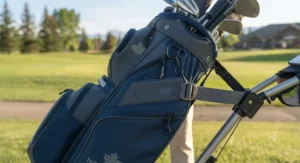
The Sun Mountain C-130 has anchored Sun Mountain’s cart bag lineup for roughly two decades, and it earns that longevity honestly. The bag runs about 6.6-6.9 lbs (3 kg), with a 14-way top featuring full-length individual dividers and a dedicated putter well, plus 11 pockets including a ventilated cooler pouch and a magnetic-close rangefinder pocket. What matters in practice is the Smart Strap System: two Velcro straps loop the bag to a cart’s frame while leaving a pass-through gap so pockets stay fully accessible, which solves the classic annoyance of straps blocking your glove pocket mid-round. Based on the spec comparison against rival cart bags, the C-130’s reverse-orientation top and forward-facing pockets are genuinely built around cart use, not adapted from a stand-bag shell as an afterthought. Reviewers consistently note the individual full-length dividers as the standout feature, praising how they stop shafts and grips from tangling on rough terrain, though a handful mention the single shoulder strap feels like an afterthought for anyone who occasionally carries the bag on foot without a cart. This is the bag for golfers who want one cart bag that works on both a push cart and a riding cart without swapping gear.
Pros:
- ✅ 14-way full-length dividers keep every club separated
- ✅ Smart Strap pass-through preserves pocket access
- ✅ Insulated cooler pocket plus rangefinder storage
Cons:
- ❌ Single shoulder strap is weak for foot-carry days
- ❌ Among the pricier cart bags in this roundup
Expect a price around C$350-C$400 at the time of research, though prices may vary — check current price before you buy. For golfers who want one bag to handle both trolley and riding-cart rounds, the Sun Mountain C-130 remains the safest, most proven pick.
2. Sun Mountain Sync Cart Bag — purpose-built for push-cart mounting
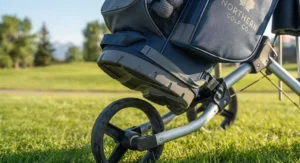
Where the C-130 is a cart bag that also works on a trolley, the Sun Mountain Sync flips that priority: it’s engineered specifically for push carts from the ground up. Weighing roughly 6 lbs (2.7 kg), its standout feature is an oval-shaped anti-twist base, molded so it seats directly over the bag rest on Sun Mountain’s own Speed Cart V1R and Pathfinder PX3/PX4 models with almost no side-to-side movement — a detail that matters more than any spec sheet number once you’re pushing over cart-path seams. The pass-through bungee strap system holds the bag flush against the cart frame instead of letting it lean, and every pocket faces forward for one-handed access while walking. What most buyers overlook about the Sync is that this tight-fit design is a trade-off: it performs best when paired with a compatible cart shape, and golfers running an older or off-brand trolley may need to test the fit before committing. Aggregated reviewer sentiment frames the Sync as one of the more secure-riding push-cart bags on the market, with the anti-twist base specifically singled out as the reason it doesn’t shift on hilly courses.
Pros:
- ✅ Anti-twist oval base resists shifting on hills
- ✅ Forward-facing pockets for on-the-move access
- ✅ Purpose-built for push-cart bag rests, not adapted
Cons:
- ❌ Best fit is with Sun Mountain-brand carts specifically
- ❌ Fewer premium extras than the flagship C-130
Pricing typically lands in the C$350-C$420 range at the time of research. If your push cart is a Sun Mountain model, the Sun Mountain Sync is arguably the tightest factory-matched fit you’ll find.
3. Bag Boy Chiller Pro Cart Bag — the lock-on system that skips straps entirely
The Bag Boy Chiller Pro takes a different approach to the entire strap problem: it mostly avoids it. Its patented Top-Lok technology lets the bag lock directly onto any 2017-or-newer Bag Boy push or electric cart, eliminating the need for cart straps altogether and removing the twisting that loose straps often cause. On paper this means less setup time at the first tee and one less thing that can loosen mid-round; in practice, reviewers testing the bag describe it as an easy top pick for anyone who wants simple, reliable mounting without fiddling with buckles. Beyond the mounting system, the bag carries a redesigned 14-way organizer top with full-length individual dividers, a rubberized putter well sized for oversized grips, and nine zippered pockets including a fleece-lined valuables pocket. The genuinely clever touch is the removable insulated cooler pocket, which holds up to six 12-ounce cans — a detail testers have specifically flagged as a differentiator versus bags that only offer a single small cooler sleeve. The catch: Top-Lok is a closed ecosystem. It only clicks onto Bag Boy (and sibling brand Datrek) carts, so this bag isn’t the pick if your trolley is a different brand.
Pros:
- ✅ Top-Lok eliminates straps and twisting entirely
- ✅ Removable insulated cooler holds six cans
- ✅ 14-way IDS dividers with rubberized putter well
Cons:
- ❌ Top-Lok only fits 2017+ Bag Boy/Datrek carts
- ❌ Less useful if you switch cart brands later
Look for it around C$300-C$340 in the mid-tier bracket, prices varying by retailer. For Bag Boy cart owners specifically, the Bag Boy Chiller Pro is close to a no-brainer.
4. Titleist Cart 15 Cart Bag — the most refined club organization in this lineup
The Titleist Cart 15 leans hard into one thing: keeping fifteen dividers’ worth of clubs and shafts completely separated. At roughly 6.5 lbs (3 kg), with an 11-inch top width, 9.5-inch base, and a premium single strap, it’s built with a wider stance than several competitors here, which translates to better balance once it’s loaded on a push cart’s bag rest. Here’s what to weigh: the 15-way full-length divider system is the highest divider count in this roundup, meaning even a bag stuffed with hybrids, multiple wedges, and a rangefinder stays tangle-free — genuinely useful for golfers who hate digging for a club mid-swing-thought. Eleven pockets round out the storage, including multiple valuables compartments. Aggregated reviewer feedback is largely positive on space and the magnetic front flap, though a recurring complaint is that the single strap doesn’t cinch quite tight enough for golfers who also carry the bag on foot occasionally, echoing a theme seen across several premium cart bags in this category. What the spec sheet won’t tell you, but reviewers note, is that the wider base actually helps stability on push carts more than the strap tightness does day to day.
Pros:
- ✅ 15-way full-length dividers, most in this lineup
- ✅ Wide 9.5-inch base improves push-cart balance
- ✅ Multiple valuables pockets with magnetic front flap
Cons:
- ❌ Single strap runs loose for some foot-carry use
- ❌ No dedicated cooler pocket unlike Bag Boy Chiller Pro
Expect a price in the C$330-C$390 range, subject to change — always check current price on the listing. Golfers who prioritize immaculate club organization over cooler space should put the Titleist Cart 15 near the top of their shortlist.
5. Callaway ORG 14 Cart Bag — the balanced pick with the deepest pocket count
The Callaway ORG 14 shows up in comparative reviews with the highest overall pocket count of the bags tested against it, alongside a weight class that sits comfortably between the lighter Titleist option and the heavier Ping alternatives reviewers compared it to. Its dual-adjustable padded shoulder straps measure roughly 2.5 inches wide with a 12 mm EVA foam core wrapped in a breathable mesh liner — comfortable padding that matters when you’re lifting the bag on and off a cart rather than wearing it all round. Based on the spec comparison, that dual-strap design is more of a stand-bag holdover than a push-cart-specific mount, so golfers relying purely on cart straps rather than lifting the bag may find the padding somewhat redundant for their use case — though it’s a genuine advantage for anyone splitting rounds between walking and riding. The insulated cooler bag scored well in the same comparative review, described as larger than some rivals’, while reviewers noted the trade-off of no dedicated phone pocket, a small but real annoyance for GPS-app users. Overall, this bag reads as the generalist’s choice: strong across the board, without a single stand-out weakness.
Pros:
- ✅ Highest pocket count among comparable premium bags
- ✅ Padded dual straps ease on/off-cart lifting
- ✅ Larger insulated cooler bag than several rivals
Cons:
- ❌ No dedicated phone pocket
- ❌ Dual-strap design adds bulk versus single-strap rivals
Pricing tends to run in the C$400-C$450 range at the premium end, prices varying by retailer and time of year. If pocket space and lift comfort matter more than raw weight, the Callaway ORG 14 earns its spot.
6. Datrek Lite Rider 2.0 Cart Bag — the budget entry that still locks onto a cart
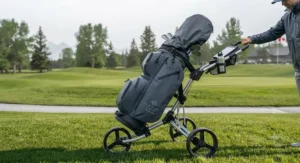
Datrek sits under the same parent company as Bag Boy, and the Datrek Lite Rider 2.0 benefits directly from that relationship: it’s built to work with the same Top-Lok bag-to-cart attachment system found on the pricier Chiller Pro, so budget-focused golfers don’t have to give up secure, strap-free mounting to save money. Published spec sheets for this model are thinner than for the flagship Sun Mountain or Titleist bags, and in the interest of honesty, we won’t invent divider counts or pocket specs we can’t verify — what’s consistently confirmed is the lightweight rider-style build and Top-Lok compatibility. What most buyers overlook about budget cart bags in general is that the compatibility system, not the pocket count, is usually the deciding factor for day-to-day frustration; a bag that locks in cleanly beats a feature-loaded bag that leans sideways. For golfers newer to push-cart golf who aren’t ready to spend C$350+ on a bag, this is a reasonable low-risk starting point, provided your cart is a compatible Bag Boy-family model.
Pros:
- ✅ Shares Top-Lok compatibility with pricier siblings
- ✅ Meaningfully lighter price point than flagship bags
- ✅ Lightweight rider-style construction for easier handling
Cons:
- ❌ Fewer publicly documented specs than flagship models
- ❌ Top-Lok fit still limited to Bag Boy/Datrek carts
Typical pricing sits around C$260-C$310, though as with all Amazon.ca listings, treat this as a rough range rather than a guaranteed figure. For first-time push-cart buyers watching their budget, the Datrek Lite Rider 2.0 is a sensible entry point.
7. Motocaddy Lite Series Cart Bag — the lightest bag with the broadest strap compatibility
At roughly 2.2 kg (4.85 lbs), the Motocaddy Lite Series is meaningfully lighter than every other bag in this list, built from a durable lightweight nylon shell with seven well-organized pockets. It’s designed first for a snug fit with Motocaddy’s own electric and push trolleys via an Easi-lock-style base, but its elasticated strap system is genuinely generic enough to loop around most standard push-cart frames, which is why it shows up repeatedly in “universal fit” discussions rather than being locked to one brand’s proprietary hardware the way Bag Boy’s Top-Lok bags are. Reviewers testing this bag against premium electric trolleys specifically highlighted “superb trolley compatibility” as a defining trait. Here’s what to weigh: the trade-off for that low weight is a smaller top divider count and less structured club separation than the 14- or 15-way bags above, so golfers carrying a full 14-club set with multiple wedges may find clubs sit a little closer together than they’d like. For golfers who value a light push above all else — especially walking multiple rounds a week — that trade-off is usually worth it.
Pros:
- ✅ Lightest bag in this roundup at ~2.2 kg
- ✅ Elasticated straps fit most generic push-cart frames
- ✅ Durable nylon build despite the low weight
Cons:
- ❌ Fewer top dividers than 14/15-way rivals
- ❌ Best-optimized for Motocaddy’s own trolley range
Expect a price around C$300-C$350, always subject to current listings. For golfers who walk often and want the lightest possible bag on a generic push cart, the Motocaddy Lite Series is the standout.
Best Cart Bag Straps: What Actually Keeps a Bag Secure
Not every strap system is created equal, and this is where a lot of buyers get burned after the purchase, not before it. The single most useful thing to understand about best cart bag straps is that there are really three different approaches on the market: pass-through Velcro or elastic straps (used by the Sun Mountain C-130 and Sun Mountain Sync), proprietary lock-on hardware (Bag Boy and Datrek’s Top-Lok, used on the Bag Boy Chiller Pro and Datrek Lite Rider 2.0), and generic elasticated bungee straps that came with the cart itself, which is what most push carts — including Clicgear models — ship with by default.
| Strap Type | Example Bags | Setup Effort | Failure Point |
|---|---|---|---|
| Pass-through Velcro/bungee | Sun Mountain C-130, Sun Mountain Sync | Low, reusable | Can loosen over rough terrain |
| Lock-on proprietary system | Bag Boy Chiller Pro, Datrek Lite Rider 2.0 | Very low, no straps | Brand-locked to matching cart |
| Generic elastic straps | Titleist Cart 15, Callaway ORG 14, Motocaddy Lite Series | Moderate, needs adjusting | Wears out, needs replacement |
The analysis here is straightforward: lock-on systems win on convenience but sacrifice flexibility if you ever switch cart brands, while generic elastic straps are less elegant but work across almost any cart, including third-party trolleys like Clicgear. Reviewers and cart-forum discussions consistently note that stock elastic straps are also the most common wear item, meaning most golfers will eventually replace them at least once regardless of which bag they buy.
✨ Don’t Miss These Exclusive Deals!
🔍 Compare cart bags side by side and lock in the model that actually fits your trolley. Click through to check current pricing before it changes!
Universal Cart Strap Golf Bag Systems Explained
A universal cart strap golf bag setup is essentially any strap hardware not tied to a single manufacturer’s push cart — the kind that works whether you’re pushing a Clicgear, a Bag Boy, or a generic three-wheeler picked up secondhand. Clicgear, one of the most widely used third-party push cart brands, sells its own replacement elastic bag straps and a silicone strap upgrade kit that fits models 1.0 through 3.5+, which tells you something important: even cart manufacturers expect these straps to wear out and need replacing over time.
Universal doesn’t mean identical, though. Reviewers consistently note that some golf bags, particularly rounder-bottomed stand-style bags mistakenly used as cart bags, simply don’t sit flat on a generic bag rest no matter how the straps are adjusted — Clicgear’s own support documentation even acknowledges that “in some rare instances, you may have a bag that does not fit properly on the Clicgear cart due to the shape of the bottom of the bag.” That’s a genuinely useful piece of honest guidance: before buying any bag marketed as universally compatible, confirm it has a flat or molded cart-style base, not a rounded stand-bag bottom.
Strap Attachment Points: How to Check Before You Buy
Strap attachment points are the loops, buckles, or moulded slots on a bag’s back panel where cart straps thread through, and checking them before purchase avoids a frustrating return. Here’s how to evaluate them in five steps:
- Count the attachment loops. Most cart-specific bags have two, positioned upper and lower on the back panel, matching the two straps on most push carts.
- Check loop material. Reinforced nylon webbing loops outlast thin fabric tabs, especially with a fully loaded bag bouncing over cart paths.
- Look for a pass-through gap. Bags like the Sun Mountain C-130 design their attachment points so straps don’t block pocket zippers — a small detail with a big day-to-day payoff.
- Confirm base shape compatibility. A flat or moulded base seats more securely against a cart’s bag rest than a rounded stand-bag base.
- Match strap width to your cart’s buckle hardware. Some carts use wider webbing than others; a mismatch can mean straps that won’t cinch fully tight.
What most buyers overlook is step five — strap width mismatches are a common, avoidable source of the “my bag keeps sliding” complaint seen across owner reviews.

Cart Compatibility Check: 5 Steps Before You Click Buy
Running a proper cart compatibility check takes about two minutes and saves a return shipment. Before adding any of the seven bags above to your cart, walk through this:
- Confirm your push cart’s brand and model year, since proprietary systems like Top-Lok only fit specific generations.
- Measure your cart’s bag-rest width against the bag’s base dimensions where listed.
- Check whether your cart uses Velcro, elastic bungee, or a lock-in bracket, and match that to the bag’s strap type.
- Read the manufacturer’s compatibility notes directly — Bag Boy, for instance, states plainly that Top-Lok only works with 2017-and-newer carts.
- If in doubt, favour a bag with generic elastic strap loops over a brand-locked system, since it will fit a wider range of carts including Clicgear.
On paper this looks like extra homework, but reviewers who skip this step are disproportionately the ones leaving complaints about bags that lean, twist, or won’t cinch down — a pattern worth taking seriously before you buy.
Secure Bag Mounting: A Practical Setup Guide
Getting secure bag mounting right on day one prevents the wobble that ruins an otherwise good bag. Start by loading the bag roughly as you would for a full round — clubs, balls, and a rangefinder — before mounting it, since an empty bag sits differently than a loaded one and straps adjusted empty will loosen once weight is added. Position the bag so its base sits fully flat against the cart’s bag rest rather than propped at an angle; even a slight tilt compounds into a lean by hole six. Thread pass-through straps (as on the Sun Mountain C-130 and Sun Mountain Sync) so they cross the widest part of the bag’s midsection rather than near the top, which better resists the twisting motion carts pick up on cambered fairways.
For lock-on systems like Bag Boy’s Top-Lok, listen for the audible click that confirms full engagement — a common first-time mistake is assuming the bag is locked when it’s only partially seated. In the first thirty days, recheck strap tension every few rounds, since new webbing and Velcro both stretch slightly with use. A quick maintenance habit worth adopting: wipe down strap hardware after wet rounds, since trapped moisture accelerates wear on both elastic and Velcro attachment points — a small step that noticeably extends strap lifespan.
📌 Ready to build your own secure setup? Browse the full lineup and find your fit today!
Real-World Scenarios: Which Cart Bag Fits Your Game
The weekend walker on a budget. A golfer playing twice a month on a public course, using a basic Clicgear-style cart borrowed or bought secondhand, doesn’t need brand-locked hardware. The Datrek Lite Rider 2.0 or Motocaddy Lite Series make more sense here — generic strap compatibility and a lighter overall bag matter more than premium organization for someone not chasing every last convenience feature.
The regular Bag Boy cart owner. For golfers who already own a modern Bag Boy push or electric cart, fighting straps is simply unnecessary. The Bag Boy Chiller Pro or budget-friendly Datrek Lite Rider 2.0 both use Top-Lok, meaning setup becomes a five-second click rather than a strap-adjustment ritual every round.
The golfer who splits time between riding and walking. Someone who rides carts on weekdays but walks weekend rounds needs a bag that performs on both. The Sun Mountain C-130 or Callaway ORG 14 cover that dual use case — both include comfortable strap systems built for lifting on and off a riding cart, while still mounting securely to a push cart.
Common Mistakes When Buying a Cart Bag for a Push Cart
The most frequent, avoidable mistake is buying a stand bag and expecting cart-bag performance — rounded stand-bag bases simply don’t seat the same way on a flat bag rest, regardless of how tightly the straps are cinched. A close second is ignoring proprietary lock systems entirely; golfers who buy a Top-Lok bag without checking their cart’s manufacture year end up needing separate strap hardware anyway, defeating the purpose of the purchase. A third common error is prioritizing pocket count over base stability — a bag with fifteen pockets that leans sideways every hole is a worse experience than a simpler bag that sits flat. Finally, several reviewers note that buyers underestimate weight: a heavier bag doesn’t feel like much in a showroom, but it changes how a push cart handles on hills, particularly for anyone playing hillier Canadian courses.
Cart Bag vs Stand Bag: Which Is Right for Push-Cart Golfers
| Factor | Cart Bag | Stand Bag |
|---|---|---|
| Base shape | Flat/moulded, seats on cart rest | Rounded, meant for legs to deploy |
| Weight | Heavier, more storage | Lighter, built for shoulder carry |
| Pockets | More, cart-oriented (coolers, valuables) | Fewer, walk-focused |
| Best For | Push-cart or riding-cart golfers | Golfers who occasionally carry by hand |
A cart bag and a stand bag aren’t interchangeable despite both technically fitting on some carts. Cart bags like the Titleist Cart 15 and Callaway ORG 14 are built heavier with more storage because they’re never meant to be lifted onto your shoulder for a full round — that weight becomes a non-issue once it’s strapped to a cart. Stand bags, by contrast, sacrifice storage and structure for a lighter shoulder-carry experience, and forcing one onto a push cart regularly is exactly the mismatch behind the “my bag won’t sit flat” complaints. If you’re buying specifically for push-cart use and don’t expect to hand-carry the bag regularly, a true cart bag will outperform a stand bag on every practical measure except raw portability.
Long-Term Cost & Maintenance of Cart Bag Straps
The upfront price of a cart bag is only part of the real cost. Strap hardware — whether Velcro, elastic, or bungee — is a wear item across every brand in this roundup, and Clicgear’s own parts catalogue selling replacement elastic and silicone straps confirms this is expected, not a defect. Budgeting an extra C$10-C$40 every one to two seasons for strap replacement is realistic regardless of which bag you choose. Proprietary lock systems like Top-Lok have a different cost profile: no strap replacement needed, but you’re functionally locked into that cart ecosystem, meaning a future cart upgrade to a different brand could mean re-buying a bag too. Over a five-year ownership window, a mid-range bag like the Titleist Cart 15 or Callaway ORG 14 paired with occasional strap replacements typically works out cheaper in total cost of ownership than repeatedly buying budget bags that wear out faster under cart strain.
Features That Actually Matter (And Those That Don’t)
Cutting through marketing language, a few features genuinely affect day-to-day performance: a flat or moulded base, a pass-through or lock-on strap system, and full-length club dividers that actually separate shafts rather than just the top openings. An insulated cooler pocket is a real, tangible perk for warm-weather rounds, as reviewers repeatedly call out on the Bag Boy Chiller Pro and Callaway ORG 14. On the other hand, some marketed features matter less than they sound: an extra one or two pockets beyond what you already fill, cosmetic colour options, and oversized ball-pocket capacity rarely change the actual push-cart experience. The spec sheet won’t tell you this, but reviewers note that strap and base quality consistently outweighs pocket count in real-world satisfaction — worth remembering the next time a listing leads with “17 pockets!” as its headline feature.
Safety, Fit & General Compliance Notes
Golf bags themselves aren’t subject to specific Canadian safety certification the way electrical or children’s products are, but a few general precautions apply. Canada’s physical activity guidelines recommend at least 150 minutes of moderate-to-vigorous activity per week for adults, and walking a full round with a properly mounted cart bag is a practical way to work toward that — provided the bag doesn’t strain your back from repeated lifting on and off a cart, which is where padded straps like those on the Callaway ORG 14 genuinely help. Push cart manufacturers typically list a maximum weight capacity (commonly around 35 lbs / 16 kg); loading a bag beyond that limit stresses both the cart frame and the strap hardware, accelerating wear regardless of which bag you own. If you’re new to walking golf specifically for the exercise benefit, easing into it over a few rounds rather than committing to 18 holes immediately is a sensible approach, similar to any new physical activity.
FAQ
❓ Do all golf bags fit on a push cart?
❓ What is the best strap system for a push cart bag?
❓ How do I attach a golf bag to a push cart without straps?
❓ Are cart bags heavier than stand bags?
❓ Can I use a riding cart bag on a Clicgear push cart?
Conclusion
Choosing among golf bags compatible with push carts really comes down to matching strap or mount type to the cart you already own, then layering personal priorities like cooler space, divider count, or weight on top of that foundation. The Sun Mountain C-130 remains the safest all-around pick for golfers who move between push and riding carts, while the Bag Boy Chiller Pro and Datrek Lite Rider 2.0 reward anyone already inside the Bag Boy ecosystem with genuinely strap-free convenience. For golfers who simply want the lightest possible push, the Motocaddy Lite Series is hard to beat, and for maximalists who want every pocket and divider available, the Titleist Cart 15 and Callaway ORG 14 both deliver. As Canadian golf continues its post-pandemic growth — what CBC has called a national golf renaissance that’s brought new walkers and cart-pushers onto courses from coast to coast — getting this equipment decision right early saves both money and mid-round frustration down the line.
✨ Ready to upgrade your setup? Check today’s pricing on these top-rated cart bags before you head to the course!
Recommended for You
- 14 Way Golf Bags: 7 Best Picks for 2026
- Lightweight Golf Bag for Seniors: 7 Best Picks for 2026
- 7 Best Waterproof Golf Bags in Canada (2026): Tested amp; Rated
Disclaimer: This article contains affiliate links. As an Amazon Associate, I earn from qualifying purchases. If you purchase products through these links, we may earn a small commission at no additional cost to you.
✨ Found this helpful? Share it with your friends! 💬🤗
