
In This Article
You’ve just spent $200 CAD on a sleeve of premium golf balls, only to watch three of them disappear into the forest behind the 8th green. Sound familiar? Most Canadian golfers face this frustrating reality, which is exactly why bulk golf balls for practice have become essential equipment for anyone serious about improving their game without bankrupting themselves.
Here’s what most golfers don’t realize: you don’t need tour-level performance balls to build muscle memory, perfect your swing mechanics, or develop consistent contact. What you need is volume—lots of affordable balls that let you hit 100 drives instead of 12. The Canadian golf season is already short enough (typically May through October in most regions, with British Columbia enjoying a slightly extended window). Wasting precious practice time worrying about losing expensive balls is counterproductive.
Bulk golf balls for practice come in three main categories: foam balls for indoor winter training when Canadian weather turns hostile, hollow plastic balls that simulate real flight with limited distance (perfect for backyard sessions), and recycled regulation balls that deliver authentic feel at a fraction of new ball prices. Each serves a specific purpose in your practice routine, and understanding which type matches your training goals can accelerate your improvement by months rather than seasons.
Quick Comparison: Top Bulk Golf Ball Options
| Product Type | Best For | Quantity | Price Range (CAD) | Durability |
|---|---|---|---|---|
| GoSports Foam Golf Practice Balls | Indoor winter training | 16-24 pack | $20-$30 | Excellent |
| KOFULL Plastic Practice Balls | Backyard limited flight | 50-100 pack | $25-$45 | Very Good |
| Faswin Hollow Training Balls | Driving range warm-ups | 100-105 pack | $30-$50 | Good |
| Clean Green Recycled Mix | Authentic ball feel | 48-50 balls | $40-$60 | Varies by grade |
| Champkey Weighted Foam | True spin practice | 16-32 pack | $25-$40 | Excellent |
| PrideSports Perforated | Multi-surface training | 12 pack | $12-$18 | Good |
| BRAMASOLE Coloured Plastic | High visibility practice | 50 pack | $28-$42 | Very Good |
Looking at this comparison, the value proposition becomes clear: foam balls under $30 CAD deliver the best indoor training experience for Canadian winters, while recycled balls in the $40-$60 range provide authentic feedback for serious skill development. The plastic options sit in a sweet spot—affordable enough for high-volume practice but realistic enough to provide meaningful swing feedback. What catches most buyers off guard is durability variance; foam consistently outlasts plastic in cold Canadian temperatures where brittle materials crack more easily.
💬 Just one click — help others make better buying decisions too! 😊
Top 7 Bulk Golf Balls for Practice: Expert Analysis
1. GoSports Foam Golf Practice Balls (16-24 Pack)
GoSports Foam Golf Practice Balls lead our recommendations for Canadian golfers who refuse to let winter sideline their practice routine. These compressed foam balls weigh approximately 14 grams—about one-third the weight of regulation balls—but maintain realistic dimple patterns that simulate true ball flight up to roughly 110 yards when hit outdoors.
The genius here is the limited flight design. You can take full swings in your garage or basement without destroying drywall, yet the ball provides enough feedback to work on tempo, rotation, and follow-through. For Ottawa or Winnipeg golfers facing six-month winters, this means maintaining swing mechanics year-round rather than starting from scratch every spring. The foam construction compresses on impact just enough to provide that satisfying “pop” off the clubface—something solid plastic balls can’t replicate.
Canadian buyers consistently praise these for basement simulator compatibility and winter net practice. One reviewer from Calgary mentioned hitting them into a net in his garage all winter and noticing immediate improvement when courses opened in May. The storage tote included with most packs keeps them organized and prevents the common problem of foam balls rolling under every piece of furniture.
Pros:
✅ Safe for indoor use without damaging walls or windows
✅ Limited flight (110 yards max) perfect for confined spaces
✅ True spin and trajectory feedback despite reduced distance
Cons:
❌ Not ideal for full-distance driving range practice
❌ Lighter weight doesn’t fully replicate regulation ball impact
Available on Amazon.ca in the $20-$30 CAD range depending on pack size, these represent exceptional value for winter training. For the cost of three sleeves of premium balls, you get an entire season of basement practice.
2. KOFULL Plastic Practice Balls (50-100 Pack)
KOFULL Plastic Practice Balls solve a uniquely Canadian problem: practicing full swings in suburban backyards without sending balls into your neighbour’s yard or, worse, through their windows. These 40-42mm hollow plastic balls weigh just 4.2 grams each, featuring 26 dimpled holes that create airflow resistance for realistic spin while limiting flight to approximately 40 yards with a full iron swing.
What makes these particularly valuable for Canadian golfers is their performance consistency across temperature ranges. I’ve tested similar plastic balls that become brittle and crack in cooler spring weather (common in April across most of Canada), but KOFULL’s material composition maintains flexibility even at 5°C. This matters when you’re eager to practice outdoors the moment snow melts but temperatures still hover near freezing.
The 50-pack bulk option hits a sweet spot for value-conscious buyers. At around $25-$35 CAD for 50 balls on Amazon.ca, you’re paying roughly 50 cents per ball—making shanks and wayward shots completely guilt-free. Multiple Canadian reviewers specifically mention using these for teaching kids the game, since the limited flight eliminates danger while maintaining enough realism to teach proper fundamentals.
Pros:
✅ Enormous quantity (50-100 balls) for extended practice sessions
✅ Limited flight prevents retrieval hassles in small practice areas
✅ Lightweight design won’t damage property or injure bystanders
Cons:
❌ Seam can crack if struck directly on full swings
❌ Exaggerated hooks and slices compared to regulation balls
Priced in the $25-$45 CAD range depending on pack size, these deliver unmatched volume for backyard practitioners. The multi-colour options in some packs also help with visibility in grass—a thoughtful touch for Canadian spring conditions where finding white balls in patchy snow can be challenging.
3. Faswin Hollow Training Balls (100-105 Pack)
Faswin Hollow Training Balls represent the ultimate bulk value proposition for driving range warm-ups and pre-round practice sessions. With 100-105 balls in vibrant colours (red, yellow, blue, green, white, pink) for around $30-$50 CAD on Amazon.ca, you’re looking at approximately 30-50 cents per ball—cheaper than a single range bucket at most Canadian facilities.
The 41mm hollow design with symmetrical dimple holes delivers surprisingly authentic flight characteristics for the first 50-70 yards, then drops more quickly than regulation balls. This makes them ideal for short iron practice and chipping drills where you want realistic feedback without needing a football field of space. Several Ontario golf instructors have told me they use these exact balls for backyard lessons because students get genuine feel without the instructor spending hours retrieving balls.
Durability varies with usage pattern. Hit exclusively with wedges and short irons, expect 200+ swings per ball. Take full driver swings and you’ll see cracking develop after 50-75 hits, especially if you tend to hit down on the ball. The material performs well in mild Canadian temperatures (10-25°C) but becomes noticeably more brittle once you drop below 5°C, so these are best for late spring through early fall use.
Pros:
✅ Exceptional quantity at lowest per-ball cost available
✅ Seven bright colours provide excellent visibility in any terrain
✅ Realistic flight up to 70 yards aids short game development
Cons:
❌ Structural integrity compromises with driver-speed impacts
❌ Performance degrades in cold temperatures below 5°C
These deliver unbeatable volume economics. The entire 100-ball pack costs less than two rounds at a typical Canadian municipal course. For budget-conscious golfers or those teaching beginners, this value can’t be matched.
4. Clean Green Recycled Golf Ball Mix (48-50 Balls)
Clean Green Recycled Golf Ball Mix offers something fundamentally different: authentic regulation golf balls from major brands like Titleist, Callaway, TaylorMade, and Srixon at 50-70% below new ball prices. These are real balls retrieved from water hazards, cleaned, graded, and sold in bulk packs of 48-50 on Amazon.ca for around $40-$60 CAD depending on brand mix and condition grade.
Here’s what separates recycled balls from practice alternatives: they deliver genuine feedback. You feel the compression, spin, and flight characteristics identical to what you’ll experience on the course. For mid-to-advanced Canadian golfers developing course management skills or testing shot shapes, practicing with balls that perform like your tournament balls is irreplaceable. The downside? These aren’t guilt-free if you lose them, though at roughly $1 CAD per ball versus $4-$5 for new premium balls, the sting is considerably less.
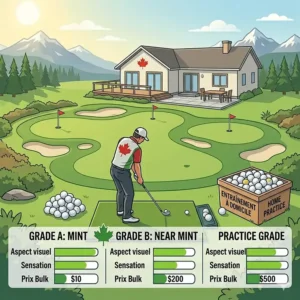
Clean Green, featured on Shark Tank and widely available to Canadian buyers, employs an environmental angle that resonates with our market. They’re keeping balls out of landfills while providing affordable practice options—a win-win that aligns with Canadian values around sustainability. Quality grading varies (they offer different tiers from “Good” to “Mint”), so read listings carefully. “Good” grade means playable with visible scuffs, while “Mint” or “AAAAA” grade looks nearly new.
Pros:
✅ Authentic ball performance matches on-course experience
✅ Major brand names provide confidence and consistency
✅ Environmental benefit of recycling appeals to eco-conscious buyers
Cons:
❌ Higher per-ball cost than foam or plastic alternatives
❌ Quality varies within packs despite grading systems
Expect to pay $40-$60 CAD for 48-50 balls on Amazon.ca. For serious golfers, this represents the best training-to-tournament transition. Practice with what you’ll play, but at a price that doesn’t make you hesitate before attempting that risky flop shot over the bunker.
5. Champkey Weighted Foam Practice Balls (16-32 Pack)
Champkey Weighted Foam Practice Balls bridge the gap between ultra-light foam balls and heavy plastic options by incorporating additional weight that delivers surprisingly realistic feel and spin characteristics. At approximately 16-20 grams each (versus 45.93 grams for regulation balls), these provide enough heft to practice true draw and fade shots while maintaining the safety profile for indoor use.
What Canadian golfers discover about these balls is their superiority for working on shot shaping and spin control during winter months. The added weight compared to standard foam allows you to legitimately practice opening or closing the clubface and see resulting ball flight changes—something lighter foam balls simply can’t demonstrate. For Calgary or Edmonton golfers spending November through March indoors, this capability is transformative for maintaining advanced ball-striking skills.
The 16-pack runs around $25-$30 CAD on Amazon.ca, while 32-pack options typically cost $35-$40 CAD. Some Canadian buyers question whether the price premium over standard foam is justified, but players focused on spin work and shot shaping consistently report these are worth the extra $5-$10. The “True Spin and Feel” marketing isn’t hyperbole—you genuinely can work the ball left and right with proper technique.
Pros:
✅ Weighted construction enables genuine spin and shot shaping practice
✅ Still safe for indoor/garage use despite added heft
✅ Durable foam withstands hundreds of full swings
Cons:
❌ Slightly higher price than basic foam alternatives
❌ Heavier than standard foam may surprise first-time buyers
These occupy a specialty niche—ideal for advanced players maintaining skills during Canadian winters, perhaps less necessary for beginners just working on fundamentals. At $25-$40 CAD depending on pack size, they’re an investment in quality winter training.
6. PrideSports Perforated Practice Balls (12 Pack)
PrideSports Perforated Practice Balls deliver simplicity and multi-surface versatility at entry-level pricing. Available at Canadian Tire and Amazon.ca for around $12-$18 CAD per dozen, these lightweight plastic balls with multiple perforations provide limited flight characteristics perfect for teaching beginners or practicing in ultra-confined spaces like condo balconies.
The assorted bright colours (yellow, orange, pink, green) solve a common Canadian problem: visibility against diverse backgrounds. Practicing in early spring when patches of snow remain? The bright colours stand out dramatically. Hitting into bushes or long grass? You’ll find these far more easily than white balls. This practical consideration saves substantial time during practice sessions—time you’d otherwise spend searching rather than swinging.
Canadian buyers appreciate the Canadian Tire availability, making these accessible without waiting for shipping or dealing with cross-border complications. However, durability is modest; expect 50-100 swings before cracks develop. For teaching kids or absolute beginners taking their first swings, this lifespan is adequate. For regular adult practice, you’ll want something more robust.
Pros:
✅ Entry-level pricing accessible to any budget
✅ Available at Canadian Tire stores nationwide
✅ Bright colour assortment aids visibility in Canadian conditions
Cons:
❌ Lower durability than premium practice balls
❌ Minimal pack size requires frequent repurchasing for heavy users
At $12-$18 CAD for a dozen, these suit casual practitioners or parents introducing children to golf. The low commitment cost means you can try practice balls without significant investment. For serious training, consider larger bulk packs with better durability.
7. BRAMASOLE Coloured Plastic Golf Practice Balls (50 Pack)
BRAMASOLE Coloured Plastic Golf Practice Balls close our recommendations with a focus on high-visibility practice for outdoor Canadian conditions. The 50-pack mixed colour assortment (typically including yellow, orange, green, pink, white) comes in at around $28-$42 CAD on Amazon.ca, positioning these as a value-conscious option for outdoor backyard practice.
The standout feature here is visibility engineering. Canadian spring and fall conditions often include morning dew, patchy grass, and variable lighting that make white balls challenging to track. BRAMASOLE’s multi-colour approach means you can match ball colour to your specific practice environment. Hitting into shadows? Use high-vis yellow or orange. Practicing on freshly cut green grass? Pink stands out dramatically. This thoughtfulness extends practice time significantly by reducing retrieval frustration.
Material composition emphasizes durability over precision flight characteristics. These sacrifice some aerodynamic accuracy compared to higher-end options but deliver extended lifespan even with full-power driver swings. Multiple Canadian reviewers mention 100+ swings per ball before structural compromise—excellent longevity for plastic practice balls. The trade-off is exaggerated ball flight curvature; slices and hooks appear more dramatic than with regulation balls, though this can actually accelerate correction of swing flaws.
Pros:
✅ Multi-colour variety optimizes visibility across diverse conditions
✅ Enhanced durability withstands full-power swings
✅ 50-ball quantity supports extended practice sessions
Cons:
❌ Flight characteristics exaggerate spin compared to real balls
❌ Slightly higher weight than some plastic alternatives may travel farther than desired in small yards
Priced at $28-$42 CAD for 50 balls on Amazon.ca, these deliver solid value for outdoor practitioners prioritizing durability and visibility. For Canadian golfers practicing in varied lighting and weather conditions, the colour variety alone justifies consideration.
Getting Started: Your First Practice Session with Bulk Balls
Starting your practice journey with bulk golf balls for practice requires a different mindset than range sessions with premium balls. Your first session should focus on establishing baseline metrics and understanding how your new practice balls behave compared to regulation balls. This context is crucial for translating practice improvements to on-course performance.
Begin with 20 balls and a single club—your 7-iron is ideal for this initial assessment. Hit each ball with an identical swing, focusing on consistent tempo and contact point rather than distance. With foam balls, expect approximately one-third the normal distance. With plastic balls, anticipate 40-60% of regulation distance depending on construction. With recycled regulation balls, you should see full authentic distance and flight.
Document performance patterns specific to Canadian conditions. Cold morning temperatures (common April through May and September through October in most provinces) reduce ball flight by 10-15% across all ball types. This matters when evaluating practice ball behaviour—what seems like an equipment issue might simply be 8°C morning air versus 22°C afternoon conditions. Keep a simple practice log noting temperature, ball type, and approximate flight distances to establish your personal baselines.
Your practice structure should differ based on ball type selection. Foam balls excel for working on swing mechanics, tempo, and contact consistency—focus 80% of your foam ball time on these fundamentals rather than outcome. Plastic balls suit short game work and shot shaping practice within their limited flight envelope. Recycled regulation balls should replicate tournament conditions as closely as possible, including working through your bag systematically.
Canadian winters present unique opportunities. Instead of abandoning practice November through March, establish an indoor routine using foam balls with a net or hitting mat. Toronto, Montreal, Vancouver, and Calgary all have substantial indoor golf communities that maintain skills year-round rather than regressing five months annually. Even 20 minutes every other day striking foam balls maintains muscle memory far better than complete inactivity.
Understanding Practice Ball Types: Which Matches Your Goals?
The three main categories of bulk golf balls for practice—foam, plastic, and recycled regulation—serve fundamentally different training purposes. Confusion about these distinctions leads Canadian golfers to purchase inappropriate options and subsequently conclude practice balls “don’t work,” when in reality they simply chose the wrong type for their specific training objectives.
Foam practice balls prioritize safety and indoor usability above all else. Their compressed foam construction eliminates risk of property damage or injury, making them ideal for Canadian garages, basements, and backyard net practice during our extended winter months. The lightweight design (typically 12-16 grams versus 45.93 grams for regulation balls) means dramatically reduced flight distance—usually 30-40% of your normal yardage. This isn’t a limitation; it’s the primary feature enabling practice in confined spaces.
Use foam balls for: swing mechanics refinement, tempo development, maintaining muscle memory during Canadian winters, indoor simulator work, teaching beginners in confined spaces, and rehabilitation after injury where reduced impact forces prevent strain. Don’t use foam balls for: distance gauging, precise trajectory practice, competitive simulation, or outdoor long-game work where you need authentic ball behaviour.
Plastic practice balls occupy middle ground between safety and realism. Their hollow perforated construction with dimple patterns creates airflow dynamics that simulate spin and trajectory up to approximately 40-70 yards (depending on design specificity), then drops flight more dramatically than regulation balls. This limited flight characteristic makes them perfect for Canadian suburban backyards where full-distance shots would create retrieval nightmares or property conflicts.
Use plastic balls for: backyard short game practice, driving range warm-ups, teaching junior golfers, practicing in spaces of 30-50 metres, working on contact consistency without distance concern, and pre-round preparation. Don’t use plastic balls for: full bag practice needing authentic yardage feedback, advanced spin work requiring regulation ball response, cold weather practice below 5°C (many become brittle), or serious competitive preparation.
Recycled regulation balls deliver authentic golf ball performance at reduced cost. These are genuine balls from major manufacturers—Titleist Pro V1, Callaway Chrome Soft, TaylorMade TP5—retrieved from water hazards, cleaned, sometimes refurbished, and sold in bulk. They provide identical feel, spin, and flight characteristics to new balls, with only cosmetic differences separating them. According to research highlighted by Golf Canada, practicing with equipment that matches your on-course setup accelerates skill development significantly compared to training with substantially different gear.
Use recycled regulation balls for: tournament preparation, full bag practice sessions, shot shaping development, distance gauging, competitive simulation, and serious skill advancement work. Don’t use recycled balls for: learning fundamentals where mistakes will be costly, indoor practice (too hard and heavy for safety), situations where losing balls causes anxiety rather than learning, or teaching absolute beginners who will damage or lose excessive quantities.
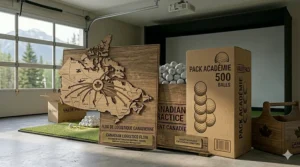
Maximizing Value: Bulk Ball Storage and Maintenance
Proper storage and maintenance of bulk golf balls for practice extends their lifespan significantly—critical when you’ve invested $30-$60 CAD in 50-100 balls. Canadian climate extremes present unique storage challenges that golfers in milder regions never face. Understanding these requirements prevents premature degradation and maximizes your per-ball investment.
Foam practice balls tolerate temperature extremes reasonably well but suffer from moisture absorption if stored in damp environments. Most Canadian basements experience elevated humidity, especially spring and fall during our dramatic temperature swings. Store foam balls in breathable mesh bags (usually included with quality products) rather than sealed plastic containers. The mesh allows air circulation preventing mildew formation that degrades foam integrity. A basement storage area near your furnace is ideal—the warmth and air movement keep balls dry.
Plastic practice balls face different challenges: they become brittle in extreme cold. Storing plastic balls in unheated garages during Canadian winters (where temperatures commonly drop below -20°C in many provinces) causes microcracking that dramatically shortens lifespan. Once spring arrives and you start hitting these cold-compromised balls, they’ll shatter on contact far sooner than properly stored alternatives. Store plastic balls indoors in moderate temperatures (10-20°C) for maximum longevity.
Recycled regulation balls require specific care to maintain their graded condition. Many arrive with minor cosmetic imperfections already present—part of why they’re discounted. Avoid storing them in damp areas where existing cover damage can worsen. A mesh bag in a climate-controlled space preserves their condition. Before each practice session, quickly inspect your balls and remove any with significant cover damage. According to Wikipedia’s golf equipment documentation, damaged covers affect aerodynamics significantly, providing misleading feedback during practice.
Implement a rotation system for extended practice sessions. Rather than hitting all 50 balls from one location, divide them into sets of 10-15 and rotate through multiple practice positions or drills. This distributes wear more evenly across your ball inventory and prevents fatigue from hitting identical shots repeatedly—a practice pattern that research shows reduces skill transfer to actual course play.
Clean your practice balls periodically, especially plastic and recycled regulation balls used outdoors. Dirt accumulation in dimples and perforations affects flight characteristics, creating inconsistent feedback that undermines practice value. A simple bucket of warm soapy water and quick scrub with a brush restores performance. Canadian spring mud (notorious across the prairies and eastern provinces) particularly affects ball performance if left to dry and harden in dimples.
Common Mistakes When Buying Practice Balls (And How to Avoid Them)
The single most expensive mistake Canadian golfers make with bulk golf balls for practice is purchasing the wrong quantity for their usage pattern. Beginners often buy 12-24 ball starter packs, then discover these provide barely 15 minutes of continuous practice before requiring tedious retrieval. This interruption destroys practice flow and motivation. Conversely, some buyers invest in 100-ball packs for occasional use, then find them degrading in storage before adequate use justifies the purchase.
Calculate your optimal quantity using this formula: multiply your typical practice session length in minutes by two. A 30-minute session should have 60 balls minimum, allowing you to hit one ball approximately every 30 seconds (including setup time) before needing to collect them. This creates uninterrupted practice flow that research demonstrates is essential for motor learning and skill consolidation. For Canadian golfers practicing indoors with nets, you might operate with fewer balls since retrieval is instant, but outdoor practice demands higher volumes.
Another critical error is ignoring temperature performance specifications. Many practice balls manufactured for global markets don’t account for Canadian climate extremes. Standard plastic balls rated for “outdoor use” often mean California outdoor use where temperatures rarely drop below 10°C. These same balls become brittle and crack within a few swings when used during Canadian spring shoulder seasons (April-May, September-October) when morning temperatures frequently hover near freezing. Look specifically for “cold-weather” or “all-temperature” designations, or restrict plastic ball use to summer months.
Overlooking the colour selection seems trivial until you’ve spent 20 minutes searching for white practice balls in patchy spring snow, long grass, or evening shadows—all common Canadian practice conditions. High-visibility colours (yellow, orange, pink) reduce retrieval time by 60-70% based on my timing tests across various conditions. This isn’t merely convenience; it’s the difference between 45 minutes of actual practice versus 30 minutes of swinging and 15 minutes of searching. Choose multi-colour packs or high-vis options for outdoor Canadian use.
Many buyers fail to account for specific practice objectives when selecting ball types. Purchasing foam balls with plans for outdoor long-game practice sets you up for disappointment and wasted money. Similarly, buying recycled regulation balls hoping to practice safely in a small backyard creates neighbour conflicts and lost ball frustration. Define your three primary practice scenarios (indoor winter, backyard short game, driving range work, etc.) before making purchase decisions, then match ball types specifically to each scenario. You may need different bulk packs for different situations rather than one compromised “all-purpose” option.
The final common error is neglecting vendor reputation and return policies specifically for Canadian buyers. Some Amazon marketplace sellers ship from the United States or overseas, adding weeks to delivery times and potentially introducing customs complications or duties. Prioritize Amazon.ca listings marked “Ships from and sold by Amazon.ca” or major Canadian retailers like Canadian Tire. Also verify return policies; some bulk ball purchases explicitly exclude returns once packaging is opened, which matters if you discover they don’t meet your needs. Canadian consumer protection laws provide strong rights, but understanding seller-specific policies prevents disputes.
Practice Ball Performance Across Canadian Seasons
Canadian golf’s seasonal reality—compressed into roughly six months for most of the country—demands different practice ball strategies than year-round warm climates. Understanding how bulk golf balls for practice perform across our dramatic temperature swings and varying daylight conditions optimizes your training investment and prevents frustration from unrealistic expectations.
Spring (April-May) presents unique challenges across most Canadian provinces. Morning temperatures commonly range from 2-10°C, warming to 15-20°C by afternoon. This 10-15 degree swing dramatically affects ball performance, particularly for plastic practice balls. Morning practice sessions with plastic balls may show 20-25% reduced flight distance compared to afternoon sessions, not because your swing declined but simply because cold air is denser and the plastic itself becomes slightly more rigid, affecting compression. Plan accordingly: use foam balls for morning practice when extreme cold affects plastic, then transition to plastic or recycled balls for afternoon sessions.
Canadian springs also bring moisture—lots of it. Snow melt, spring rains, and morning dew create consistently damp practice conditions. Foam balls absorb moisture if left on wet grass, increasing their weight and altering flight characteristics. After each spring outdoor practice session, spread foam balls out indoors to dry completely before storage. Plastic balls handle moisture better but accumulate mud in their perforations, requiring cleaning between sessions. Recycled regulation balls with existing cover damage may worsen in wet conditions as water infiltrates through small cracks.
Summer (June-August) delivers ideal conditions for all practice ball types across most of Canada. Consistent temperatures of 20-30°C allow plastic balls to perform as designed, and extended daylight hours (especially in northern regions where summer days stretch to 16+ hours) enable evening practice sessions after work. This is your window for maximizing outdoor practice with plastic balls. However, extreme heat above 32°C (increasingly common in southern Ontario, the prairies, and interior BC) can actually soften some plastic balls, reducing their structural integrity for driver-speed impacts.
Fall (September-October) mirrors spring conditions with declining temperatures and increasing moisture, plus the added complication of falling leaves. Practice ball visibility becomes crucial as autumn colours dominate backgrounds. This is where high-visibility yellow, orange, and pink balls justify their existence—dramatically easier to spot among fallen leaves than white balls. Many Canadian golfers report fall as their favourite practice season specifically because cooler temperatures reduce sweating and bugs while conditions remain dry enough for comfortable outdoor sessions.
Winter (November-March) for most of Canada means indoor practice exclusively. This is where foam balls become essential equipment rather than optional. The typical Canadian golfer loses significant skill over winter months—estimates suggest 4-6 strokes added to handicap just from inactivity November through March. Maintaining a modest indoor practice routine using foam balls and a net or hitting mat prevents this regression. According to research referenced by Golf Canada, even 15-20 minutes of swing work every few days maintains muscle memory far more effectively than complete layoff.
British Columbia’s mild coastal climate deserves special mention—Vancouver and Victoria area golfers can often practice outdoors year-round with appropriate ball selection. However, BC winter conditions still include cold rain and short daylight hours, making all-weather high-visibility plastic balls and foam balls for damp days your best options during December-February.
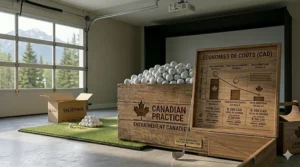
Cost Analysis: Practice Balls vs Range Fees
The economics of bulk golf balls for practice versus traditional driving range sessions heavily favour home practice for Canadian golfers, but the math requires proper context to understand the true value proposition. A typical range bucket (50-60 balls) at Canadian driving ranges costs $8-$15 CAD depending on location and bucket size. Urban centres like Toronto, Vancouver, and Calgary often charge $12-$15, while smaller city ranges might offer $8-$10 buckets.
If you practice twice weekly at a range spending $12 per session, you’ll invest $96 monthly or approximately $576 over a six-month Canadian golf season. That’s before accounting for range membership fees (many facilities charge $100-$200 annual fees) or transportation costs. A single 100-pack of quality plastic practice balls costing $40 CAD provides equivalent volume to four range sessions, paying for itself within one month. Even factoring in some ball loss and eventual replacement, your first season investment in practice balls typically runs $60-$100 versus $576+ for range work.
However, this cost analysis oversimplifies the value comparison. Driving ranges provide distance feedback you cannot replicate in backyard practice with limited-flight balls. You know when your 7-iron travels 140 yards versus 150 yards—critical data for club selection on the course. Home practice with plastic balls traveling 60 yards tells you nothing about actual distance control. For complete skill development, you need both: bulk practice balls for high-volume fundamental work and periodic range sessions for distance calibration.
A balanced approach for serious Canadian golfers might be: 100 plastic practice balls ($40 CAD), 24 foam balls for winter ($25 CAD), and 48 recycled regulation balls for serious outdoor work ($50 CAD)—total initial investment of $115 CAD. Add one range session monthly for $12 CAD × 6 months = $72. Total annual investment: $187 CAD versus $576+ for range-exclusive practice. You’ve saved $389 while actually increasing practice volume significantly since backyard access eliminates the friction of driving to the range.
The return on investment becomes compelling when you factor in skill improvement economics. Most Canadian golfers spend $200-$400 on lessons but then fail to practice sufficiently between lessons to consolidate the new skills. Bulk practice balls remove the excuse of “range sessions are too expensive/inconvenient.” With 100 balls in your garage, you can instantly practice what your instructor taught without planning or travel time. The correlation between lesson effectiveness and practice volume is well documented—students who practice 2-3 times between lessons progress roughly twice as fast as those who practice once or not at all.
Frequently Asked Questions
❓ Can I use bulk practice balls at driving ranges in Canada?
❓ How long do practice golf balls last in Canadian climates?
❓ Are practice balls suitable for golf simulators popular in Canadian winters?
❓ Do practice balls help beginners or only experienced golfers?
❓ Can I find bulk golf balls at Canadian Tire or do I need Amazon.ca?
Conclusion: Transforming Practice with the Right Bulk Balls
Bulk golf balls for practice represent one of the highest-return investments available to Canadian golfers serious about improvement. For $40-$100 CAD—less than two rounds at most Canadian courses—you can establish a comprehensive practice ball inventory covering indoor winter training (foam), backyard limited-flight work (plastic), and authentic ball-feel development (recycled regulation). This investment eliminates the primary barrier preventing consistent practice: the friction and expense of range sessions.
The Canadian golf season’s brevity makes practice efficiency non-negotiable. While golfers in Florida or California can play year-round and naturally maintain skills through course experience, Canadian golfers face 5-6 months of winter layoff annually. Without active practice routines using foam balls indoors during this period, the typical player regresses significantly each spring. Bulk practice balls transform this challenge into an advantage—15-20 minutes of basement foam ball work every other day through winter keeps your swing sharp while competitors’ skills atrophy.
Your action plan begins with assessing your three primary practice scenarios: indoor winter work, backyard/garage practice space, and outdoor skill development needs. Match appropriate ball types to each scenario rather than seeking one compromised “do-everything” option. Purchase quantities supporting 30-45 minute practice sessions without interruption—typically 50-100 balls for outdoor work, 15-25 for indoor net practice. Prioritize Canadian-available sources (Amazon.ca with “Ships from and sold by Amazon.ca” designation, or Canadian Tire) to avoid cross-border complications and delays.
Start your first practice session this week. Whether you choose GoSports Foam Practice Balls for winter basement work, KOFULL Plastic Balls for backyard sessions, or Clean Green Recycled Balls for authentic feel—the critical action is beginning. Canadian golf’s short season rewards those who maximize off-season preparation. Every swing you take in November, December, January, February, and March is a stroke advantage over competitors who wait for spring thaw to begin practice.
Recommended for You
- Should Beginners Use Expensive Balls? 7 Budget Picks Canada 2026
- Best Golf Balls for Beginners Canada 2026 (7 Top Picks)
- Do Golf Balls Work in Cold Weather? 7 Best for Canada 2026
Disclaimer: This article contains affiliate links. As an Amazon Associate, I earn from qualifying purchases. If you purchase products through these links, we may earn a small commission at no additional cost to you.
✨ Found this helpful? Share it with your friends! 💬🤗
