
In This Article
If you’re shooting between 80 and 95 consistently, you’ve reached a pivotal point in your golf journey where equipment choices actually matter. Control golf balls for mid handicappers represent that sweet spot between forgiving distance balls and tour-level performance — and for Canadian golfers, selecting the right ball means accounting for conditions that our American counterparts don’t face. Think about it: that premium urethane cover behaves differently at 5°C on a damp October morning in Calgary than it does at 25°C in Phoenix.
Mid handicappers need balls that deliver controllable spin around the greens without sacrificing too much distance off the tee. According to Golf Canada’s handicap system, players in the 9-20 handicap range represent the largest segment of active golfers in the country — roughly 42% of all registered players. What this demographic shares is moderate swing speeds (typically 85-100 mph), improving short game skills, and a growing ability to shape shots intentionally rather than accidentally.
The challenge? Most golf ball marketing focuses on extremes — either maximum distance for beginners or tour-level spin for scratch golfers. Control golf balls for mid handicappers bridge this gap with mid-compression cores (usually 70-90 compression) and either urethane or advanced ionomer covers that grip wedge grooves without spinning excessively off the driver. For Canadian buyers shopping on Amazon.ca, availability and pricing can differ significantly from the U.S. market, with exchange rates and shipping costs pushing some premium balls into the $70-90 CAD range per dozen — a consideration when you’re still losing 3-4 balls per round.
In this guide, we’ll cut through the marketing noise and examine seven real products available on Amazon.ca that deliver legitimate scoring zone control for mid handicappers. You’ll learn which balls perform best in Canadian conditions, how to match compression to your swing speed, and which features actually matter when you’re standing over a 60-metre wedge shot trying to get up and down.
Quick Comparison: Top Control Golf Balls Available on Amazon.ca
| Ball Model | Construction | Compression | Cover Type | Price Range (CAD) | Best For |
|---|---|---|---|---|---|
| TaylorMade Tour Response | 3-piece | 70 | Cast Urethane | $45-55 | Aggressive spin seekers |
| Callaway Chrome Soft | 3-piece | 75 | Tour Urethane | $55-65 | All-around control |
| Titleist TruFeel | 2-piece | 60 | TruFlex Ionomer | $35-45 | Budget-conscious control |
| Srixon Q-Star Tour | 3-piece | 72 | Urethane | $40-50 | Value urethane option |
| Bridgestone e12 Contact | 3-piece | 60 | Ionomer | $40-50 | Straighter flight priority |
| Titleist Pro V1 | 3-piece | 87 | Urethane Elastomer | $70-85 | Premium performance |
| Callaway Supersoft | 2-piece | 38 | Hybrid Cover | $30-40 | Maximum forgiveness |
💬 Just one click—help others make better buying decisions too! 😊
✨ Don’t Miss These Exclusive Deals!
🔍 Take your short game to the next level with these carefully selected products. Click on any highlighted item to check current pricing and availability on Amazon.ca. These balls will help you create authentic scoring opportunities your playing partners will envy!
Top 7 Control Golf Balls for Mid Handicappers: Expert Analysis
1. TaylorMade Tour Response — The Spin Authority
The TaylorMade Tour Response delivers tour-calibre urethane performance without the tour-calibre price tag, making it the go-to choice for competitive mid handicappers who want maximum greenside bite. With its 70-compression core and 100% cast urethane cover, this 3-piece ball generates serious wedge spin — we’re talking 7,500-8,500 rpm on a 56-degree from 75 metres, which is genuinely impressive for a ball priced in the mid-$40s CAD.
What sets the Tour Response apart is TaylorMade’s Speedmantle with HFM (High-Flex Modulus) technology, which sits between the soft core and urethane cover. This intermediate layer does the heavy lifting: it keeps driver spin manageable (around 2,400-2,600 rpm for most mid handicappers) while still allowing the soft cover to engage wedge grooves aggressively. In practical terms, this means you can flight a 9-iron into a firm green and trust it’ll check up within a metre or two of its pitch mark — a game-changer when you’re trying to attack tucked pins.
For Canadian golfers, the Tour Response performs admirably in cooler temperatures. Unlike some premium balls that feel like rocks below 10°C, this one maintains reasonable compression down to about 5°C, though you’ll notice slightly reduced spin below that threshold. Spring and fall players in Ontario and BC particularly appreciate this extended temperature range. Customer feedback on Amazon.ca consistently mentions the soft feel off the putter face and the visible stripe alignment aid (available on certain models), which helps square up short putts.
Pros:
- ✅ Exceptional greenside spin for the price point
- ✅ Soft feel without sacrificing ball speed
- ✅ Performs well in Canadian spring/fall temperatures
Cons:
- ❌ Can balloon slightly in strong headwinds
- ❌ Durability suffers if you catch thin wedge shots
The Tour Response typically runs around $48-52 CAD per dozen on Amazon.ca, delivering exceptional value for mid handicappers ready to take their scoring seriously.
2. Callaway Chrome Soft — The Versatile Performer
The Callaway Chrome Soft has earned its reputation as the most versatile control ball on the market, and for good reason. At 75 compression with Callaway’s Hyper Elastic SoftFast Core and Tour Urethane Cover, it’s engineered for that perfect balance mid handicappers crave: enough distance to keep up with your buddies off the tee, enough spin to hold greens from 120 metres in.
Here’s what most reviews won’t tell you: the Chrome Soft’s real advantage is its consistency across different swing speeds. Whether you’re swinging your 7-iron at 75 mph or 90 mph, this ball compresses predictably and delivers similar spin rates relative to club speed. That matters enormously for mid handicappers whose tempo varies from range session to on-course pressure. The seamless Tour Aero design (338 tetrahedral dimple pattern) produces a penetrating mid-trajectory that handles Canadian prairie winds better than higher-launching competitors.
Customer reviews on Amazon.ca frequently mention the Chrome Soft’s exceptional durability — many Canadian players report getting 25-30 holes from a single ball before cosmetic damage affects performance, which is impressive given our tendency to cart-path-bounce balls during dry summer conditions. The TruTrack alignment pattern (available on select models) provides excellent visual feedback on putts, helping you diagnose your stroke path.
Pros:
- ✅ Consistent performance across varying swing speeds
- ✅ Outstanding durability for a urethane-covered ball
- ✅ Penetrating ball flight handles wind exceptionally
Cons:
- ❌ Slightly firmer feel than Tour Response may not suit everyone
- ❌ Canadian pricing often $5-10 more than U.S. equivalents
Expect to pay in the $58-62 CAD range on Amazon.ca, positioning it as a premium mid-priced option worth every dollar.
3. Titleist TruFeel — The Budget Control Champion
Don’t let the 2-piece construction fool you — the Titleist TruFeel delivers greenside performance that punches well above its $38-42 CAD price point. With a 60-compression core and Titleist’s proprietary TruFlex cover (an advanced ionomer), this ball generates surprising spin around the greens while maintaining the forgiveness and distance that 2-piece designs are known for.
What Canadian mid handicappers appreciate most about the TruFeel is its soft feel without mushiness. At 60 compression, it’s easy to compress even with moderate swing speeds, yet the TruFlex cover is engineered to be softer than traditional ionomer while maintaining durability. The result? You get approximately 5,500-6,500 rpm of wedge spin — not tour-ball numbers, but more than enough to stop a well-struck pitching wedge within your target circle from 90 metres.
The TruFeel’s real genius shows in Canadian winter storage scenarios. Because it lacks the delicate urethane cover that can crack in extreme cold, you can safely store these in an unheated garage over winter without worrying about performance degradation come spring. Several Amazon.ca reviewers specifically mention this advantage for golfers in Alberta and Saskatchewan where winters hit -30°C regularly. The larger 1.6-inch core helps maintain ball speed even in early-season cold rounds.
Pros:
- ✅ Impressive spin for a 2-piece ionomer design
- ✅ Exceptional cold-weather resilience
- ✅ Outstanding value under $45 CAD
Cons:
- ❌ Can’t match urethane balls for premium feel
- ❌ Slightly lower peak spin than 3-piece competitors
The TruFeel typically sells for $36-44 CAD on Amazon.ca, making it the smart choice for mid handicappers still losing 4-6 balls per round.
4. Srixon Q-Star Tour — The Value Urethane Secret
The Srixon Q-Star Tour represents perhaps the best-kept secret in the control ball category. At 72 compression with a genuine urethane cover and Srixon’s FastLayer Core technology, it delivers 85-90% of what you’d get from balls costing $20 CAD more per dozen. This is the ball you recommend to your golf buddies when they complain about Pro V1 pricing but refuse to give up greenside spin.
Srixon’s FastLayer Core is the differentiator here — it starts soft in the centre (for easy compression and feel) and gradually gets firmer toward the outer edge. This gradient approach means you get soft-ball benefits (high launch, good feel) with firm-ball characteristics (ball speed, controlled spin) all in one package. For mid handicappers with swing speeds in the 85-95 mph range, this design absolutely nails it. The 338 Speed Dimple Pattern produces a slightly lower, more penetrating trajectory than the TaylorMade Tour Response, which Canadian golfers appreciate when playing into our persistent westerly winds.
Amazon.ca customer reviews consistently praise the Q-Star Tour’s greenside performance, with many noting it spins similarly to the Pro V1 on pitch shots while being noticeably more durable. The urethane cover is formulated to be slightly firmer than Titleist’s, which extends playability by 5-10 holes per ball according to user reports. At Canadian courses where rough can be punishing and cart paths are omnipresent, this durability advantage matters.
Pros:
- ✅ Genuine urethane performance at mid-tier pricing
- ✅ FastLayer technology optimizes for moderate swing speeds
- ✅ More durable than similarly-priced urethane competitors
Cons:
- ❌ Brand recognition lags behind Titleist/Callaway
- ❌ Slightly firmer feel may not suit soft-ball purists
Look for the Q-Star Tour in the $42-48 CAD range on Amazon.ca — arguably the best value in premium control balls.
5. Bridgestone e12 Contact — The Accuracy Specialist
The Bridgestone e12 Contact takes a different approach to control golf balls for mid handicappers: instead of maximizing spin, it prioritizes straight flight and consistent distance. With 60 compression and Bridgestone’s revolutionary Contact Force Dimple pattern, this 3-piece ball features raised areas in the centre of each dimple that increase clubface contact time by 38% according to company testing.
Here’s why that matters for Canadian mid handicappers: more contact time means better energy transfer, which translates to faster ball speeds from the same swing effort. In practical terms, you might pick up 5-8 metres of carry distance compared to conventional balls at the same swing speed. The Active Acceleration Mantle (made from high-performance polymer with added surfactant) further enhances this energy transfer while keeping driver spin low — typically 2,200-2,400 rpm, which produces a very straight, penetrating ball flight.
The trade-off? Greenside spin is good but not exceptional — expect 5,000-6,000 rpm on full wedge shots, which is adequate for most mid handicappers but won’t satisfy those chasing tour-level bite. Where the e12 Contact excels is approach shot accuracy: the low driver spin and predictable flight make it easier to find fairways, and the controlled iron spin means your landing zones are more predictable. For Canadian players battling strong crosswinds at links-style courses, this directional stability is invaluable.
Pros:
- ✅ Exceptional straight flight characteristics
- ✅ Faster ball speed from moderate swing speeds
- ✅ Outstanding directional control in wind
Cons:
- ❌ Greenside spin lags behind urethane competitors
- ❌ Unique dimple design requires trust period
Pricing on Amazon.ca typically runs $42-50 CAD, positioning it as a mid-priced option for accuracy-focused players.
6. Titleist Pro V1 — The Premium Standard Bearer
The Titleist Pro V1 remains the benchmark against which all other golf balls are measured, and for Canadian mid handicappers serious about lowering scores, it represents a genuine performance upgrade. At 87 compression with Titleist’s proprietary urethane elastomer cover and reformulated 2.0 ZG Process Core, this 3-piece ball delivers tour-calibre performance that’s actually accessible to skilled amateurs.
What separates the Pro V1 from cheaper alternatives isn’t dramatic — it’s subtle refinement across every shot type. Off the driver, it produces optimal spin rates (2,300-2,500 rpm for most mid handicappers) with a mid-launch trajectory that maximizes carry distance. With irons, the Drop-and-Stop™ control is immediately noticeable: well-struck approach shots land softly and check within a club length, even on firm summer greens. Around the greens, the soft urethane cover generates 8,000-9,000 rpm on pitch shots, allowing you to attack tight pins with confidence.
For Canadian players, two factors make the Pro V1 particularly appealing: consistency and quality control. Titleist’s manufacturing tolerances are extremely tight, meaning every ball in the box performs identically — critical when you’re trying to dial in precise yardages. The downside is Canadian pricing: expect $72-85 CAD per dozen on Amazon.ca, roughly $15-20 more than U.S. buyers pay. That premium stings when you’re still finding water occasionally, but if you’re genuinely working toward breaking 80, the Pro V1’s precision can save you 2-3 strokes per round through better approach shot control alone.
Pros:
- ✅ Industry-leading consistency and quality control
- ✅ Exceptional performance across all shot categories
- ✅ Trusted by majority of tour professionals
Cons:
- ❌ Premium Canadian pricing ($70+ CAD)
- ❌ Cover can scuff on cart paths and rough lies
The Pro V1 is the gold standard, but at this price point, you need to be consistently shooting low-80s or better to justify the investment.
7. Callaway Supersoft — The Forgiving Control Option
The Callaway Supersoft occupies a unique space in the control ball category: it’s technically a 2-piece distance ball with 38 compression, but Callaway’s Hybrid Cover technology gives it surprising greenside performance that exceeds typical low-compression offerings. For mid handicappers still working on consistency who lose 5-8 balls per round, this represents the most affordable entry point into legitimate scoring zone control.
At 38 compression, the Supersoft is extremely easy to compress — golfers with swing speeds as low as 70 mph will get full performance, making it ideal for Canadian players facing cold early-season conditions that rob 5-10 mph from your swing speed. The Hybrid Cover combines the durability of ionomer with enhanced grip characteristics that generate approximately 4,500-5,500 rpm on wedge shots — not urethane-ball numbers, but significantly better than traditional distance balls. The HEX Aerodynamics dimple pattern produces a high, soft-landing trajectory that helps balls stop on greens despite moderate spin rates.
Where the Supersoft truly shines is forgiveness. Off-centre strikes produce minimal distance loss and directional deviation compared to firmer balls, which matters enormously when your ball-striking isn’t tour-quality. Canadian reviewers on Amazon.ca frequently mention this ball’s performance in windy conditions, noting that the low spin characteristics keep it boring through crosswinds rather than ballooning. At $32-38 CAD per dozen, it’s the budget-friendly option that doesn’t sacrifice too much performance.
Pros:
- ✅ Extremely forgiving on mishits
- ✅ Easy to compress for moderate swing speeds
- ✅ Unbeatable value under $40 CAD
Cons:
- ❌ Limited spin compared to urethane options
- ❌ Very soft feel isn’t everyone’s preference
The Supersoft typically sells for $30-40 CAD on Amazon.ca, making it the ideal choice for developing mid handicappers.
How to Maximize Performance: Setup and Optimization Guide
Getting the most from control golf balls for mid handicappers requires more than just buying the right model — you need to optimize your setup and maintenance approach for Canadian conditions. Here’s what most golfers overlook.
Temperature Management Strategy
Golf ball compression changes with temperature. For every 5°C drop, effective compression increases by approximately 3-5 points, which means your 70-compression Tour Response feels more like an 80-compression ball during a 10°C April morning in Montreal. Counter this by:
- Storing balls indoors at room temperature (20-22°C) the night before your round
- Keeping 2-3 spare balls in your pocket during cold rounds to rotate warm balls into play
- Switching to slightly lower compression options (60-65 range) for early spring/late fall golf
- Avoiding urethane balls entirely below 5°C — the covers become rock-hard and lose grip
Wedge Groove Maintenance
Even premium urethane balls can’t generate proper spin from worn wedge grooves. Canadian golfers face accelerated groove wear from:
- Sand mixed with small pebbles at many municipal courses
- Frequent cart path contact eroding groove edges
- Range ball practice with abrasive covers
Clean grooves after every shot using a brass brush — not steel, which damages softer metals. Replace wedges every 60-80 rounds of active play, or when you notice decreased spin consistency. A $120 CAD wedge investment will improve your scoring zone control more than switching from a $45 ball to an $80 ball with worn grooves.
Ball Compression Matching
Use this simple test to match ball compression to your swing speed:
Driver swing speed 75-85 mph: Choose 50-65 compression (TruFeel, Supersoft, e12 Contact)
Driver swing speed 85-95 mph: Choose 65-75 compression (Tour Response, Q-Star Tour, Chrome Soft)
Driver swing speed 95-105 mph: Choose 75-90 compression (Pro V1, Chrome Soft, higher-compression tour balls)
Most mid handicappers fall into the middle category, but if you’re unsure, visit a golf shop offering launch monitor fitting. Ten minutes of data collection will reveal your optimal compression range and potentially add 10-15 metres of carry distance simply through better ball selection.
Real-World Scenarios: Matching Balls to Canadian Golfer Profiles
Understanding specifications is one thing — knowing which ball fits your actual playing situation is another. Here are three typical Canadian mid handicapper profiles and their ideal matches:
Profile 1: The Toronto Weekend Warrior
Situation: Plays 25-30 rounds per year, mostly at public tracks around the GTA. Shoots 86-92, swing speed around 88 mph. Loses 3-4 balls per round in ponds and tree lines. Budget-conscious but wants legitimate performance improvement.
Best Ball Match: Srixon Q-Star Tour
Why it works: At $42-48 CAD per dozen, losing 3-4 balls costs $14-16 per round instead of $24-28 with Pro V1s. The urethane cover delivers genuine greenside spin for approach shots from 100-150 metres — the scoring zone where mid handicappers make or lose strokes. FastLayer Core technology optimizes perfectly for 88 mph swing speeds, delivering both distance and feel. Slightly firmer cover withstands the cart path abuse common at busy municipal courses.
Profile 2: The Calgary Course Junkie
Situation: Member at a semi-private club, plays 50+ rounds per season in windy prairie conditions. Shoots 82-88, swing speed 92 mph. Good ball striker who rarely loses balls. Wants every advantage to break 80 consistently.
Best Ball Match: Titleist Pro V1
Why it works: Playing 50+ rounds means spending $3,600+ annually on golf anyway — the extra $30-40 per month for premium balls is negligible against total golf budget. Pro V1’s tight manufacturing tolerances deliver the shot-to-shot consistency needed to dial in precise yardages for breaking 80. Penetrating mid-trajectory handles Calgary’s notorious crosswinds better than higher-launching competitors. Drop-and-Stop control transforms marginal approach shots into birdie opportunities. At this skill level, the investment pays for itself in better scoring.
Profile 3: The BC Senior Player
Situation: Retired golfer playing 3-4 times weekly, mostly at B.C. coastal courses with soft conditions. Shoots 88-94, swing speed decreased to 82 mph. Struggles with distance but maintains good short game touch. Fixed income limits spending.
Best Ball Match: Callaway Supersoft
Why it works: At 38 compression, the Supersoft compresses fully at 82 mph swing speeds, maximizing available distance without forcing swing changes. High launch and soft landing trajectory works perfectly for B.C.’s typically soft, receptive greens — balls don’t need extreme spin to stop when landing angles are steep. Hybrid Cover provides adequate greenside feel for an experienced short game player. At $32-38 CAD per dozen, it’s affordable for frequent play on a fixed income while still delivering legitimate performance.
What Makes a Ball “High Control” — The Technology Explained
Control golf balls for mid handicappers rely on specific design characteristics that balance spin, feel, and consistency. Understanding these elements helps you make informed decisions beyond marketing hype.
Layer Construction and Spin Gradient
The fundamental principle of golf ball spin is “soft over firm” — placing softer layers over firmer ones creates friction that generates spin. Three-piece balls achieve this through:
Core Layer: Typically polybutadiene rubber, softer in the centre (50-70 compression) to promote easy compression and good feel. Some manufacturers like Srixon use graduated cores that firm up toward the outer edge, optimizing energy transfer.
Mantle Layer: The middle layer is usually the firmest part of the ball (90-110 hardness on Shore D scale). This firm layer under the soft cover creates the spin gradient — when the cover grips wedge grooves, the firm mantle resists deformation, allowing the cover to slide up the grooved face and generate rotation. Without this firm intermediate layer, soft balls would simply compress without spinning.
Cover Layer: Urethane covers are softest (55-65 Shore D) and most elastic, allowing maximum deformation and grip engagement. Advanced ionomer covers (like TruFlex) try to approximate this by using softer polymers, getting 70-80% of urethane’s performance at lower cost.
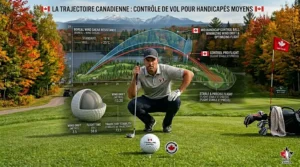
Compression and Energy Transfer
Compression measures how much the ball deforms under a 100 kg load. Lower compression balls (50-65) require less force to compress fully, making them ideal for slower swing speeds. Higher compression balls (85-105) need faster swing speeds to compress properly and fully utilize the core’s energy storage capacity.
For mid handicappers with typical swing speeds of 85-95 mph, optimal compression is 65-80. Too soft (below 60), and you’ll over-compress the ball, creating excess spin and losing control. Too firm (above 90), and you won’t compress it fully, losing distance and feel. This is why balls like the Tour Response (70) and Q-Star Tour (72) hit the sweet spot for this demographic.
Dimple Aerodynamics and Flight Control
Dimple patterns create turbulent boundary layer airflow that reduces drag and increases lift. Control balls typically use 330-352 dimples arranged in patterns that produce mid-trajectory flight — high enough to land softly on greens, low enough to penetrate wind.
Bridgestone’s Contact Force Dimples represent a unique approach: raised centres increase clubface contact time (longer energy transfer), while the outer dimple ring manages airflow. This creates straighter flight but slightly reduces spin compared to conventional dimple designs. TaylorMade’s Tour Flight Dimple Pattern uses shallower, wider dimples for more consistent aerodynamics across varying conditions — particularly valuable in Canadian weather.
Common Mistakes When Buying Control Golf Balls
Mid handicappers often sabotage their own performance through poor ball selection decisions. Here are the costly errors we see repeatedly:
Mistake 1: Buying Based on Tour Player Usage
Just because Scottie Scheffler uses Pro V1x doesn’t mean you should. Tour players swing drivers at 115-120 mph and generate 9,000+ rpm of wedge spin naturally. They need high-compression balls (95-105) that resist over-spinning and ballooning. Most mid handicappers swing 85-95 mph and generate 6,000-7,000 rpm naturally — using tour balls designed for much faster speeds costs you distance and feel without providing benefit.
The Canadian factor: our shorter season means you’re playing maybe 25-40 rounds annually versus tour pros’ 120+ competitive rounds. Durability matters less; performance optimization matters more. Choose balls designed for your swing speed and skill level, not what you see on TV.
Mistake 2: Ignoring Cold Weather Performance
This is uniquely Canadian: a ball that performs brilliantly at 22°C can be unplayable at 8°C. Urethane covers become rock-hard in cold weather, losing the compliance that generates spin. Core compression increases, making the ball feel and play firmer. Below 5°C, even premium balls underperform significantly.
Smart Canadian mid handicappers keep two ball types: urethane options (Tour Response, Q-Star Tour) for May-September when temperatures exceed 12°C, and firmer ionomer balls (TruFeel, e12 Contact) for April/October rounds when temperatures hover near 10°C. This seasonal rotation optimizes performance year-round rather than forcing one ball type to work in conditions it wasn’t designed for.
Mistake 3: Prioritizing Feel Over Performance
Many mid handicappers choose balls that “feel good” off the putter without considering overall performance trade-offs. Super-soft balls (compression below 40) do feel pleasant on short putts, but they sacrifice distance, durability, and often greenside spin. The Supersoft is an exception — Callaway’s Hybrid Cover maintains adequate performance — but most ultra-soft balls optimize for feel at the expense of scoring.
Better approach: choose balls in the 65-75 compression range that balance feel with performance, then adjust to the slightly firmer sensation through practice. Within 5-10 rounds, your brain recalibrates “normal” feel, and you’ll appreciate the added control and distance these performance-oriented balls provide.
Mistake 4: Not Testing in Real Conditions
Many Canadian golfers buy balls online based on reviews and specs without ever hitting them. While Amazon.ca’s return policies are generous, you can’t truly evaluate a golf ball from 5-10 shots at a range. Balls behave differently over 18 holes across varying lies, trajectories, and shot types.
Smart testing protocol: buy two dozen of a candidate ball and play 3-4 rounds exclusively with that model. Track specific metrics: driving distance/accuracy, greens in regulation, scrambling percentage, and overall score. Compare these numbers to your baseline with your current ball. Only then can you make an informed decision about whether the $10-15 CAD price premium for that specific ball delivers measurable results.
Understanding Spin: What Mid Handicappers Actually Need
Golf ball marketing obsesses over spin numbers, but raw RPM figures mean little without context. Here’s what actually matters for control golf balls for mid handicappers:
Driver Spin: Lower is Usually Better
Most mid handicappers generate 2,800-3,500 rpm of driver spin. Optimal range for maximizing distance while maintaining control is 2,200-2,600 rpm. Higher spin creates balloon trajectory that loses distance and exaggerates hooks/slices. Lower compression balls (60-70) naturally produce less driver spin by reducing the interaction between clubface grooves and cover material at high impact velocities.
Practical implication: if you struggle with slice or hook, a ball like the e12 Contact (2,200-2,400 rpm typical driver spin) will fly straighter than a Pro V1 (2,400-2,600 rpm). The difference might be 8-12 metres of offline dispersion over 225 metres of carry — potentially the difference between fairway and trees.
Iron Spin: Consistency Matters More Than Peak
With 7-iron, mid handicappers average 5,500-7,000 rpm depending on swing speed and angle of attack. What separates control balls from distance balls isn’t peak spin — it’s consistency. A urethane-covered ball might spin 6,500 rpm on a pure strike and 6,200 rpm on a slight mishit (300 rpm variance). An ionomer-covered distance ball might spin 5,800 rpm pure and 4,900 rpm mishit (900 rpm variance).
That 600 rpm difference in consistency is massive: 900 rpm variance can change landing distance by 8-10 metres, turning a pin-seeking approach into a two-putt par save. Urethane covers maintain consistent spin across varying strike quality because the soft material grips grooves similarly whether contact is centred or slightly off.
Wedge Spin: Adequate Beats Excessive
Mid handicappers don’t need 10,000 rpm of wedge spin — that’s tour player territory for attacking firm, fast greens. Canadian courses typically feature softer conditions where 6,000-8,000 rpm provides plenty of stopping power. The TruFeel’s 5,500-6,500 rpm is adequate for most situations; the Tour Response’s 7,500-8,500 rpm gives you options to attack tight pins.
More important than raw spin: predictability. Can you consistently generate similar spin rates from 50, 70, and 90 metres with the same wedge? Mid handicappers need balls that spin predictably across the scoring zone, not balls that spin maximally in ideal conditions but inconsistently when grass, moisture, or strike quality varies.
How to Choose Control Golf Balls for Canadian Conditions
Canadian golf presents unique equipment challenges that American golfers never face. Here’s how to select balls optimized for our reality:
Factor 1: Extended Season Temperature Range
Canadian golf seasons span 5°C spring mornings to 32°C July afternoons — a 27-degree range that dramatically affects ball performance. Choose balls with proven cold-weather compression characteristics (Tour Response, TruFeel) and avoid extreme low-compression options (under 50) that become mushy in summer heat.
Factor 2: Diverse Course Conditioning
Canadian courses range from links-style prairie layouts with firm, fast conditions to parkland tracks with lush, soft fairways and greens. Versatile balls like the Chrome Soft adapt better to these varying conditions than specialists. If you primarily play one course type, optimize for that: firmer, lower-spinning balls (e12 Contact) for firm conditions; higher-spinning, softer balls (Tour Response, Q-Star Tour) for receptive conditions.
Factor 3: Wind Management
Prairie provinces face persistent 20-30 km/h winds; coastal B.C. deals with gusts off the Pacific. Penetrating, lower-trajectory balls (Q-Star Tour, Chrome Soft) handle wind better than high-launch options. The Pro V1’s mid-trajectory is specifically designed for wind play — one reason it dominates Canadian professional and amateur championships.
Factor 4: Availability and Pricing on Amazon.ca
Some balls readily available on Amazon.com don’t ship to Canada or carry significant markup. Verify Amazon.ca availability before committing to a ball choice. Generally, major manufacturers (Titleist, Callaway, TaylorMade, Bridgestone, Srixon) maintain good Canadian distribution, while boutique brands (Vice, Snell, Cut) have limited availability or premium pricing. Factor shipping times: Amazon.ca Prime typically delivers in 2-3 days in major cities, but rural areas might wait 5-7 days.
Factor 5: Provincial Regulations and Environmental Considerations
Quebec requires bilingual packaging (not affecting ball performance but sometimes limiting selection). Some provinces have restrictions on ball types at ecological preserve courses. British Columbia’s wetter climate means balls get muddier — choose options with visible colours or patterns (TruTrack, alignment aids) for easier spotting in rough.
Long-Term Value: Cost Per Round Analysis in Canadian Dollars
Smart ball selection means understanding total cost of ownership, not just purchase price. Here’s how the math actually works out:
The $45 Ball that Costs $5 Per Round
Scenario: Buy Srixon Q-Star Tour at $45 CAD per dozen, lose 2.5 balls per round average
Cost calculation: $45 ÷ 12 balls = $3.75 per ball × 2.5 lost = $9.38 per round in lost balls
Plus: 0.5 balls retired due to scuffs/cuts = $1.88
Total cost per round: $11.26 CAD
The $80 Ball that Costs $16.67 Per Round
Scenario: Buy Titleist Pro V1 at $80 CAD per dozen, lose 2.5 balls per round average
Cost calculation: $80 ÷ 12 balls = $6.67 per ball × 2.5 lost = $16.68 per round in lost balls
Plus: 0.5 balls retired = $3.34
Total cost per round: $20.02 CAD
The Value Calculation
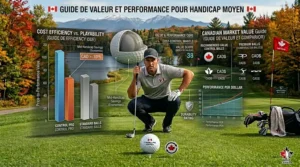
Over a 30-round Canadian season, the Q-Star Tour costs $337.80 while the Pro V1 costs $600.60 — a $262.80 difference. Unless the Pro V1 directly saves you 2+ strokes per round (worth potentially $13 per round in competition or bet scenarios), the Q-Star Tour delivers superior value for most mid handicappers.
The break-even point: if you lose fewer than 1.5 balls per round and consistently shoot low-80s, premium balls justify their cost through scoring improvement. If you lose 3+ balls per round or shoot high-80s/low-90s, mid-tier balls offer better value until your consistency improves.
Seasonal Buying Strategy for Canadian Golfers
Spring (March-April): Stock up during Amazon.ca spring sales, typically 15-25% off. Buy full-season supply (4-6 dozen for casual player, 10-12 dozen for frequent player).
Summer (June-July): Prices peak due to high demand. Avoid buying if possible unless you run low.
Fall (September-October): Second sale window as retailers clear inventory. Good time to stock up for next season at 20-30% discounts.
Winter (November-February): Deepest discounts (up to 40% off on Amazon.ca) but selection dwindles. Previous year’s models become excellent value — a 2025 Tour Response performs 95% as well as the 2026 version at 35% lower cost.
❓ Frequently Asked Questions
❓ Can I use the same golf ball year-round in Canada, or should I switch for cold weather?
❓ What's the real difference between a $45 CAD ball and an $80 CAD ball for a 15-handicap golfer?
❓ How can I tell if a golf ball is still performing well or if it needs to be retired?
❓ Are 'refurbished' or 'refinished' golf balls on Amazon.ca worth buying for mid handicappers?
❓ Does golf ball compression really matter if my swing speed is only 88 mph?
Conclusion: Your Path to Better Scoring Starts with Better Balls
Selecting the right control golf balls for mid handicappers isn’t about finding the “best” ball — it’s about finding the best ball for YOUR game, YOUR budget, and YOUR Canadian conditions. If you’re a competitive mid handicapper shooting low-80s who plays 50+ rounds annually, the Titleist Pro V1’s precision and consistency justify the $75-85 CAD investment. You’ll save strokes through better approach shot control and more predictable greenside performance.
For the vast majority of Canadian mid handicappers, the sweet spot lives in the $40-55 CAD range with balls like the Srixon Q-Star Tour and TaylorMade Tour Response. These deliver genuine urethane performance, adequate greenside spin for scoring, and surprising durability — all at prices that don’t sting when you inevitably find water or trees. The Q-Star Tour particularly stands out as the value champion, offering 85-90% of Pro V1 performance at 55% of the cost.
Budget-conscious players still working on consistency should embrace the Titleist TruFeel or Callaway Supersoft. At under $40 CAD per dozen, these balls provide legitimate scoring zone control without the premium pricing that punishes frequent lost balls. They’re also more resilient in Canadian cold weather and rough conditions, extending playability when premium balls would already show wear.
Remember: the ball alone won’t fix swing flaws or cure inconsistency. But once you’ve developed reliable ball-striking and moderate swing speed (85+ mph), the right ball becomes a precision instrument that transforms good shots into great results. Pay attention to compression matching, seasonal temperature adjustments, and realistic cost-per-round calculations. Test thoroughly before committing, and don’t be swayed by tour player endorsements or marketing hype.
Canadian golf is challenging enough with our short seasons, variable weather, and diverse course conditions. Choose balls that optimize for your reality, not someone else’s. The difference between shooting 88 and 84 often comes down to 2-3 better approach shots per round — exactly what proper ball selection provides. Your short game will thank you, your scores will improve, and you’ll finally have the control to attack those tucked pins with confidence.
Recommended for You
- Best Distance Golf Balls for Seniors Canada 2026
- 7 Best Distance Golf Balls Canada 2026 – Maximum Yardage Guide
- Golf Club Performance Data: 7 Best Launch Monitors Canada 2026
Disclaimer: This article contains affiliate links. As an Amazon Associate, I earn from qualifying purchases. If you purchase products through these links, we may earn a small commission at no additional cost to you.
✨ Found this helpful? Share it with your friends! 💬🤗
