
In This Article
Ever stood in the fairway, unsure whether to reach for your 5 wood or 7 wood? You’re not alone. The decision between these two fairway metals can genuinely transform your approach game, especially on those challenging par-5s or long par-4s that Canadian courses love to throw at us.
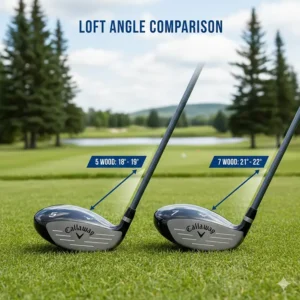
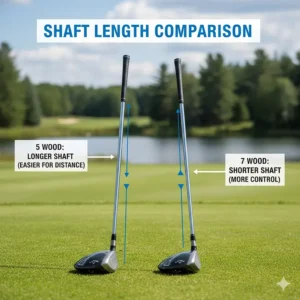
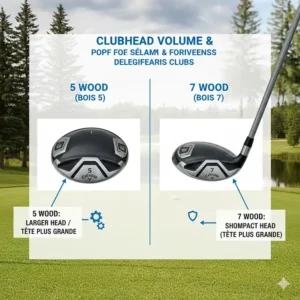
The 5 wood vs 7 wood comparison isn’t just about numbers—it’s about understanding your swing speed, launch characteristics, and how these clubs fit into your overall bag strategy. While a 5 wood typically features 18-19 degrees of loft and delivers crushing distance from the fairway, the 7 wood offers 21-22 degrees of loft with significantly easier launch characteristics. This difference might seem minor on paper, but out on the course? It’s the distinction between confidently attacking greens and leaving yourself in awkward positions.
Canadian golfers face unique challenges with our diverse course conditions—from the firm fairways of summer to transitional season play where ground conditions vary dramatically. Choosing between choosing fairway wood lofts becomes even more critical when you consider how these clubs perform in different weather patterns and on varying turf conditions across our provinces.
Quick Comparison Table
| Feature | 5 Wood | 7 Wood |
|---|---|---|
| Loft Angle | 17.5-19° | 21-23° |
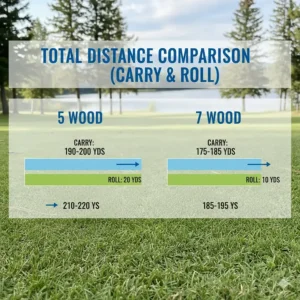
| Average Distance (Men) | 210-230 yards | 190-210 yards |
| Average Distance (Women) | 160-180 yards | 140-160 yards |
| Launch Angle | Medium | High |
| Forgiveness | Moderate | High |
| Best For | Faster swing speeds, experienced players | Moderate-slower swing speeds, all skill levels |
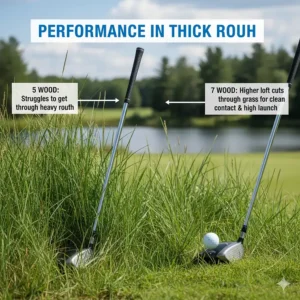
| From Rough | Challenging | Easier |
| Price Range (CAD) | $199-$549 | $199-$549 |
💬 Just one click – help others make better buying decisions too! 😊
Top 7 Fairway Woods Available in Canada: Expert Analysis
1. TaylorMade Stealth 2 HD Fairway Wood
The TaylorMade Stealth 2 HD represents exceptional engineering for golfers seeking forgiveness without sacrificing distance. Available in both 5-wood (18°) and 7-wood (21°) configurations, this club features TaylorMade’s signature carbon crown technology paired with their V Steel sole design that glides through turf effortlessly.
Key Specifications:
- Loft options: 18°, 21°, 24°
- Carbon face construction (C300 twist face)
- 200cc head size for maximum forgiveness
Canadian Price: $449-$549 CAD
Canadian golfers appreciate the high-launching characteristics particularly suited for our firmer summer fairways. The draw-biased weighting helps players fighting a slice, while the larger 200cc head inspires confidence at address.
Customer Feedback: Toronto-based reviewers consistently mention the Stealth 2 HD launches incredibly high from tight lies, with several Vancouver golfers noting improved consistency from fairway bunkers—common on West Coast courses.
✅ Pros:
- Exceptional forgiveness across the face
- Easy launch from various lies
- Draw bias helps correct slices
❌ Cons:
- Premium pricing
- May be too forgiving for low handicappers
2. Callaway Paradym Fairway Wood
Callaway’s Paradym Fairway Wood showcases revolutionary 360° carbon chassis technology, completely eliminating titanium from the body. This weight redistribution creates explosive ball speeds while maintaining exceptional stability through impact. Available in 5-wood (18°) and 7-wood (21°) variants.
Key Specifications:
- Jailbreak A.I. batwing technology
- Carbon sole panel
- Adjustable hosel (±2°)
Canadian Price: $479-$599 CAD
The adjustability feature proves particularly valuable for Canadian golfers dealing with altitude variations—whether you’re playing at sea level in Halifax or higher elevations in Calgary, you can fine-tune your launch conditions.
Customer Feedback: Ontario golfers highlight the satisfying feel and consistent distances, while Alberta reviewers appreciate how the club maintains performance in windy Prairie conditions.
✅ Pros:
- Industry-leading ball speed technology
- Gorgeous aesthetics
- Adjustability for precise tuning
❌ Cons:
- Premium price point
- Adjustment sleeve adds slight weight
3. Cobra DS-ADAPT X Fairway
The Cobra DS-ADAPT X delivers tour-level performance with game-improvement forgiveness. Featuring Cobra’s innovative PWR-Bridge weighting and A.I.-designed H.O.T. Face, this fairway wood maximizes distance while maintaining incredible stability.
Key Specifications:
- H.O.T. Face variable thickness design
- PWR-Bridge suspended weight system
- Available in 16.5°, 19°, 22° lofts
Canadian Price: $298-$449 CAD
Canadian value-seekers find the Cobra DS-ADAPT X compelling, especially with frequent promotional pricing at major retailers. The club performs exceptionally well from Canadian-style tight lies.
Customer Feedback: Montreal golfers praise the consistent ball flight in crosswinds, while B.C. players note the club’s ability to handle wet conditions without sacrificing performance.
✅ Pros:
- Excellent value proposition
- Versatile from multiple lies
- Strong distance performance
❌ Cons:
- Less brand prestige than TaylorMade/Callaway
- Fewer custom shaft options
4. Ping G440 MAX Fairway Wood
Ping’s G440 MAX continues their legacy of engineering excellence with their proven Spinsistency technology and Carbonfly Wrap Crown. The G440 MAX offers unmatched forgiveness in both 5-wood (17.5°) and 7-wood (20.5°) configurations.
Key Specifications:
- Carbonfly Wrap Crown saves 10g of weight
- Facewrap Technology for ball speed
- Three-dot alignment system
Canadian Price: $476-$529 CAD
Ping’s reputation for quality manufacturing resonates with Canadian golfers who value durability through multiple seasons. The G440 MAX handles our temperature extremes exceptionally well.
Customer Feedback: Prairie golfers appreciate the club’s stability in wind, while Eastern Canadian players note consistent performance from morning dew to afternoon firm conditions.
✅ Pros:
- Exceptional build quality
- Consistent performance
- Great sound and feel
❌ Cons:
- Conservative aesthetics
- Less adjustability than competitors
5. Wilson DYNAPWR Carbon Fairway Wood
Wilson’s DYNAPWR Carbon brings tour-quality technology to a more accessible price point. The full-carbon crown and A.I.-optimized face deliver impressive distance while the deep center of gravity promotes easy launch.
Key Specifications:
- Full carbon construction
- Dynamic Launch Control system
- Available in 15°, 18°, 21° lofts
Canadian Price: $349-$399 CAD
This represents exceptional value in the Canadian market, often available with free shipping across provinces. Wilson’s improving reputation among serious golfers makes this an increasingly popular choice.
Customer Feedback: Budget-conscious Canadian golfers highlight the exceptional performance-to-price ratio, with several reviewers noting it rivals clubs costing $200+ more.
✅ Pros:
- Outstanding value
- Modern carbon construction
- Surprisingly premium feel
❌ Cons:
- Limited availability at some retailers
- Smaller aftermarket support
6. Cleveland Halo XL Fairway Wood
The Cleveland Halo XL targets golfers seeking maximum forgiveness and confidence. With an oversized profile and low-and-deep center of gravity, this fairway wood makes launching the ball effortless. Perfect for 7 wood or 5 wood for slower swing speeds scenarios.
Key Specifications:
- XL Head design (180cc)
- Rebound Frame technology
- Gliderail sole design
Canadian Price: $249-$399 CAD
The Halo XL offers tremendous value for high-handicap Canadian golfers or those transitioning from hybrids. The oversized profile inspires confidence that encourages aggressive play.
Customer Feedback: Beginner and intermediate Canadian golfers consistently rate this highly, appreciating how forgiving it is on mishits—crucial when learning the game on public courses.
✅ Pros:
- Ultra-forgiving design
- Affordable pricing
- Easy to hit from anywhere
❌ Cons:
- Large head may not suit all players
- Less workability than player clubs
7. XXIO 13 Fairway Wood
The XXIO 13 represents the pinnacle of lightweight engineering specifically designed for moderate swing speeds. Japanese craftsmanship meets cutting-edge technology with a rebound frame and flat cup face that delivers exceptional distance.
Key Specifications:
- Rebound Frame for flex at impact
- Lightweight construction (under 300g)
- Weight Plus system for consistency
Canadian Price: $449-$549 CAD
Senior Canadian golfers and those with moderate swing speeds find the XXIO 13 transformative. The lightweight design reduces fatigue during extended rounds—important for Canadian golf trips.
Customer Feedback: Mature Canadian players rave about regained distance, with several noting 15-20 yard gains compared to their previous fairway woods.
✅ Pros:
- Perfect for moderate swing speeds
- Exceptional craftsmanship
- Noticeably lightweight
❌ Cons:
- Premium pricing
- May be too light for powerful swingers
✨ Don’t Miss These Exclusive Deals!
🔍 Take your fairway wood selection to the next level with these carefully selected products available in Canada. Click on any highlighted item to check current pricing and availability on Amazon.ca. These clubs will help you create authentic distance gaps your playing partners will envy!
Understanding Loft Differences: The Science Behind the Numbers
Loft is the angle between the club’s face and the vertical plane, serving as the primary determinant of the golf ball’s ascending trajectory. According to Wikipedia’s comprehensive golf club article, loft remains the most significant difference between clubs of the same type. When examining the 5 wood vs 7 wood comparison, this fundamental principle shapes everything about how these clubs perform.
5 Wood Loft Characteristics
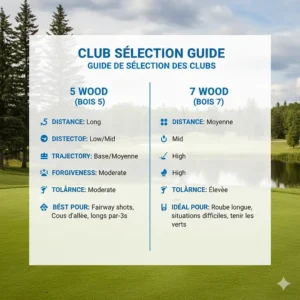
A typical 5 wood features 18-19 degrees of loft, though manufacturers range from 17.5° to 19.5° depending on target audience and design philosophy. This moderate loft creates a penetrating ball flight ideal for:
- Long approach shots on par-5s (200-220 yard range)
- Tee shots on tight par-4s requiring accuracy
- Fairway shots where you need maximum distance
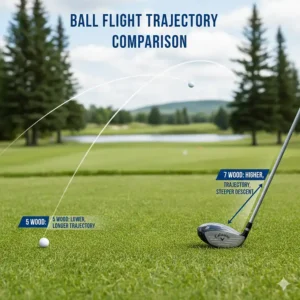
- Situations demanding a lower, more controlled trajectory
7 Wood Loft Profile
The 7 wood typically carries 21-23 degrees of loft, with most manufacturers settling on 21° as the standard. This increased loft fundamentally changes the club’s applications:
- Easier launch from various lies (fairway, rough, tight)
- Higher landing angle for better green-holding ability
- More forgiving on mishits
- Improved performance for slower swing speeds
The Critical 3-4 Degree Gap
Ensure lofts are spaced adequately—typically 3-4 degrees between consecutive clubs—to maintain sufficient distance gaps. This gapping principle, supported by professional club fitting research from Hireko Golf, proves essential for bag setup optimization. If your 5 wood is 18° and your 7 wood is 21°, that 3° difference typically translates to 15-20 yards of carry distance separation—perfect for having the right club for every situation.
Canadian course architects often design holes requiring precise distance control. Having properly gapped fairway woods ensures you’re never stuck between clubs on those demanding approach shots at courses from Victoria Golf Club to Royal Montreal.
Distance Gapping Chart: What to Expect
Understanding realistic yardage expectations helps with choosing fairway wood lofts that complement your game:
Men’s Distance Expectations
| Swing Speed | 5 Wood Carry | 7 Wood Carry | Gap |
|---|---|---|---|
| 75-85 mph | 180-200 yards | 165-180 yards | 15-20 yards |
| 85-95 mph | 200-220 yards | 185-200 yards | 15-20 yards |
| 95-105 mph | 220-240 yards | 205-220 yards | 15-20 yards |
| 105+ mph | 240-260 yards | 220-235 yards | 20-25 yards |
Women’s Distance Expectations
| Swing Speed | 5 Wood Carry | 7 Wood Carry | Gap |
|---|---|---|---|
| 55-65 mph | 130-150 yards | 115-135 yards | 15 yards |
| 65-75 mph | 150-170 yards | 135-155 yards | 15-20 yards |
| 75-85 mph | 170-190 yards | 155-175 yards | 15-20 yards |
| 85+ mph | 190-210 yards | 175-195 yards | 15-20 yards |
Note: Distances reflect carry yardage under standard conditions (sea level, 21°C, minimal wind). Canadian golfers should account for cooler temperatures reducing distance by approximately 2 yards per 5°C drop.
7 Wood or 5 Wood for Slower Swing Speeds
This question frequently troubles golfers with swing speeds below 95 mph—and the answer might surprise you. For many slower-swinging players, the 7 wood becomes the superior choice for several compelling reasons.
Launch Angle Optimization
Slower swing speeds struggle generating sufficient launch angle with lower-lofted clubs. A 5 wood requiring 18° of dynamic loft might launch at only 12-13° for a slower swinger, creating a weak, low ball flight that loses significant distance. Callaway’s official fairway wood buying guide confirms that more loft helps maximize distance on slower swings for players having trouble creating proper launch angles. The 7 wood’s additional loft compensates for lower swing speed, promoting optimal launch between 14-16°.
Spin Rate Considerations
Higher lofts help maximize distance on slower swings for players having trouble creating proper launch angles. The 7 wood generates approximately 500-800 more RPMs of backspin than a 5 wood, crucial for carrying hazards and stopping on greens. This additional spin proves especially valuable on Canadian courses with firm, fast greens during summer.
Versatility Advantages
Canadian golfers appreciate versatility given our varied playing conditions. A 7 wood excels from:
- Fairway lies (obviously excellent)
- Light rough (significantly easier than 5 wood)
- Fairway bunkers (higher loft clears lips easier)
- Tight lies (forgiveness helps inconsistent contact)
- Elevated tees (extra loft prevents ballooning)
Real-World Performance Data
Testing reveals that golfers with 85 mph driver swing speeds often hit their 7 wood only 10-12 yards shorter than their 5 wood—but with significantly better consistency. When factoring mishits, the 7 wood frequently produces better overall results because its forgiveness maintains distance even on imperfect strikes.
Recommendation Framework
Choose 7 Wood If:
- Driver swing speed below 95 mph
- Struggle launching long irons/hybrids
- Play courses with elevated greens requiring high shots
- Value consistency over maximum distance
- Experience with 5 wood shows low, weak ball flights
Choose 5 Wood If:
- Driver swing speed above 95 mph
- Need maximum distance gaps
- Frequently face long par-5 second shots
- Possess consistent ball-striking ability
- Play wide-open courses rewarding distance
Club Selection Strategy: Building Your Ideal Bag
Effective club selection strategy extends beyond simply choosing between a 5 wood and 7 wood—it requires understanding your entire bag’s distance architecture. Canadian golfers carrying 14 clubs must optimize every selection.
The Gap Management Approach
Start by mapping your current distances. Hit 10-15 balls with each club, eliminate outliers, and identify your average carry distances. As detailed in comprehensive golf club loft analysis by Club Up Golf, having smooth, consistent gapping of approximately 15 yards between clubs ensures always having a suitable club option from any distance.
Typical Bag Configurations
Configuration 1: Traditional Setup
- Driver
- 3 Wood (15°)
- 5 Wood (18°)
- 4 Hybrid (22°)
- 5-PW Irons
- 50°, 54°, 58° Wedges
- Putter
This setup works excellently for stronger ball-strikers with swing speeds exceeding 95 mph. The 5 wood fills the gap between 3 wood and 4 hybrid perfectly.
Configuration 2: High-Launch Friendly
- Driver
- 3 Wood (15°)
- 7 Wood (21°)
- 5 Hybrid (25°)
- 6-PW Irons
- 50°, 54°, 58° Wedges
- Putter
This arrangement benefits moderate swing speeds (<95 mph), replacing difficult long irons with easier-to-hit fairway woods and hybrids.
Configuration 3: Fairway Wood Focus
- Driver
- 3 Wood (15°)
- 5 Wood (18°)
- 7 Wood (21°)
- 6-PW Irons
- 50°, 56° Wedges
- Putter
Some golfers, particularly seniors or those preferring fairway woods over hybrids, thrive with three fairway metals. This setup requires eliminating the 4 or 5 iron but provides excellent versatility.
Testing Your Configuration
Visit a launch monitor facility—major Canadian cities from Toronto to Calgary feature excellent fitting centres. Proper fitting reveals:
- Actual carry distances (not guesswork)
- Launch angles and spin rates
- Dispersion patterns
- Optimal shaft weights and flexes
Many Canadian golf retailers offer free basic fitting with purchase, making this accessible for serious golfers.
Choosing Fairway Wood Lofts: Advanced Considerations
Modern fairway woods offer unprecedented adjustability, allowing precise loft customization. Understanding how to leverage these features optimizes performance.
Adjustable Hosel Technology
Most premium fairway woods now feature adjustable hosels permitting ±1° or ±2° loft changes. This seemingly small adjustment significantly impacts performance:
- +1° Adjustment: Increases launch angle ~1.5°, adds ~300 RPM backspin, reduces carry distance 3-5 yards
- -1° Adjustment: Decreases launch angle ~1.5°, reduces backspin ~300 RPM, potentially adds 5-8 yards carry
When to Adjust Lofts
Increase Loft (+) When:
- Struggling to get sufficient height
- Playing courses with elevated greens
- Facing into prevailing winds (higher launch fights wind better)
- Transitioning to firmer ground conditions
- Need better stopping power on approaches
Decrease Loft (-) When:
- Ball flight too high, losing distance
- Playing downwind frequently
- Course conditions soft, don’t need extra height
- Seeking maximum distance
- Gap to next club too small
Custom Fitting Considerations
Canadian weather presents unique fitting challenges. A club fitted in Calgary’s dry summer air performs differently in Vancouver’s coastal moisture. Consider:
- Altitude Effects: Higher elevations (Calgary, Edmonton) allow using slightly less loft as thinner air launches balls higher
- Temperature Impact: Colder spring/fall rounds benefit from slightly stronger lofts maintaining carry distance
- Humidity: Coastal regions (B.C., Maritimes) might benefit from fractionally more loft compensating for heavier air
Shaft Selection Impact
Don’t overlook shaft selection when choosing fairway wood lofts. The shaft dramatically influences launch and spin:
- Regular Flex (60-65g): Best for swing speeds 75-90 mph, promotes higher launch
- Stiff Flex (70-75g): Suits 90-105 mph, balanced launch
- X-Stiff (75-85g): For 105+ mph, controls spin and trajectory
Lighter shafts generally launch higher, heavier shafts lower. Pairing a 5 wood with lighter shaft can produce similar launch to a 7 wood with heavier shaft—advanced players manipulate this relationship.
Fairway Wood Gapping: Optimizing Your Long Game
Proper fairway wood gapping ensures no frustrating yardage gaps leaving you between clubs. This becomes increasingly critical as manufacturers strengthen lofts to advertise distance.
The 15-20 Yard Rule
Ideal gapping maintains 15-20 yard separations between consecutive clubs. Closer than 15 yards creates redundancy; wider than 20 yards leaves exploitable gaps. Apply this principle throughout your bag setup optimization.
Identifying Problem Gaps
Many golfers discover unintended overlaps or gaps when accurately measuring distances. Common issues include:
Overlap Example:
- 5 Wood: 210 yards
- 4 Hybrid: 208 yards
- 4 Iron: 205 yards
These three clubs cover essentially identical yardage—wasteful use of bag spots. Solution: Replace either the 4 hybrid or 4 iron with a 7 wood (190 yards) or different hybrid loft.
Gap Example:
- 3 Wood: 235 yards
- 5 Iron: 185 yards
This 50-yard chasm creates problems on 210-220 yard approaches. Solution: Add a 5 wood (210 yards) and possibly 7 wood (195 yards) to properly fill the range.
Dynamic Gapping Adjustments
Remember that gapping changes with conditions:
- Cold Weather: All clubs lose distance; gaps tighten
- Altitude: Thinner air increases distance; gaps widen
- Wind: Headwinds compress gaps, tailwinds expand them
- Ground Firmness: Firm fairways add roll, affecting total distance
Experienced Canadian golfers account for these variables, sometimes selecting slightly different lofts for spring versus summer play.
Using Technology for Precision
Modern launch monitors provide unprecedented gapping insights. If visiting a fitting facility isn’t feasible, consider these alternatives:
- On-Course Apps: Shot tracking applications like Arccos or Game Golf map actual playing distances
- Range Finders: Laser rangefinders enable accurate range practice distance measurement
- GPS Devices: Modern GPS watches track approach shot distances throughout rounds
Accumulating this data over multiple rounds reveals true gapping, accounting for real-world variability versus idealized range conditions.
Bag Setup Optimization: Practical Examples
Let’s examine real-world bag configurations for different player profiles common among Canadian golfers:
Profile 1: Senior Golfer (70 mph driver speed)
John, 68, plays weekly at his Calgary club:
- Driver (12° loft)
- 5 Wood (19°) – but considering 7 wood
- 7 Wood (22°)
- 5 Hybrid (26°)
- 6 Hybrid (29°)
- 7-PW Irons
- 52°, 56° Wedges
- Putter
Analysis: John’s setup wisely emphasizes higher-lofted, easier-to-hit clubs. His 5 wood might create a gap issue with his 7 wood, potentially making a 9 wood (25°) or adjusting to only a 7 wood configuration more effective. The dual hybrid approach before transitioning to irons at 7-iron maximizes consistency.
Profile 2: Female Golfer (85 mph driver speed)
Sarah, 45, member at a Vancouver Island course:
- Driver (11.5°)
- 3 Wood (16.5° high-launch)
- 7 Wood (22°)
- 5 Hybrid (25°)
- 6-PW Irons
- 50°, 54°, 58° Wedges
- Putter
Analysis: Sarah’s setup exemplifies smart modern gapping. The jump from 3 wood (16.5°) to 7 wood (22°) creates a 25-30 yard gap—perfect for her game. Eliminating the 4 and 5 irons in favor of the 7 wood and 5 hybrid provides better versatility on her coastal course where conditions vary dramatically.
Profile 3: Competitive Amateur (100 mph driver speed)
David, 32, plays competitive events across Ontario:
- Driver (9°)
- 3 Wood (14° strong loft)
- 5 Wood (18°)
- 3 Iron (20° driving iron)
- 4-PW Irons
- 48°, 52°, 56°, 60° Wedges
- Putter
Analysis: David’s athletic setup maximizes distance while maintaining versatility. His strong-lofted 3 wood complements driver well, the 5 wood fills the mid-range gap, and the 3 iron provides a penetrating wind option. Four wedges offer exceptional short game control—essential for competitive golf.
Playing Conditions and Club Selection
Canadian golf spans dramatically different environments—what works in dry Alberta differs from humid Atlantic provinces. Understanding how conditions influence the 5 wood vs 7 wood comparison proves invaluable.
Firm, Fast Conditions
Summer golf across the Prairies or on Ontario’s sandier courses often features firm fairways and fast greens. In these conditions:
5 Wood Advantages:
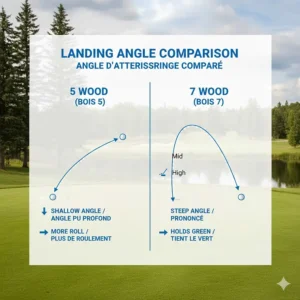
- Lower flight penetrates wind better
- Additional roll from firm fairways adds distance
- Workability helps shape shots around trouble
7 Wood Advantages:
- Steeper descent angle holds firm greens better
- Higher launch clears firm fairway “kick points”
- Forgiveness valuable when fairways offer less cushion
Soft, Receptive Conditions
Spring golf or courses with significant irrigation (common in B.C. and Maritimes) creates softer playing surfaces:
5 Wood Advantages:
- Maximum distance unaffected by reduced roll
- Lower flight sometimes needed under tree canopies
- Larger gaps between clubs justified by reduced roll
7 Wood Advantages:
- Extra height unnecessary when greens receptive
- May lose some distance advantage of soft conditions
- Still offers superior consistency
Wind Considerations
Prairie golfers intimately understand wind’s impact. Prevailing winds dramatically influence club selection:
Into the Wind:
- 5 wood’s lower flight penetrates better
- Reduced loft minimizes ballooning
- Distance loss less severe than higher-lofted clubs
Downwind:
- 7 wood’s higher flight captures more assistance
- Extra loft helps ball ride wind longer
- Landing angle steep enough to control distance
Crosswinds:
- 5 wood offers better workability for shaping shots
- 7 wood’s forgiveness helps when wind affects swing
- Personal comfort level determines best choice
Frequently Asked Questions
❓ What is the typical distance difference between a 5 wood and 7 wood in Canada?
❓ Should beginners choose a 7 wood or 5 wood for slower swing speeds?
❓ Can I carry both a 5 wood and 7 wood in my golf bag?
❓ How much do quality fairway woods cost in Canada in 2026?
❓ What loft should I choose for high-altitude golf courses in Canadian cities like Calgary?
Conclusion: Making Your Decision
The 5 wood vs 7 wood comparison ultimately depends on your individual game characteristics, swing speed, and playing style. Neither club is universally superior—each excels in specific situations and for particular player profiles.
Canadian golfers should consider our unique playing conditions when making this decision. Our seasonal temperature variations, diverse course designs from links-style layouts to tree-lined parkland tracks, and varied elevations across provinces all influence which club better suits your game.
Choose a 5 wood if: You possess swing speeds above 95 mph, need maximum distance for your fairway wood, play wide-open courses where distance matters most, and demonstrate consistent ball-striking ability. The 5 wood rewards better players with distance and versatility.
Choose a 7 wood if: Your swing speed falls below 95 mph, you value consistency over maximum distance, you frequently face challenging lies in rough or bunkers, or you’re building a high-launch friendly bag setup. The 7 wood offers forgiveness that builds confidence and improves overall scoring.
Many golfers ultimately carry both clubs, creating a comprehensive long-game arsenal perfectly gapped from driver through mid-irons. This approach, while requiring sacrifice elsewhere in the bag (typically eliminating long irons), provides exceptional versatility across the varied challenges Canadian courses present.
Test both options at a reputable fitting facility, preferably during conditions matching your typical play. Major Canadian golf retailers from Golf Town to Sporting Life offer excellent demo programs allowing on-course testing before purchase. Take advantage of these opportunities—the investment of time pays dividends in improved performance and greater enjoyment of this wonderful game.
Remember that technology continues advancing rapidly. Modern fairway woods deliver performance unimaginable just five years ago, making this an exciting time to optimize your equipment. Choose wisely, practice diligently, and enjoy those magical moments when you pure a fairway wood into a par-5 green!
Recommended for You
- Best Callaway 3 Wood Canada 2026: Top 7 Expert Picks
- 7 Best Fairway Woods Canada 2026
- 7 Best TaylorMade Drivers Canada 2026
Disclaimer: This article contains affiliate links to Amazon.ca. If you purchase products through these links, we may earn a small commission at no additional cost to you.
✨ Found this helpful? Share it with your friends! 💬🤗
